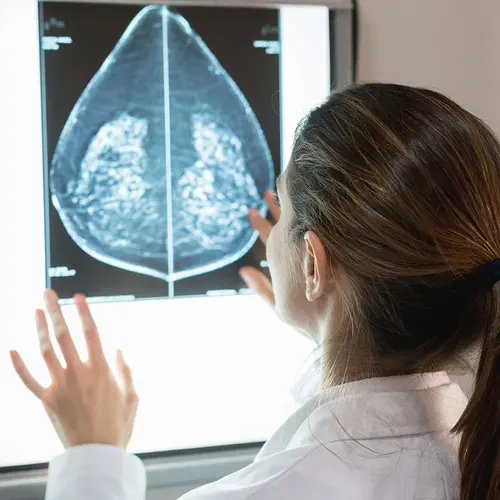
Breast cancer in men is rare, but it can happen. It’s more common in women. But everyone — including men — has some breast tissue. Men get the same types of breast cancers that women do. In the U.S., men make up about 1% of breast cancer diagnoses.
The major problem is that breast cancer in men is often diagnosed later than breast cancer in women. This may be for a few reasons, including:
- A lack of education about symptoms
- Not knowing that breast cancer in men is possible
- Feeling embarassed
What Are the Risk Factors for Breast Cancer in Men?
Your chance of getting breast cancer goes up with age. Most breast cancers in men happen between ages 60 and 70.
Other things that raise the odds of breast cancer when you’re a man include:
- Having a family history of breast cancer
- Having certain DNA changes (like BRCA1 and BRCA2)
- Enlarged breasts (gynecomastia) because of drug or hormone treatments, some infections, or poisons
- Having hormone therapy for prostate cancer (or other drugs that have estrogen)
- A rare genetic condition called Klinefelter syndrome
- Severe liver disease (called cirrhosis)
- Conditions involving your testicles, such as mumps orchitis, a testicular injury, or an undescended testicle
- Having obesity
Symptoms of Breast Cancer in Men
The symptoms of breast cancer in men are similar to those in women. They may include:
- A lump that doesn’t hurt
- Bleeding or discharge coming from your nipple
- Changes to the skin on your chest (like scaling, thickening, dimpling, or changes to the color of your skin)
Most male breast cancers are diagnosed when a man or his doctor find a lump on his chest.
But some men tend to delay going to the doctor until they have more serious symptoms, like bleeding from the nipple. By that point, the cancer may have spread.
If you notice any changes in your chest, make an appointment with your doctor to get checked out.
Diagnosis and Treatment of Breast Cancer in Men
The same techniques that are used to diagnose breast cancer in women are used in men: physical exams, mammography, and biopsies (looking at small samples of tissue under a microscope).
Treatments for men and women are generally the same. You may have a combination of treatments.
Surgery. The typical treatment for men is a mastectomy, in which your entire breast is removed. Breast-conserving surgery — in which only the tumor is taken out — is sometimes done. Often, the surgeon also takes out one or more lymph nodes to see if the cancer has spread.
Radiation therapy. You may have treatment with radioactive rays or particles after surgery. It can help kill off any cancer cells that surgery missed. If the cancer is inoperable, radiation may be your main treatment.
Chemotherapy. With this treatment, you’ll be given drugs — by mouth or by injection — to attack the cancer cells. You may have chemotherapy after surgery to lower the risk of the cancer coming back. If you have advanced cancer or cancer that has spread to other parts of your body, chemotherapy may be the main treatment.
Hormone therapy. Some kinds of breast cancer need certain hormones to grow. This therapy blocks the effects of these hormones, stopping the cancer’s growth. It often works better in men than in women because about 90% of men’s cancers are hormone receptor-positive. The drug tamoxifen is the standard hormone therapy for male breast cancer. Sometimes, removal of the testes reduces the amount of certain male hormones in the system.
If you have breast cancer, never take testosterone because it causes breast cancer cells to grow. You may have hormone therapy after surgery to lower the risk of the cancer coming back. If you have locally advanced or metastatic cancer, it may be the main treatment. For men with ER-positive, HER2-negative metastatic breast cancer with an ESR1 mutation, imlunestrant (Inluriyo) may be an option if your cancer grows after taking at least one other type of hormone therapy. Camizestrant (Etcamah) may be another hormonal treatment option for your ER-positive, HER2-negative cancer.
Targeted therapy. Some men have an excess of a protein (HER2) that makes cancer spread quickly. Trastuzumab (Herceptin) is one of the drugs approved to treat breast cancer that’s spread to other areas of the body. It stops this protein from making cancer cells grow. It may also boost your immune system, giving it more strength to fight the cancer.
Your doctor may give you an antibody-drug conjugate (ADC) if your cancer is hormone receptor-positive and human epidermal growth factor receptor 2 (HER2)-negative (HR+/HER2-) or some triple-negative breast cancers. ADCs use an antibody to target a specific protein on cancer cells and deliver chemotherapy directly into the cell. Approved ADCs include sacituzumab govitecan (SG/Trodelvy) and datopotamab deruxtecan (Datroway).
Remember, like anyone who has breast cancer or who has recovered from it, you’ll need to have checkups with your doctor for the rest of your life. Getting regular medical care is key to staying healthy.