
Non-DMAID Medicines for Moderate to Severe Ulcerative Colitis in Adults
If you live with ulcerative colitis (UC), common symptoms like belly pain, cramping, diarrhea, and blood in your stool can affect not only your day-to-day life, but your mental health, too. Having more than six bloody bowel movements a day is what doctors call moderate to severe UC. There’s no cure. But different treatments, like immunomodulators, can help you stay in remission. This is a period when you have no symptoms and your colon has time to heal.
Learn what happens in your body when you have UC:
Types of Immunomodulators
What Are Immunomodulators for UC?
Conventional, or nonbiologic, immunomodulators are a type of disease-modifying antirheumatic drug (DMARD). IMs have been around since the 1960s. They’re a group of prescription drugs for certain autoimmune conditions, where an overactive immune system causes inflammation, pain, and other UC symptoms. Because they’re not biologics, they’re sometimes known as traditional DMARDs.
These drugs can “turn down” your immune system. This is helpful since UC is caused, in large part, by an overactive immune system. They can be helpful for some people with UC. But they can take up to six months to work and can cause side effects. Your doctor may have you try other treatments before trying immunomodulators. Or they may have you take an immunomodulator and a different type of medicine at the same time.
Which Immunomodulators Are Prescribed to Treat UC?
Doctors have several types of immunomodulator drugs they can prescribe to treat your UC symptoms.
How Do Immunomodulators Work?
Some IMs help by tamping down your immune system response. With fewer immune cells in the blood, the level of inflammation in the colon that causes ulcerative colitis goes down.
When Are Immunomodulators Prescribed for UC?
If your UC is mild to moderate, your doctor will likely first try to get your UC to remission with anti-inflammatory medications like:
5-aminosalicylates (5-ASAs). These drugs act specifically to reduce inflammation in your gut so it has a chance to heal.
Corticosteroids. Because they can rapidly turn down your immune system response, these drugs are often prescribed when 5-ASAs don’t work well. But you don’t usually take them for a long period of time. A long course of steroids can raise your risk of health issues like glaucoma, cataracts, osteoporosis (thinning bones), increased infections, and high blood sugar.
If your UC is moderate to severe, your doctor may use biologics as your first-line treatment. Your doctor could prescribe a conventional IM as the next step, either alone or along with a biologic. Once your UC is under control, IMs can help you maintain remission – stop flares from happening for as long as possible.
Depending on the type they prescribe, you may get a course of steroids at the same time. The steroids can help you start to feel better right away, though you’ll need to take the IM for a few weeks or months before you see a difference.
Your doctor could prescribe a biologic or an S1P receptor modulator if:
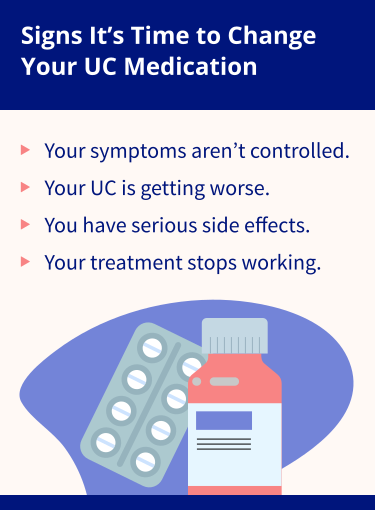
- Your symptoms don’t get better on a traditional DMARD
- Traditional DMARDS cause serious side effects
- You have moderate to severe UC
How Do You Take Immunomodulators for UC?
Azathioprine (Azasan, Imuran), and 6-mercaptopurine (Purinethol, Purixan) are available in oral form. Your doctor will give you instructions on how much and when to take them.
How Effective Are Immunomodulators for UC?
Azathioprine and 6-mercaptopurine are effective at keeping people in remission and preventing relapse.
Sphingosine 1-phosphate (S1P) receptor modulators
Etrasimod (Velsipity)
32% taking 2 milligrams of etrasimod achieved clinical remission by 52 weeks compared to 7% in the placebo group.
Ozanimod (Zeposia)
37% taking 1 milligram of ozanimod achieved clinical remission by 52 weeks compared to 18.5% in the placebo group.
Are Immunomodulators Safe?
Like all drugs, IMs can cause side effects.
Before you begin taking your drug, talk to your doctor about what to expect and what you can do to manage any side effects.
Make sure to share any other medications, natural supplements, or recreational drugs you take and if you are pregnant, planning to have a baby or get someone else pregnant, or nursing. This information can help your doctor decide which IM is safest for you to take.
What Are the Common Side Effects of Immunomodulators for UC?
Every medication carries with it the chance of side effects. Some of the more common ones you could have with immunomodulators for UC are:
Using azathioprine for a long time could also raise your risk for some types of cancers. Taking it is not advised if you’re pregnant or nursing.
Mercaptopurine can cause serious harm to a fetus. It’s very important not to get pregnant while you’re taking mercaptopurine and for six months after you stop taking it. Use an effective form of birth control during this time. If you’re a man, use an effective method of birth control while taking this drug and for three months after you stop.
S1P receptor modulators: Common Side Effects
- Headache
- Dizziness
- Upper respiratory tract infections
- Higher liver enzyme levels, which could mean inflammation or damage to liver cells
S1P receptor modulators: Uncommon Side Effects
- Trouble breathing
- Blurred vision due to macular edema
- Heart block
Because IMs reduce the strength of your immune system, it will be important for you to let your doctor know if you start to feel sick. And while vaccines help keep you healthy, your doctor will need to advise you on the best timing and types to get.
How Much Do Immunomodulators Cost?
Depending on the medication you take, IMs for UC can be expensive. How much you’ll pay for your treatment depends on many things, including what medication you’re taking, whether or not you have health insurance, the type of plan you have, and any other discounts you qualify for.
A couple of IMs are also included in drugmaker copay cards and coupons:
VelsipityForMe. This copay savings program may help you get Velsipity at no cost if you have commercial insurance.
Zeposia Support and Savings. If you have commercial insurance, this copay savings program can help you get your Zeposia prescription at no charge.
Some nonprofits, like the Crohn’s & Colitis Foundation (CCF), keep a list of programs that may be able to reduce the cost of your treatment.
Clinical Trials for Immunomodulators
Clinical trials are a way to try new treatments before they’re available to the general public. These studies help to find new treatments and make sure they’re safe and effective. They may also show how existing treatments could work better.
If your UC treatments haven’t worked well for you, a clinical trial may be a good option.
Ask your doctor if they know a clinical trial that might be a good fit for you. You can also search for “ulcerative colitis” at clinicaltrials.gov.
Are Immunomodulators Right for Me?
Treating UC isn’t a “one size fits all” approach. Your doctor and you will decide if you should try IMs based on a few factors.
Cost. IMs have been shown to work well if you have moderate-to-severe ulcerative colitis. But it can be confusing to understand their cost. Contact your health plan to find out how much you’ll pay for a prescription. If you aren’t covered, contact a nonprofit like the Crohn’s and Colitis Foundation to see if you qualify for a patient assistance program.
Other medications you’ve tried. Before IMs, your doctor will probably first try to manage your mild to moderate symptoms with quick-acting medications that have fewer side effects, like steroids and 5-ASAs. For more severe UC, you may try biologics before Immunomodulators.
Your health history. Your doctor will need to take into account any other health issues you live with or may be at risk for. Because IMs reduce how well your immune system works, make sure you also understand the steps you’ll need to take to stay healthy. For instance, you’ll see your doctor more often and have regular blood tests. Ask your doctor which vaccines are safe for you and stay up to date on them. Steer clear of exposure to germs as much as you can: Wash your hands regularly, stay away from people who are sick, and practice food safety when cooking and eating.
Potential side effects. Which side effects are you prepared to deal with to try to put your UC into remission? As with any new medication, make sure you’re aware of the risks. This is especially important if you’re thinking about starting a family. Some types of IMs can harm a developing fetus.
Your lifestyle. Drugs, alcohol, and even over-the-counter supplements may interfere with how well IMs work for you and could cause more severe side effects. When talking about different treatment options with your doctor, be honest about any products you regularly use.
Some IMs tamp down your body’s immune response. Others target a protein receptor such as sphingosine 1-phosphate (S1P) on immune T and B cells. This stops the release of these cells into the blood. The lower level of immune cells lessens the inflammation that causes UC.