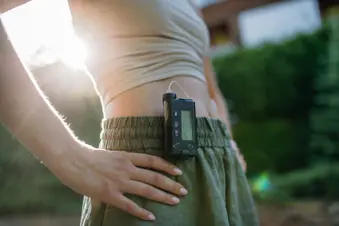
Type 2 diabetes management has come a long way over the past few decades, and not just because of research and new medications. Technology – from wearable devices and insulin delivery systems to simple phone apps or reminders – has given us new and improved ways to manage daily life with type 2 diabetes.
Each adjustment can take a lot of effort, and sometimes it can be hard. But technology can help you. It doesn't replace the need to make the changes, but it can make living with diabetes easier.
Wearable Devices and Phones
Smartwatches, smart rings, and smartphones can be used in many ways to help you manage your diabetes. Watches and rings can help track your activity, heart rate, and even your sleep patterns. The results can help you make decisions about what you're doing, how you're doing it, and what you might want to improve on.
There are phone apps that help you track the foods you eat and your weight. There are even apps that can give food suggestions and recipes. Others analyze your activity levels, telling you how many calories you expend doing certain activities. There are countless apps (many free) that present information in a variety of formats, from graphs and charts to summaries. You can choose what is right for you. Many people who use these apps share their information with their care teams to help with their care.
Blood Sugar Testing
In the 1980s, glucometers – small devices that analyze blood sugar from a drop of blood – became available to the public. This allowed people with diabetes to test their blood sugar levels at home with more accuracy. Before this, the only way to test your blood was by placing a drop of it on a color-change strip. Then you would hold the strip next to a color chart, which gave you an average of your blood sugar levels. This wasn't very precise because so much depended on how someone saw the colors, if there was enough blood on the strip, and how long they waited to check the results.
Glucometers made it possible for people to take better control of their treatment. The devices took the guesswork out, and people with diabetes could adapt their treatment according to the results. Since then, more advanced devices have come on the market. In 2012, continuous testing became available. This meant that you didn't need to poke your finger every time you needed to check your blood sugar levels.
Finger stick vs. continuous monitoring
Finger stick monitoring tests how your blood sugar is the moment you're checking it. Although prices vary, studies show that it can cost from $180 to $785 a year for testing supplies once you've bought the glucometer itself.
Continuous glucose monitors (CGMs) are devices that use a tiny sensor, or electrode, placed just under your skin, usually your upper arm. The electrode measures the glucose (sugar) levels from the fluid that's normally in your tissues instead of the sugar in your blood. The transmitter is attached to the electrode. Some transmitters are round. Some are rectangular, but they're not very big. You can easily wear clothing over them. To get your reading, you scan a reader over the transmitter or it sends measurements via Bluetooth to your smartphone or computer. You'll still have to do finger sticks once in a while, but not several times a day anymore. These sticks would be to calibrate (set) the machine and make sure it's accurate. Or you may have to do a finger stick to check to make sure the monitor is working properly.
A big advantage of continuous monitoring is you know what's happening to your blood sugar overnight, when it can drop without you knowing it. With continuous, 24/7 monitoring, the device can alert you if your blood sugar gets too low.
The prices of these devices are typically thousands of dollars per year. There are also repeat costs to replace the sensors, calibration strips, and other components.
Insulin Pens and Pumps
If you've just been diagnosed with type 2 diabetes, you'll probably be treated with oral medications (pills) to help lower your blood sugar first. Metformin is usually the first medication a doctor will prescribe. Your doctor may add or substitute other medications until your blood sugar levels are controlled. If oral drugs don't work, you might need insulin, which you take by injection.
It can be intimidating to give yourself a shot. In the past, you'd withdraw a small amount of insulin from a vial using a syringe before giving the shot to yourself. The insulin pen, an alternative to insulin vials and needles, came on the U.S. market in 1985. These pens have replaced syringes, making it easier to give yourself insulin with fewer mistakes. The pens can be more expensive than buying syringes and insulin in a vial. But the cost depends on the type of insulin and the actual device.
Insulin pens are either reusable, with replacement cartridges, or disposable. The designs differ between different makers, but a common design has a dial or button that you set for your dose, so it delivers the right amount of insulin. There are also newer smart pens that store memory about when you took your last doses and how much insulin you had.
Insulin pumps, officially called continuous subcutaneous insulin infusions (CSIIs), deliver insulin over time as you need it. Insulin is stored in a refillable pump, and a fine needle placed under your skin attaches to the pump with a thin clear tube. The programmed pump delivers insulin through the tubing.
There are many advantages to using an insulin pump. Aside from not having to do individual injections several times a day, you get a constant flow of insulin rather than a large amount at once. Newer, "smarter" pumps can be connected to a continuous glucometer to help control your blood sugar levels even more. They are expensive, though, and users need to be comfortable handling them and using the technology. The pumps are small – about the size of a deck of cards – and you can wear them on a belt or in your pocket.
Which delivery system is right for you?
Speak with your diabetes care team when deciding which type of delivery system is right for you. Here are some things to keep in mind when talking about your options.
Needle, syringe, and vial
- This is the least expensive option.
- You must be able to insert the needle into a vial and measure the correct amount of insulin using the lines on the syringe to get the right dose.
Insulin pens
- Prices vary, depending on if they are reusable/refillable or disposable.
- They are easier for people who have issues with their hands or vision.
Insulin pumps
- This is the most expensive option.
- You won't need daily shots, and pumps are usually used together with a continuous glucometer.
- You must be comfortable handling a pump, refilling the insulin, and managing the technology.
Technology is improving all the time, and sometimes it's not easy to keep up with all the changes. The important thing is for you to feel comfortable with the type of technology that you are using. If you aren't comfortable handing an insulin pump, it will be too intimidating and you might not use it properly or at all. Only you know your comfort level.
If you want to learn more about what technology is available to you, speak with your diabetes care team or your pharmacist. And be sure to check with your insurance company to see what types of devices they cover. Medicare and Medicaid cover some devices, too. For example, Medicare pays for some continuous monitor supplies if you have trouble keeping your blood sugar under control and your doctor feels you can use the device safely. If your diabetes care team has a social worker, they should be able to find this type of information for you.
Show Sources
Photo Credit: iStock/Getty Images
SOURCES:
Clinical Diabetes/Therapeutics: "Budget Impact Analysis of Self-Monitoring of Blood Glucose vs. Flash-Continuous Glucose Monitoring in Intensive Insulin Users with Diabetes Type 2 Covered by Medicare and Medicaid."
Diabetes Canada: "Pharmacologic Glycemic Management of Type 2 Diabetes in Adults: 2024 Update," "Continuous Glucose Monitor (CGM)."
Diabetes Care: "Pharmacologic Approaches to Glycemic Treatment: Standards of Care in Diabetes – 2024."
Diabetes Therapy: "Evolution of Insulin Delivery Devices: From Syringes, Pens, and Pumps to DIY Artificial Pancreas."
Endocrine Society: "Continuous Glucose Monitoring."
JAMA Internal Medicine: "Out-of-Pocket Spending for Insulin, Diabetes-Related Supplies, and Other Health Care Services Among Privately Insured US Patients With Type 1 Diabetes."
Journal of Diabetes Science and Technology: "Evolution of Diabetes Insulin Delivery Devices," "Does Device Make Any Difference? A Real-world Retrospective Study of Insulin Treatment Among Elderly Patients With Type 2 Diabetes."
Medicare.gov: "Continuous glucose monitors."
Role of Continuous Glucose Monitoring in Diabetes Treatment: "Introduction: History of Glucose Monitoring."


