

Pediatric growth hormone deficiency is a condition in which your child's pituitary gland, a small gland at the base of their brain, doesn't make enough growth hormone (GH). This can affect your child's height, as well as many other parts of their body, like their muscles, bones, and metabolism (how well their body can turn food into fuel). pGHD is a rare condition. It only affects 1 in 4,000 to 10,000 children.
The good news is that it's treatable.
"Most children respond well to growth hormone therapy without side effects and are able to achieve heights within the range expected for their family," says Dennis J. Brenner, MD, medical director of pediatric endocrinology at RWJBarnabas Health in West Orange, New Jersey.
The earlier that your child is diagnosed, the more likely that it is that they'll reach a near-normal height as an adult.
Pediatric Growth Hormone Deficiency Types
pGHD has three different types, based on its cause.
Idiopathic pGHD. "Idiopathic" is a medical term doctors use when they can't find a specific cause. Most kids have this type.
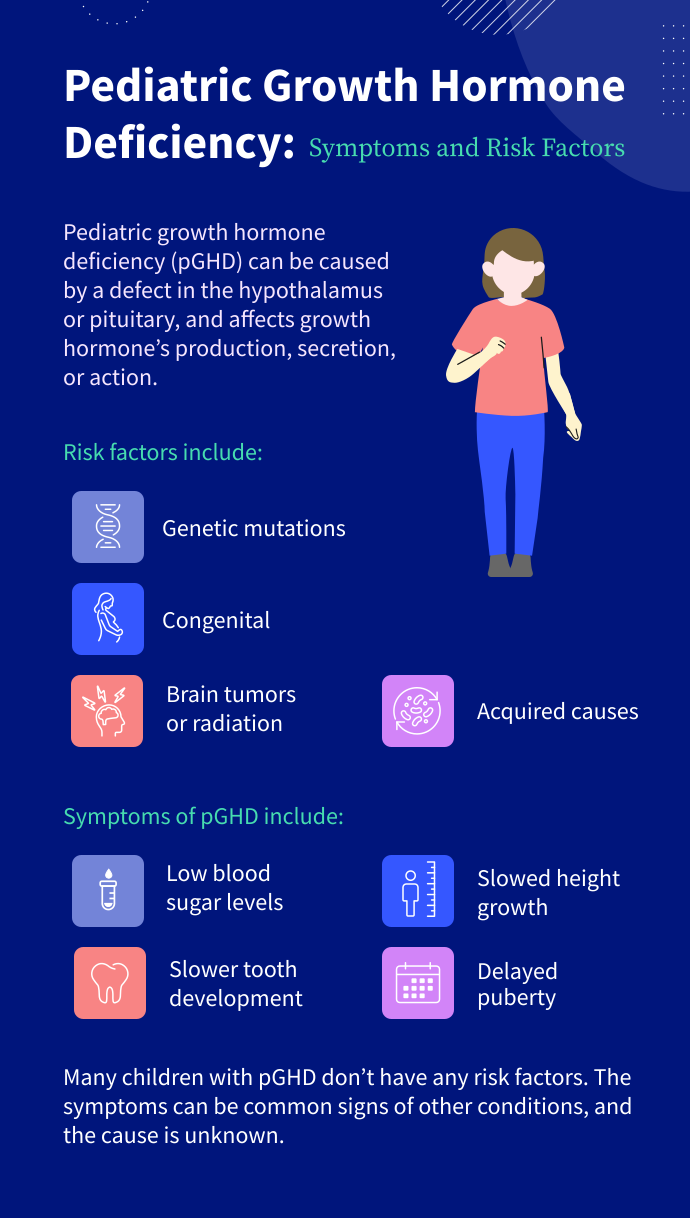
Congenital pGHD. This means that your child was born with the condition, either because of a genetic mutation (change) or because an area in their brain isn't working the way it should. It's a rarer type of pGHD.
Acquired pGHD. This kind happens during or after birth, because of damage to your child's pituitary gland.
Pediatric Growth Hormone Deficiency Causes
If your doctor says that your child has idiopathic pGHD, "no identifiable cause can be found for the lack of growth hormone despite a typical battery of blood and radiology testing," says Brenner.
Here's what researchers know so far about the other types of pGHD and causes.
Isolated growth hormone deficiency
If your child's pituitary gland simply doesn't make enough or any growth hormone, it's called isolated growth hormone deficiency (GHD).
Specific genetic changes are linked to certain types. These include:
Isolated growth hormone deficiency type IA. Because this type affects fetal growth, children who have it are small at birth. Even with growth hormone treatment, they are often very short adults.
Isolated growth hormone deficiency type IB. Kids with this genetic change have some growth hormone in their bodies when they're born.
Isolated growth hormone deficiency type II. If your child has this kind, they were born with a low amount of growth hormone. Kids with type II may also have a condition called pituitary hypoplasia, in which their pituitary gland doesn't function as well as it should.
Isolated growth hormone deficiency type III. This genetic type is similar to type II, but kids may also have a weak immune system that makes it easier for them to get sick.
Combined pituitary hormone deficiency
If your child has this type of pGHD, they don't have enough of two or more hormones that are usually made by the pituitary gland. Besides GH, that could include:
- Follicle-stimulating hormone (FSH) and luteinizing hormone (LH), which play a role in fertility
- Thyroid-stimulating hormone (TSH), which helps your body use energy
- Adrenocorticotropic hormone (ACTH), which helps your body respond to stress and maintains healthy blood pressure and blood glucose levels
Acquired pGHD causes
Some reasons for acquired pGHD include:
- Head injury
- Traumatic brain injury
- Brain tumor
- Brain surgery complication
- Radiation therapy that affects the pituitary gland
- Central nervous system infection
- Any other condition that affects your pituitary gland or hypothalamus (your brain's "control center")
Pediatric Growth Hormone Deficiency Symptoms
The most common sign of pGHD is slow growth (less than 1.4 inches a year) after your child's third birthday.
Other symptoms can include:
- Looking younger than their age
- A chubby build
- Slow hair or fingernail growth
- Teeth that come in late
- Delayed puberty
- Hypoglycemia (low blood sugar) in babies and toddlers
- A micropenis (very small penis) in babies assigned male at birth
Pediatric Growth Hormone Deficiency Diagnosis
Getting a pGHD diagnosis can be a long journey. It's important to work with a doctor who listens to your concerns and explains each step of the process.
First, your child's doctor will do a physical exam, looking for common pGHD symptoms. They'll also carefully review their medical history and growth patterns.
Pediatricians use a chart like the one below to figure out if your child's height and weight are growing at a normal rate.
| Your child's age (in years) | Height (in inches) for girls | Height (in inches) for boys | Weight (in pounds) for girls | Weight (in pounds) for boys |
| 1 | 27 to 31 | 28 to 32 | 15 to 20 | 17 to 21 |
| 2 | 31.5 to 36 | 32 to 37 | 22 to 32 | 24 to 34 |
| 3 | 34.5 to 40 | 35.5 to 40.5 | 26 to 38 | 26 to 38 |
| 4 | 37 to 42.5 | 37.5 to 43 | 28 to 44 | 30 to 44 |
| 6 | 42 to 49 | 42 to 49 | 36 to 60 | 36 to 60 |
| 8 | 47 to 54 | 47 to 54 | 44 to 80 | 46 to 78 |
| 10 | 50 to 59 | 50.5 to 59 | 54 to 106 | 54 to 102 |
| 12 | 55 to 64 | 54 to 63.5 | 68 to 136 | 66 to 130 |
| 14 | 59 to 67.5 | 59 to 69.5 | 84 to 160 | 84 to 160 |
| 16 | 60 to 68 | 63 to 73 | 94 to 172 | 104 to 186 |
| 18 | 60 to 68.5 | 65 to 74 | 100 to 178 | 116 to 202 |
"It's important for a child's pediatrician to be looking at the rate of growth during childhood and not just the actual height percentile," says Brenner. "A child dropping from the 50th to the 25th percentile may not be seen as likely to have growth hormone deficiency as a child dropping from the 10th to the 1st percentile, but both of those types of children need evaluation."
That can include:
X-rays. The bones in your child's hand can provide important information about how they're growing.
Magnetic resonance imaging (MRI). This can give a detailed view of the pituitary gland, as well as your child's brain.
Blood tests. For instance, these can:
- Rule out other health conditions
- Check levels of insulin-like growth factor (IGF-1), a hormone that manages the effects of GH
- Check levels of insulin-like growth factor binding protein-3 (IGFBP-3), which helps carry IGF-1 through the body
Growth hormone (GH) stimulation test. This is the most common way to check for pGHD, but it's not an easy test for kids to take.
What happens during a GH stimulation test?
GH is naturally released in bursts, and usually while you sleep. That makes it hard to detect in the blood. During a GH stimulation test, your child will be given medicine that tells their body to release GH. Then, their blood will be taken several different times over two to five hours.
Your child will need to fast (stop eating and drinking) 10-12 hours before this test.
If the results show that your child's GH levels are still low, they may have pGHD.
If so, your doctor may suggest genetic testing. "There are some fairly new genetic testing panels that can shed light on the cause of the growth hormone deficiency in certain cases," Brenner says.
Questions to Ask Your Doctor
It's normal to be worried about your child's health and what a pGHD diagnosis means for them. Your doctor can provide information that may help put your mind at ease. Before your next visit, you might want to write down a list of questions to ask them.
For instance, you could ask:
- What's causing my child's pGHD?
- Do they need growth hormone replacement therapy? If so, how will they take it?
- What risks or complications do I need to look out for?
- How and when will we know that the treatment is working?
- How can I help my child get used to their treatment?
- What side effects could they have?
- What complications do I need to look out for?
- How can I reach you if I have a question outside of office hours?
Start with the question that's most important to you. If you run out of time before you get through your list, ask your doctor if you can email them through your patient portal or set up a phone call.
Finding Expert Care
You should feel comfortable sharing any concerns you have about your child's height with your pediatrician. You'll probably also see a pediatric endocrinologist, a doctor who specializes in treating hormone disorders in children.
"In my experience, parental views about height vary greatly and an individualized approach is needed," Brenner says. "If a caregiver's concerned about their child's height, they should be referred to a pediatric endocrinologist who can look at the growth data, any testing results, and give an estimate of predicted adult height and discuss in detail why growth hormone may or may not be appropriate for a child."
Your pediatrician can help you find a pediatric endocrinologist in your area. You could also find one through a professional organization, like the Pediatric Endocrine Society, or a pGHD nonprofit group, like the MAGIC Foundation.
Pediatric Growth Hormone Deficiency Treatment
pGHD can be treated with recombinant growth hormone (rGH), a man-made version of growth hormone. Your doctor will use your child's weight and height to figure out the first dose. Then they'll adjust it as your child grows over time.
rGH is given as an injection (shot) every day before bedtime.
Newer long-acting versions are given in a weekly shot. These include:
- Lonapegsomatropin (Skytrofa)
- Somapacitan (Sogroya)
- Somatrogon (NGENLA/Genryzon)
These newer formulations haven't been studied as thoroughly or for as many years as the daily treatment. "In upcoming years, we'll have more safety and efficacy data for the weekly growth hormone products," Brenner says.
Ask your doctor to explain why they feel daily or weekly growth hormone treatment is best for your child.
Can you "wait and see" on pGHD?
"Every parent has to evaluate the risks and benefits of growth hormone treatment individually, along with their child's doctor," Brenner says. "My approach is to give parents an objective evaluation of what the possible side effects are and the expected height gain from treatment."
Talk to your doctor if you have concerns about starting treatment.
"There are some cases of severe growth hormone deficiency where other aspects of a child's health may be affected besides growth," Brenner says.
How long does pGHD treatment usually last?
Your doctor may suggest that your child take growth hormone until they reach late puberty and naturally stop growing. That may mean that your child will get daily or weekly shots for several years.
Pediatric Growth Hormone Deficiency Complications
If children have side effects, they're usually:
- A reaction where the needle went in
- Mild headaches
- Muscle pain
- Joint pain
- Swelling in hands or feet
- Worsened scoliosis (curved spine)
About 1 in 1,000 children may get a condition called benign intracranial hypertension, in which the fluid around the brain increases pressure on the skull. That can lead to hard-to-manage headaches, nausea, and double vision.
"The reasons for this side effect are not well understood, and there is nothing that can specifically be done to avoid it," Brenner says.
Other rare but severe side effects of growth hormone therapy include:
- Sleep apnea
- Pancreatitis (inflamed pancreas)
- Hip issues (the top of your child's thigh bone can slip out of place)
Can growth hormone cause cancer?
Growth hormone therapy has been used since the 1950s. It's generally considered safe. While it's not believed to cause cancer, some experts question if GH could trigger a return of cancer in children who've had it before.
Ask your doctor to explain how the benefits of growth hormone therapy will outweigh your child's risks.
When to call your doctor
Call your doctor right away if your child has:
- Swelling or redness where they were given their shot
- Skin rash
- Severe headaches (with or without throwing up)
- Kee pain
- Hip pain
Taking Care of Yourself
pGHD doesn't only affect your child, but you as well. As you help them manage their diagnosis:
Remind yourself: This isn't your fault. There's nothing that you could have done differently to prevent their growth hormone deficiency.
Pace yourself. pGHD treatment is more like a marathon than a sprint.
Take time for yourself. It's important for you to manage your stress and take time to recharge so you can best help your child. Talking to a counselor or therapist may also help.
What to Expect
When your child needs pGHD treatment:
Check with your health plan. Growth hormone therapy often requires special approval from insurers, and you'll probably need to request approval more than once during their treatment. Ask your doctor's office for help with this process.
Learn how to give the shots. Your doctor will train you. If your child is 10 years or older, they may be able to give themselves the shot, but it's important for you to still supervise.
Get organized. GH needs to be refrigerated. You'll need to plan ahead when it comes time to travel or your child goes to sleepovers or camp.
Give the treatment exactly as directed. That will probably mean within one hour of bedtime. If you miss a dose, don't double up the next time.
Call your doctor with any questions. For instance, your child can probably stick to their treatment schedule if they have a mild illness like a cold or the flu. But call your doctor to double-check.
How Your Child's Condition Might Change Over Time
The first year that your child takes GH, they may grow two to three times faster than they did before. Doctors call this "catch up" growth. It will slow down over time.
Your child will have checkups with your doctor every three to six months. These are important visits, so try not to miss them. Your child's growth will be measured and your doctor will make sure they're doing well with the current treatment plan. They can change the GH dosage if they need to.
At least once a year, your child will also get a blood test and X-ray to monitor their progress.
Getting Support
You might feel overwhelmed to learn that your child has pGHD and will need long-term treatment. It can be stressful to juggle fears about your child's health with questions about health insurance, out-of-pocket costs, medication, and doctor visits.
You don't have to figure everything out on your own. Your doctor and their care team will want to support you. You can also find patient resources, join an online community or support group, and get help with insurance appeals or paying for your child's treatment through trusted nonprofit groups like:
- The MAGIC Foundation
- Human Growth Foundation
- Pediatric Endocrine Society
Caring for Your Child's Emotional Health
When kids are shorter than their friends and classmates, they can feel awkward and left out. They may be at risk of low self-esteem or even depression. Although it may feel hard at first, it's important to talk about what's going on with your child. You might ask your doctor for some tips, or ask if they can refer your child to a counselor or therapist.
If you join a pGHD support group, you and your child may be able to connect with families who are going through a similar experience. That could also help you both feel less alone.
Takeaways
Growth hormone therapy has the best results when your child takes it before adolescence, when their bones begin to fuse together. Talk to your doctor about the risks and benefits. Because your child may need growth hormone shots for years, it can be helpful to get support from different places, like your doctor's office, pGHD nonprofits, and online communities where you can connect with other families.
Pediatric Growth Hormone Deficiency FAQs
How can I increase my child's growth hormone?
If your child is diagnosed with pGHD, your doctor will likely start them on growth hormone therapy. This is often given as daily shots. Although you could see a difference in three to four months, your child will likely need to continue this treatment for several years.
What is the best age to start growth hormone therapy?
There's no "best" age for your child to start growth hormone therapy. It can be started at any age. Sometimes it's important for babies to have this treatment. But you might not notice growth hormone deficiency symptoms in your child until they're in grade school or are about to go through puberty.
How long do you take growth hormone therapy?
Your child will likely stay on GH until they reach their adult height. In some cases, they may need to keep taking GH as an adult.