

On her worst days, Carrie Blivice felt "really ugly." Hypochondroplasia had stopped her growth at 4 feet, 9 inches, and she sometimes wondered if she'd ever meet someone who'd find her beautiful.
"It made me feel like Frankenstein," says Blivice, a 53-year-old artist and nature photographer in Philadelphia. While she didn't have medical or orthopedic complications from the condition, she weathered severe bouts of depression in her late teens and 20s.
After years of soul-searching and inner work, she began to feel at peace with her short stature, her strength forged at times by other people's ignorant comments or mean-spirited laughs. Today, she's married to a "kind and gentle" man of taller-than-average height, and they have two teenage daughters with "wonderful gifts." Both girls have hypochondroplasia as well.
"I hear stories about people who have done work on themselves and feel like the Phoenix that has risen from the ashes," Blivice says. "It's a gift now, but when I was going through it, it was very painful."
Getting Diagnosed With Hypochondroplasia
When Blivice was a child, her growth was delayed and her head was slightly larger than average. She also had bad joint pain at times, especially after she'd been physically active. Her pediatrician recommended that her parents (both average in height) see geneticists for testing. Doctors diagnosed her with hypochondroplasia before she turned 10.
The teasing started in elementary school. "Once in a while I would come home and ask [my parents], 'Why would someone call me a shrimp?'" As she entered her teens, the mean comments, stares, and snickering became more frequent. "I would go out into public with a friend or with my family, and somebody would pass by and laugh at me." She became hyperaware of her short stature as a result.
Blivice was the only person in her family with hypochondroplasia. Her parents looked into the possibility of human growth hormone, the only drug available at the time to try boosting final height, but doctors suspected it wouldn't work. (Research is not clear on whether growth hormone can increase height in children with hypochondroplasia.)
With medication out of the question, Blivice's mother and father found other ways to build her confidence: piano lessons, art school, and a 110-pound golden retriever named Buffy. "I think he [Buffy] really saved my life … especially when I was going
through the tough teenage years and early adult time, because he was the one thing, besides my parents or siblings, that I knew loved me," she says.
Falling in Love and Planning a Family
Blivice's bouts of depression over her short stature continued into early adulthood. She'd tried conventional treatments for it, but traditional talk therapy didn't bring lasting benefits and antidepressants didn't help. She tried alternative ways to process her painful thoughts and emotions, getting energy healing therapies like reiki, and seeking advice from spiritual advisors like shamans.
"I knew that this was really helping me and it was cathartic. But it was also very difficult to walk through those things that you don't want to face, or those things that felt really ugly," she says. Still, she sensed that going directly through the inner turmoil could help shift her state of mind and heal over time.
Rather than go to college, she went straight to work. Over time she became a nanny, a healing arts practitioner, and the owner of a pet-sitting business. Through that business she took on a client with two cats: a 6-foot, 3-inch introverted man named Charles. They became friends, meeting once a week to rent a movie and eat take-out. After a year of getting to know each other, they became a couple. Eventually they got married.
Blivice wanted to have a child. Earlier in her life, she'd met with a geneticist who explained that she'd have a 50% chance of passing on the gene change (mutation) that can cause hypochondroplasia to a baby if she conceived through sex with an average-sized partner. Another option, the geneticist said, was to harvest Blivice's eggs and her eventual partner's sperm and combine them in a lab through in vitro fertilization; each fertilized egg could then be checked for the gene change in hopes of finding a viable one without it to place in her womb.
Ultimately, though, Blivice decided that a partner who loved her for who she was wouldn't mind the odds of having a child with hypochondroplasia. Charles didn't mind. Early on in the pregnancy of their first child, a routine imaging test showed delays in the growth of the baby's upper leg and upper arm bones — an emotionally difficult discovery for Blivice.
"I remember trying not to cry until I got to my car in the parking lot in the hospital. And I remember calling my parents and feeling like I cried a river in that conversation," she says. "I guess the rest of what needed to still be healed is the worry and the pain you have: 'Will my child go through what I went through?'" Eventually, she decided that whatever challenges her child would face in life would "be important for their growth, as long as I could offer love and a stable home."
Raising Children With Hypochondroplasia
Ever since her daughters Eva, now 18, and Cate, 15, were very young, Blivice has talked openly with them about the form of dwarfism they all share.
"It's still a process for me to make sure that they didn't equate that to being this monster kind of thing that I would feel like. And I didn't want to project that. So I just fostered how beautiful they were with who they are."
One of her proudest moments came when Cate gave a calm, matter-of-fact reply to another child who called her too small to possibly be her age at the time: "That's because I have a type of dwarfism called hypochondroplasia, and I'm not gonna get that much taller," Cate said. Blivice says there's no way she herself would've been able to do that back when she was a kid.
She's talked with Eva and Cate a lot about the power of empathy — for themselves and for others. She's taught them about the possibility of turning painful moments into opportunities for self-acceptance and healing, too.
Once, for instance, while she was visiting a college with Eva, "this car drives by and it's two young guys, and one guy yells out, 'Oh my God, it's a midget!'" As much as a rude comment like that hurts, it's also an opportunity for reflection, Blivice says. Questioning the negative attention she's gotten over the years has been a great catalyst for "seeing that my 'differences' are beautiful and feeling it on a deep level."
Finding 'Unlimited' Opportunities for Personal Growth
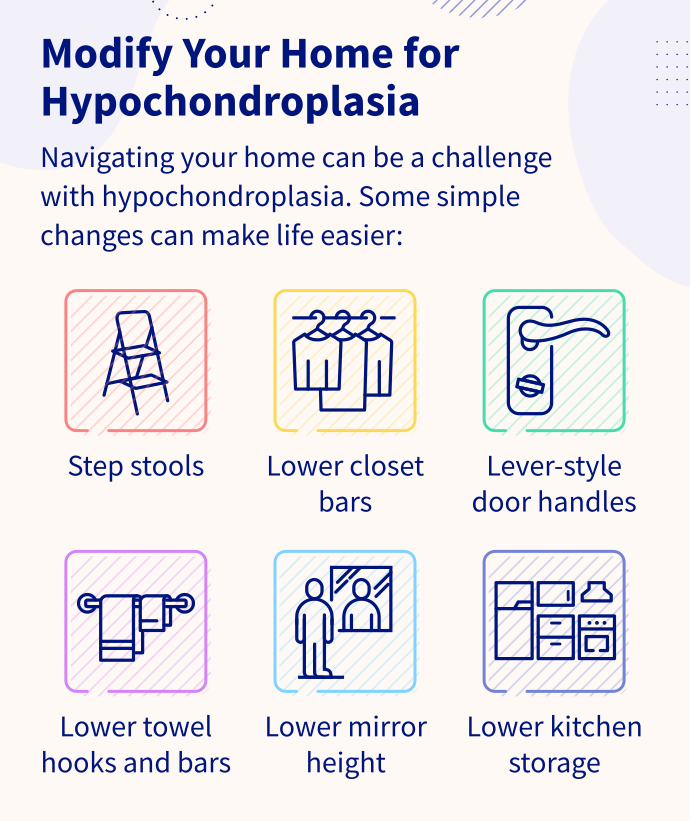
Blivice hasn't made adaptations to her home to compensate for her short stature, but she often uses a step stool around the house. When she's out shopping by herself, she sometimes asks for a hand getting items that are out of reach.
"In the past, I wouldn't have asked anybody. I would have been embarrassed," she says. "Now I look at it as an opportunity to make an icebreaker where you can say hello to somebody, and the responses have been always really, really touching."
Having overcome her insecurities about hypochondroplasia, she says she'd encourage other people with the condition who feel distressed by it to "find everything and anything that you can" to feel more at ease, whether it's a therapist, a support group like Little People of America, or a pet.
"There are unlimited things that you can find to bring you that peace in your life and in who you are, and to strengthen your peace with being unique and seeing that as a positive and an asset."