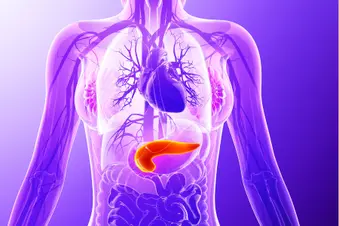
If you have the most common type of pancreatic cancer, called pancreatic ductal adenocarcinoma (PDAC), your doctor might test your tumor for gene mutations. These are simply changes in your DNA. One of the most common changes in PDAC happens in a group of genes called RAS.
RAS mutations cause cells to grow and divide when they shouldn't. This helps cancer spread. It's useful to know if your tumor has a RAS mutation, so doctors can better understand your cancer and make treatment decisions.
What Are RAS Mutations?
RAS is a family of genes that controls how cells in your body grow. It includes these genes:
- KRAS
- HRAS
- NRAS
RAS genes normally act like a control switch for cell growth. Simply put, they help cells know when to grow and when to stop.
"It is like a light switch that toggles back and forth, turning it 'on' and 'off,' depending upon growth signaling," explains Brandon Huffman, MD, an assistant professor of medicine at Harvard Medical School and a medical oncologist at Dana-Farber Cancer Institute in Boston.
Usually, RAS can turn itself off using something called GTPase activity to shut down the growth signal. But when a mutation happens, this "off switch" doesn't work the way it should. The RAS protein stays "on" too long. This means cells grow too fast and divide nonstop. Over time, they can become cancerous.
Types of RAS Mutations
There are several types of RAS mutations. KRAS is the most common RAS mutation in PDAC. About 95% of pancreatic tumors have a mutation in the KRAS gene. Less than 1% of PDAC mutations are NRAS mutations, and almost none are HRAS mutations.
Researchers discovered the KRAS gene mutation in 1983. They've learned a lot about it since that time.
Doctors classify these KRAS subtypes in different ways:
Codons
Codons are a set of three DNA letters that tell cells what to do. Often, KRAS mutations are described by the exact codon where the change happens, like:
- Codon 12 (the most common mutation site)
- Codon 13
- Codon 61
Mutation name
KRAS subtypes can also be labeled with more detail. In this case, they're named by the specific change that happens in the gene. Some examples are:
- G12D
- G12V
- G12R
- G12C
- Q61H
- G13D
Transition vs. transversion
KRAS mutations can be further categorized by the ways their DNA letters change:
- Transition. This means a DNA letter in the gene is swapped for a similar type.
- Transversion. A DNA letter is swapped for a different type. Most KRAS mutations are transversions.
What Causes RAS Mutations?
RAS gene mutations usually develop due to a random DNA mistake that happens over time. "The mechanisms are unclear for why KRAS mutations develop," Huffman says. But the mutation has been linked to:
- Aging
- Chronic inflammation
- Smoking
- Pollution or exposure to other chemicals
- Certain inherited health conditions
When Do RAS Mutations Happen?
In PDAC, changes in the KRAS genes are quick to happen.
"They arise early in the development of pancreatic cancer," Huffman says. "In fact, 60% of healthy individuals likely acquire them in the normal pancreas without having developed pancreatic cancer."
Knowing when KRAS mutations happen helps doctors better understand the disease. Because they appear so early, these mutations are likely drivers. That means they actually help start and grow the cancer. They aren't just something that shows up later by chance.
How Do You Test for a RAS Mutation?
If you have PDAC, your doctor can order a test to see if you have a RAS mutation.
"The only way to know that a genetic mutation in KRAS is present is to test for it, which is why testing is recommended by multiple national guidelines committees for patients with advanced pancreatic cancer," Huffman says.
There are two ways to test for a KRAS mutation:
- Biopsy. Your doctor will take a small sample of tissue from your tumor. Then, they'll send it to a lab, where it's tested.
- Liquid biopsy. This test uses a blood sample instead of a tissue sample. It looks for pieces of tumor DNA that circulate in your blood.
Why Is It Important to Know if You Have a RAS Mutation?
Your RAS status can help doctors:
- Better understand your cancer
- Recommend treatment options
- Tailor your treatment to your specific tumor
- Provide you with a more accurate prognosis
Huffman says it's also important to know the specific KRAS change you have. "By knowing the type of KRAS mutation, patients can find potentially effective targeted therapies to use to control their cancer and, hopefully, help them live longer," he says.
How Do RAS Mutations Affect Your Outlook?
Because nearly all PDAC tumors have a RAS mutation, the defect is a key feature of the disease. PDAC is known for being a fast-growing type with a poor outlook. The five-year survival rate for this cancer is about 8%.
But not all KRAS mutations act the same. For instance, G12R tumors often respond better to treatment.
The good news is that research is advancing quickly. New treatment approaches to target RAS mutations are in development.
What if You Have RAS-Negative PDAC?
Most, but not all, PDAC tumors have a mutation in the KRAS gene. Though it's uncommon, you may test negative. Doctors call this KRAS wild-type.
If no KRAS mutation is found, treatments that target it won't help you. But your tumor may have other gene mutations that drive the cancer.
"For the remaining 5% of patients with pancreatic cancer, the tumors may have a separate targetable mutation that could be treated with an alternative therapy," Huffman says.
Takeaways
RAS mutations are gene changes that cause cancer cells to grow. Most people with PDAC have this gene defect. A biopsy or blood test can help doctors find out if you have a RAS mutation. It's important to know you have one, so you can receive the best treatment possible.
Show Sources
Photo Credit: Science Photo Library/Getty Images
SOURCES:
Brandon Huffman, MD, assistant professor of medicine, Harvard Medical School; medical oncologist, Dana-Farber Cancer Institute, Boston.
Dana-Farber Cancer Institute: "RAS and Pancreatic Cancer: What You Need to Know."
Pancreatic Cancer Action Network: "5 Things to Know About Targeting Mutant KRAS in Pancreatic Cancer," "KRAS Mutations and Pancreatic Cancer," "Pancreatic Cancer Diagnoses and Mortality Rates Climb; Five-Year Survival Rate for Pancreatic Cancer Stalls at 13%."
Cancerworld: "Cracking RAS: It took over 30 years to hit this ubiquitous oncogene – was it worth the wait?"
Journal of Clinical Oncology: "Frequency and incidence of oncogenic RAS mutations in patients with metastatic pancreatic ductal adenocarcinoma: Derived from the real-world evidence database Foundation Medicine Insights," "Exploring predictive factors for detecting KRAS mutations in pancreatic cancer using liquid biopsy."
MD Anderson Cancer Center: "Targeting the KRAS mutation for more effective cancer treatment," "3 recent advances in pancreatic cancer research."
Journal of Clinical Medicine: "The Clinical Implications of KRAS Mutations and Variant Allele Frequencies in Pancreatic Ductal Adenocarcinoma."
Memorial University of Newfoundland: "Transition versus Transversion mutations."
Nucleic Acids Research: "KRAS codon 12 mutations occur very frequently in pancreatic adenocarcinomas."
Canadian Cancer Society: "Genetic changes and cancer risk."
Seminars in Oncology: "KRAS mutation in Pancreatic Cancer."
Columbia University Herbert Irving Comprehensive Cancer Center: "Targeting KRAS: Promising New Therapy for Hard-to-Treat Lung Cancer Subtype."
Medical University of South Carolina: "Hollings researchers reveal why some pancreatic tumors behave differently."
Journal of Experimental & Clinical Cancer Research: "KRAS wild-type pancreatic ductal adenocarcinoma: molecular pathology and therapeutic opportunities."
MedlinePlus: "NRAS gene," "HRAS gene."


