People with atopic dermatitis often need to use many different medicines every day to help with their itchiness and rashes. Treatments, like lotions and creams, can be applied directly to the affected areas, known as topical medicines. Some people may use pills or injections to help prevent the symptoms. The goal is to reduce inflammation, keep your skin hydrated, stop the itching, reduce the rashes, and block your overactive immune system.
Janus kinase (JAK) inhibitors are newer medicines that block a specific part of your overactive immune system to control symptoms. Opzelura (ruxolitinib) is the first and only JAK inhibitor for the treatment of atopic dermatitis flare-ups available as a cream for direct use on the affected areas for adults and children ages 2 to 11
How Does Opzelura Work?
Atopic dermatitis, also called eczema, is a long-term (chronic) skin condition that is caused by an overactive immune system. This weakens the skin barrier, which can cause the skin to be irritated and inflamed. The most common parts of the body are the face, hands, feet, wrists, and legs. People with atopic dermatitis commonly have very itchy skin (pruritus), dry or sensitive skin, and red rashes. And scratching the itchy skin can cause more inflammation, which leads to more itch and rash, called the “itch-scratch cycle.”
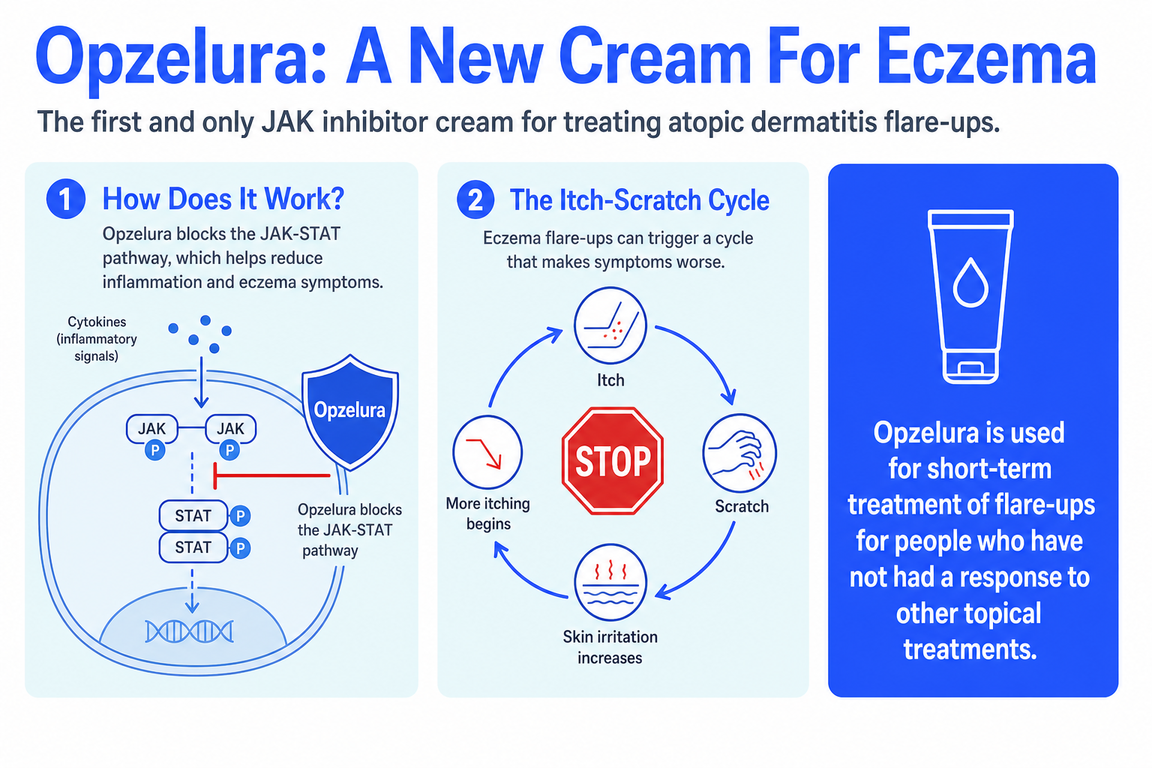
People with atopic dermatitis may have a flare-up (or exacerbation) when their symptoms are worse and may be more noticeable. The flare-ups can last for days or weeks and may involve more itching and rashes, or lead to skin infections. Although atopic dermatitis flare-ups have many different causes, some of these flare-ups are caused by certain triggers. Examples of common triggers are:
- Things that irritate the skin, like soaps, detergents, cleaning products; perfumes; fabrics; or metals (like nickel)
- Common allergens, like dust mites, pet dander, pollen, mold
- Weather or sudden change in weather
- Stress
- Hormonal changes, like the menstrual cycle or pregnancy
- Excessive sweating
- Very hot water with showers or baths
- Certain foods, like dairy, eggs, nuts, soy, and wheat
- Infections
- Some medicines
For mild-to-moderate atopic dermatitis, people commonly use over-the-counter (OTC) moisturizers and topical prescription medicines directly on the affected areas to keep the skin hydrated and to help reduce redness, inflammation, and itching. But this may not always work for people with severe atopic dermatitis.
Treatment options can be put into the following different groups, targeting different parts of the immune system response.
- Topical anti-inflammatory medicines, including corticosteroids, crisaborole (Eucrisa), pimecrolimus (Elidel), and tacrolimus (Protopic)
- Immunosuppressant medicines, like azathioprine, cyclosporine, methotrexate, and mycophenolate mofetil, that reduce the immune system response overall
- Medicines that target specific pieces of the immune system, like dupilumab (Dupixent)
- Janus kinase (JAK) inhibitors, like abrocitinib (Cibinqo), ruxolitinib (Opzelura), and upadacitinib (Rinvoq)
Opzelura is a JAK inhibitor cream that is used for short-term treatment. JAK inhibitors block the overactive signals in the JAK-STAT pathway of your immune system. This can help reduce inflammation and improve the skin barrier. JAK inhibitors are commonly used for moderate-to-severe atopic dermatitis for people that have not had a response to other topical treatments. They can also be helpful for people that have not had a response to other oral or injected immune-suppressing medicines or cannot take them.
How Should I Use This Medicine?
Opzelura is a cream that is applied as a thin layer, twice a day, on the areas that have a rash. It is only used when your atopic dermatitis symptoms flare-up, reappear or worsen. It is commonly used for a few weeks. Stop using it when your symptoms, like itch, redness, and rash, go away. Do not use it for more than 8 weeks without talking with your health care provider.
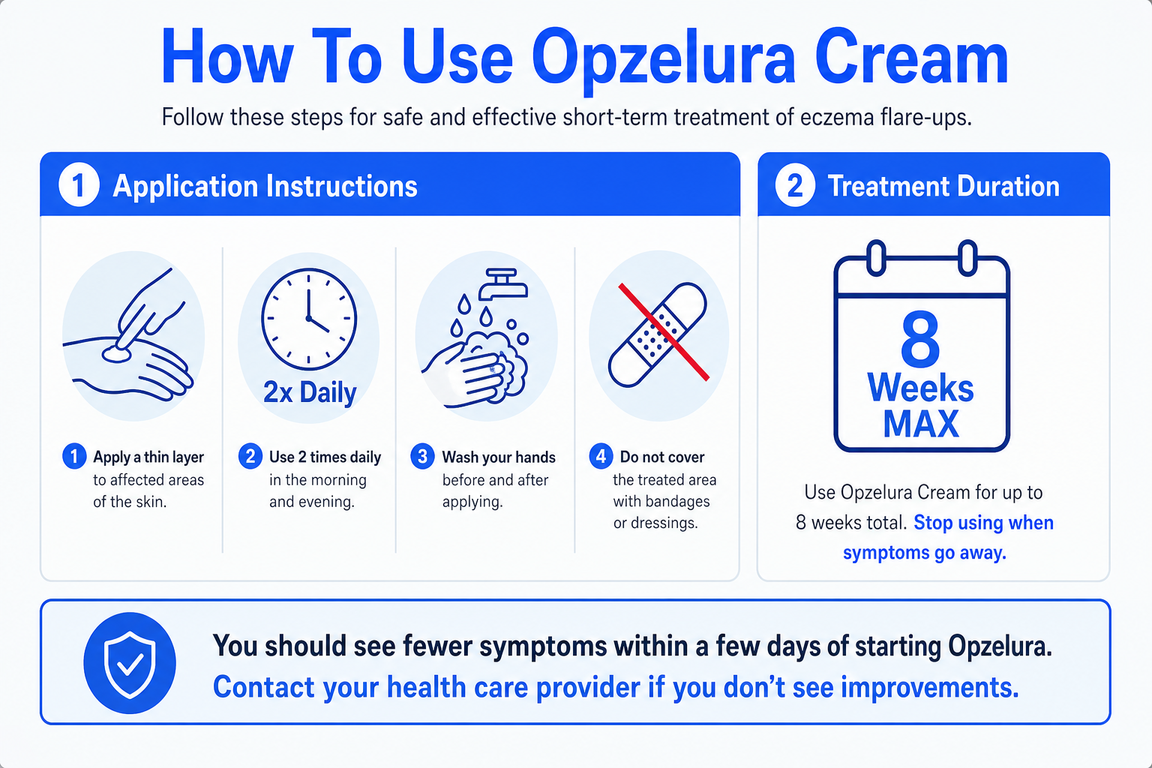
Talk with your pharmacist or health care provider if you have questions about how and where to use Opzelura. It is important to wash your hands after applying the cream, unless you are applying to a spot on your hands. Do not cover the affected area with a bandage or other wrap unless told to do so by your health care provider. If you are using other topical medicines or moisturizers, talk to your health care provider on what to continue and how to use these along with Opzelura.
How Was It Studied for Atopic Dermatitis?
Adults and Children 12 Years and Older. Two studies were done to see if Opzelura was safe and effective for the treatment of atopic dermatitis when compared with a placebo containing no medicine. Placebo-controlled studies help researchers see differences in benefit or harm of a medicine when compared with no treatment. People in the studies had mild-to-moderate atopic dermatitis for at least 2 years and had affected areas on less than 20% of their body. There were a total of 1,249 people in these two studies.
- Both studies included people that were 12 years old or older, with most (80%) being over 18. The average age in both studies was 30 to 37.
- Over half of the people in the study were female (62%), 70% identified as White, 23% as Black, 4% as Asian, and 3% were other races.
- People in the studies did not know if they were using Opzelura 0.75%, Opzelura 1.5% or placebo cream twice a day.
Efficacy was measured by a health care provider rating a person’s rash and itching using different scales (see Table).
Scale
Score Range
Meaning
Investigators Global Assessment (IGA)
0-4
0 = clear – rashes are gone
4 = severe rashes
Eczema Area and Severity Index (EASI)
0- 72
0 = clear – rashes are gone
72 = severe rashes
Numerical rating scale (NRS) for itching
0-10
0 = no itching
10 = worst imaginable itch
- To participate in the study, people had to have an IGA score of 2 or 3, which-is-mild to moderate atopic dermatitis. Most people had an IGA of 3, EASI of 8, and itch NRS of at least 5.
- At the start of both studies, people had an average of five to six flare-ups per year.
Treatment success was defined as an IGA score of 0 or 1, with a change of at least 2 points on the IGA scale. Other success measures were the number of people who had a 75% or better improvement on the EASI scale and reduction of the itch NRS score.
Children Ages 2 to 11 Years. Another study was done to see if Opzelura was safe and effective for the treatment of atopic dermatitis compared to placebo in children ages 2 to 11. There were 330 children in this study, and 51% of people were between the ages of 2 and 6, while 49% were ages 7 to 11. Over half of the people in the study were female (54%), 55% were White, 32% were Black, 6% were Asian, and 7% were other races.
To participate in the study, people had to have an IGA score of 2 or 3, which-is-mild to moderate atopic dermatitis. About 24% of people had an IGA score of 2, while 76% had a score of 3. People in this study they had affected areas on less than 20% of their body.
The main goal of the study was to see how many children had treatment success (defined as an IGA score of 0 or 1, with a change of at least 2 points on the IGA scale) after 8 weeks of using Opzelura twice a day.
What Benefits Were Seen in the Studies?
Adults and Children 12 Years and Older. After 8 weeks of treatment, people using Opzelura were more likely to have improvements in their rash and less itching than people who used placebo. This was true for all scales used to rate the severity of their atopic dermatitis.
Rash severity. In one study, over 50% of people using 0.75% or 1.5% Opzelura had an IGA score of 0 or 1, with more than a 2-point improvement on their score, compared to only 15% of the people using placebo cream. In the other study, over 50% of people using 1.5% Opzelura had the IGA improvements compared to 39% for the 0.75% Opzelura and 7.6% for placebo. In both studies, more than half of the people using Opzelura had a 75% decrease in their EASI scores compared to 14% to 24% of people using placebo. This means that with both scales, people using Opzelura had little to no signs of rash after 8 weeks of treatment.
Itching. In both studies, up to 50% of people using Opzelura had a decrease in itching scores by at least 4 points compared with 16% of people using placebo. This means that most people using Opzelura reported little or no itching by the end of the study.
Children Ages 2 to 11 Years. After 8 weeks of treatment, children using Opzelura were more likely to have improvements in their symptoms than people who used placebo. In this study, 56.5% of people using Opzelura had an IGA score of 0 or 1, with more than a 2-point improvement on their score, compared to only 10.8% of the people using placebo cream. This means that children using Opzelura had little to no signs of rash after 8 weeks of treatment.
Your results may differ from what was seen in clinical studies. You and your health care provider should decide if the benefits outweigh any potential risks.
When Does Opzelura Start Working?
You should see fewer symptoms within a few days of starting Opzelura. This should mean that your rash will take up less space on your body and you will have less itching. Contact your health care provider if you don’t see improvements or continue to have symptoms that bother you.
Are There Reasons I Should Not Use This Medicine?
Opzelura should not be used when you have an active infection. Talk to your health care provider about any of the following:
- Long-term (chronic) or recurring infections
- A previous serious bacterial or viral infection, like shingles, hepatitis B, or hepatitis C
- Exposure to tuberculosis
- A condition or use of medications that increase your risk for infection
How Can I Prevent and Manage Opzelura Side Effects?
The most common side effects of Opzelura are infections in the nose or throat, a sore throat, or common cold symptoms. This can also include serious infections. The best way to prevent infection is to reduce your exposure to germs by washing your hands and avoiding people who are sick. You should stay current on vaccinations, such as getting an annual flu vaccine. Call your health care provider if you have the following symptoms of infection:
- Fever or chills
- Body aches
- Cough
- Tiredness
- Persistent headache
- Confusion
- Vision changes
- Painful rash
- Painful or frequent need to pee
These are not all of the possible side effects. Talk with your health care provider if you are having symptoms that bother you. In the U.S., you can report side effects to the FDA at www.fda.gov/medwatch or by calling 800-FDA-1088 (800-332-1088). In Canada, you can report side effects to Health Canada at www.health.gc.ca/medeffect or by calling 866-234-2345.
What Types of Interactions Can Happen?
Several medicines can affect the blood levels of Opzelura. This may increase the risk of side effects. The following medicines should be avoided. Talk with your health care provider if you are using any of the following medicines or foods:
- Strong CYP3A4 inhibitors. Examples include ceritinib (Zykadia), clarithromycin (Biaxin), idelalisib (Zydelig), itraconazole (Sporanox, Tolsura), ketoconazole (Nizoral), and others.
- Medicines used for HIV. Examples are indinavir/ritonavir, elvitegravir/ritonavir, and others.
- Grapefruit juice
This is not a complete list of medicines that may interact with Opzelura. Tell your pharmacist or health care provider about all the prescription or over-the-counter (OTC) medicines, vitamins/minerals, herbal products, or other supplements you take or have recently taken. This will help them know if there are any interactions or if you need a dosage adjustment.
Getting Your Medicine: What to Expect
Depending on your prescription insurance, Opzelura may be considered a specialty medicine, which is a high-cost medication that is taken for rare, complex, or chronic diseases. It may require a different process than picking up a prescription at your local pharmacy. This process helps you stay on track with your treatment. The drugmaker has a program to help support the process, or your insurance company may require a specific pharmacy.
Here are some differences that you may expect.
Insurance approval. Your insurance may require approval for using this medicine, also called a prior authorization. The insurance company reviews the prescription from your health care provider to make sure it is covered and determines the process that needs to be followed.
Pharmacy access. You may be required to use a specific pharmacy to get your medicine. Your health care provider will work with you and your insurance company on which pharmacy to use and the information that will be provided.
Copay assistance. There is a copay assistance program from the drugmaker that may allow you to pay $0 for your prescription. Whether you are eligible depends on whether you have prescription insurance and what type of insurance you have. You can find out more at www.opzelura.com/atopic-dermatitis/copay-savings-program or by calling 833-613-2333.