Lambert-Eaton syndrome (LES), also called Lambert-Eaton myasthenic syndrome (LEMS), is a rare autoimmune disease that disrupts the nerve signals that tell your muscles to move. This causes your legs, arms, and sometimes face to become weak. Most doctors and researchers call it Lambert-Eaton myasthenic syndrome rather than Lambert-Eaton syndrome. Myasthenia means muscle weakness, so they believe that including the word makes the name more accurate.
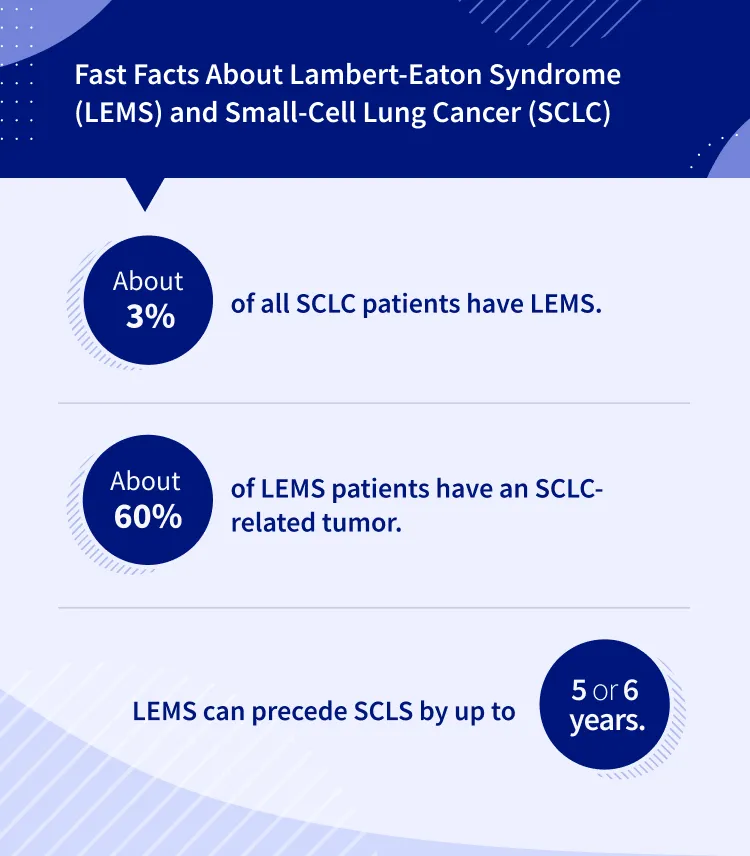
Fewer than 3 million people around the world have LES, including only 400 people in the U.S. About 50% to 60% of people with LES also have small-cell lung cancer (SCLC), although they might not have been diagnosed yet. It's possible to have symptoms of Lambert-Eaton syndrome up to six years before SCLC is discovered. Muscle weakness could be the clue that leads your doctor to a lung cancer diagnosis. Some experts say that LES might be underdiagnosed in this group. This means more people may have it and not know it.
What Causes Lambert-Eaton Syndrome?
Normally, your immune system should protect you against germs and other harmful substances. But if you have an autoimmune disease, which Lambert-Eaton syndrome is, your body attacks itself. With LES, your body mistakenly attacks your neuromuscular junctions. These are where your nerves and muscles connect.
Normally, electrical impulses travel down motor nerves to make your muscles work. When these impulses get to the nerve endings, they open little gates called calcium channels. This is to release a chemical messenger called acetylcholine into the neuromuscular junctions. Acetylcholine makes your muscles contract.
Lambert-Eaton syndrome damages the part of your nerve endings that release acetylcholine and not enough of this chemical is released. This weakens the signals that reach your muscle cells. That's why your muscles can't contract as strongly and you feel weak.
What's the Connection With Lambert-Eaton Syndrome and Small-Cell Lung Cancer?
More than half of people diagnosed with Lambert-Eaton syndrome either have or will eventually get small-cell lung cancer because the cancer triggers or causes the syndrome. But having cancer doesn’t mean you will get LES. Only about 3% of people with small-cell lung cancer get it.
If you are diagnosed with the syndrome, it’s important to be checked to see if you might have cancer if you haven’t already been diagnosed with it. “One of the main concerns that we have with LEMS is that we want to make sure that there's not an underlying process,” says Nestor Galvez-Jimenez, MD, a neurologist at Baptist Health Miami Neuroscience Institute in Miami, Florida. “We need to look for something that may be causing this.” Finding the cause would definitely affect how the syndrome is treated, he explains.
Researchers aren’t completely sure about why some people with SCLC get Lambert-Eaton syndrome and others don’t. The connection between the two diseases could be related to your immune system and the calcium channels on your nerve endings and in small-cell lung cancer cells.
Your immune system releases proteins called antibodies that fight against cancer. Because small-cell lung cancer cells contain the same calcium channels as nerve endings, the immune system sometimes mistakes the nerve endings for a threat. It releases antibodies that damage some of the calcium channels.
That said, Lambert-Eaton syndrome is still very rare, even in people with small-cell lung cancer. Your risk of developing it increases though if you:
- Are over 60 years old
- Smoked cigarettes for a long time
- Were assigned male at birth
People who develop LES but don’t have cancer tend to be younger (around 35) and researchers think that in these cases, the syndrome might be genetic.
What Are the Symptoms of Lambert-Eaton Syndrome?
The main LES symptom is weakness. This happens because the motor nerves become damaged. Lambert-Eaton syndrome affects both voluntary muscles. These are the ones you control, like your arms and legs. The syndrome also can affect muscles that you don't control, like your breathing.
Weakness often starts in the upper legs, hips, arms, and shoulders. Your legs and arms might feel heavy, making it hard to walk, climb stairs, or lift your arms. The weakness should improve when you exercise. You might also feel an aching or tingling in your muscles.
Less often, Lambert-Eaton syndrome affects muscles of the face and causes symptoms like:
- Eyelid drooping
- Double vision or blurred vision
- Problems chewing, swallowing, and speaking
Damage to your autonomic nerves can cause symptoms like these:
- Dry mouth
- Dry eyes
- Constipation
- Trouble controlling erections in men, called erectile dysfunction
- Reduced sweating
- Dizziness when you stand up
Symptoms slowly get worse over a period of weeks or months as the nerve signals are interrupted. If you have cancer, your symptoms may come on faster.
How Is Lambert-Eaton Syndrome Diagnosed?
It is very difficult to diagnose Lambert-Eaton syndrome.
Weakness, nerves tingling, and other symptoms are reasons to visit your primary care doctor, who will ask about your symptoms and do an exam. If your doctor thinks you have a problem with your nerves or muscles, they will send you to a neurologist for more tests.
An antibody blood test could show if you have antibodies that are attacking your nerves. Up to 90% of people with Lambert-Eaton syndrome have antibodies against calcium channels in their blood.
Electromyography (EMG) is a test that checks the speed of signals as they travel from your nerves to your muscles. A thin needle is placed into your skin and muscle. A monitor shows the electrical activity in your muscles when you move and when you're at rest.
Slower than normal nerve signals could be a sign of Lambert-Eaton syndrome. EMG can also rule out myasthenia gravis, a more common autoimmune disease that also affects the muscles.
Because Lambert-Eaton syndrome has such a strong link to small-cell lung cancer, your doctor should test you for cancer if you haven't been diagnosed already. Tests to diagnose lung cancer include:
- X-ray
- CT scan
- PET scan
If these tests don't show cancer, your doctor will likely check you again every few months because it could develop.
What Are the Treatments for Lambert-Eaton Syndrome?
There is no cure for Lambert-Eaton syndrome, and how it’s treated depends on the cause. "First of all, the treatment of Lambert-Eaton really very much depends upon the treatment of the underlying [cancer],” Galvez-Jimenez says. “That treatment would take precedence. So if somebody has a carcinoma, by treating that, you expect to see a change in the symptoms of LEMS."
This treatment could include chemotherapy, surgery, radiation, and other therapies.
Medications that treat Lambert-Eaton syndrome
There are some medications that your doctor can prescribe to help manage the symptoms that LES causes, such as:
Amifampridine (Firdapse). This is the only medicine specifically approved to treat muscle weakness from Lambert-Eaton syndrome. Firdapse is a potassium channel blocker. It changes how long the nerve signal lasts so your nerves can release more acetylcholine to strengthen the nerve signals to your muscles. Galvez-Jimenez says that this drug has been available for many years now and is very useful.
Pyridostigmine (Mestinon): It slows down how your body breaks down acetylcholine. This improves the signals between your nerves and the muscle cells. You may see an improvement in weakness and symptoms like dry mouth, dry eyes, and constipation. You have to take it a few times a day for it to work. The most common side effect is diarrhea, but if the dose is too high, it could cause more weakness.
Ruzurgi: A version of amifampridine that's approved for children, although Lambert-Eaton syndrome is rare in children. Both medicines have a small risk of causing seizures.
Your doctor may suggest these other drugs:
Immune-suppressing medicines like azathioprine (Azasan, Imuran), methotrexate (Rheumatrex, Trexall), and steroids (prednisone) may calm your immune system to stop it from damaging your nerves.
Immunoglobulin therapy is a treatment where you get antibodies from a healthy donor to reduce how your immune system attacks your nerves. This might increase muscle strength.
Plasmapheresis filters the harmful antibodies out of the liquid part of your blood (plasma). This treatment may temporarily help with muscle weakness.
How to Manage Your Lambert-Eaton Syndrome Symptoms at Home
Taking your medications and following your treatment plan are important, but there are steps you can take at home that might help you manage your symptoms even more. Many people with Lambert-Eaton syndrome find that their symptoms tend to flare up with stress, heat, and lack of sleep, so it’s important to address these issues.
What to Expect With Lambert-Eaton Syndrome
The effects of Lambert-Eaton syndrome are different in each person. Some people respond well to treatment and reach a stable state where they have no symptoms (remission). Others have symptoms that come and go or get worse over time. People who have LES but don’t have cancer generally have a normal life expectancy.
How might Lambert-Eaton Syndrome change over time?
It seems that the peak of how Lambert-Eaton affects people who don’t have cancer is the first one or two years after diagnosis. After that, the symptoms often even off (plateau), rather than getting worse. For those who do have lung cancer, the syndrome gets worse over time if the cancer isn’t successfully treated.
For the most part, Lambert-Eaton syndrome isn’t typically life threatening unless the muscle weakness begins to affect your ability to swallow or breathe. This doesn’t occur often and when it does, it’s usually after many years of living with the disease. Following your treatment plan could help reduce this risk. Treatment may also help prevent major long-term disability. Most people can manage to continue with their daily activities, although there might be some limitations.
Getting support can help you live better with Lambert-Eaton syndrome. Your medical team is one good source of information and advice. You can also turn to an organization like the Muscular Dystrophy Association or the National Institute of Neurological Disorders and Stroke.
What Are the Complications of Lambert-Eaton Syndrome?
Complications related to having Lambert-Eaton syndrome are related to the muscle weakness it causes.
- Difficulty walking, lifting, getting in and out of chairs
- Dry eyes
- Constipation
- Impotence
- Decreased sweating
- Unintended weight loss
- Depression
- Anxiety
- Fatigue
- Choking
- Difficulty breathing
Finding Expert Care
Typically, the most qualified specialist to care for someone with Lambert-Eaton syndrome is a neurologist who specializes in neuromuscular disorders or myasthenic syndromes. They would often be found in large academic centers or specialized neuromuscular disease clinics. The LEMS Aware website has a Specialists Who Can Help page where you can enter your ZIP code to find a specialist near you.
Because of the close connection to muscular dystrophy, the Muscular Dystrophy Association may also be a good resource for finding expert care.
What Support Is Available for People With Lambert-Eaton Syndrome?
There are a few organizations that could help you as you manage living with Lambert-Eaton syndrome. They include:
- Lambert‑Eaton LEMS Family Association (LEMSFA), an organization that offers education, advocacy, and support.
- LEMS Aware, an online community and also offers a telephone service that connects newly diagnosed people with those who have had LEMS.
There is also Lambert-Eaton Myasthenic Syndrome (LEMS) Premium Copay Assistance and LEMS Medical Assistance, which are available through the National Organization for Rare Disorders. The HealthWell Foundation also helps through their Lambert-Eaton Myasthenic Syndrome page.
Information for Caregivers
If someone you are caring for has Lambert-Eaton syndrome, this affects you too. They may be able to do things one day and struggle the next, needing your help. You can speak with their care team to see what you might expect to do. If there is a physical therapist or occupational therapist, they can show you how to help your loved one and how to use any equipment they might need.
Your loved one may need help organizing appointments and having you as their advocate, asking questions, following up, and more. This can be exhausting if you don’t take care of yourself. The resources that are available for people with the syndrome are also available to you so you can connect with other caregivers and learn from their experiences.
Takeaways
Lambert-Eaton syndrome is a rare condition. Many people who have it also have small-cell lung cancer, but not all do. The syndrome causes muscle weakness. If it is caused by cancer, treating the cancer successfully will often make the syndrome go away. If it’s not caused by cancer, LES isn’t curable but it is treatable with medications to help strengthen the muscles.
Lambert-Eaton Syndrome FAQs
What is the life expectancy of someone with Lambert-Eaton?
Life expectancy of someone with Lambert-Eaton syndrome depends on if they have cancer as well. If they don’t have cancer, the life expectancy can be similar to someone who doesn’t have the condition. If they do have cancer, how long they live will depend on if the cancer is treatable or not.
What is the difference between myasthenia gravis and Eaton-Lambert syndrome?
While myasthenia gravis (MG) and Lambert-Eaton syndrome are both autoimmune diseases and they cause muscle weakness, the causes are different. With MG, the problem is with how the antibodies attach the acetylcholine receptors in the muscle. The acetylcholine is released but not used properly. People with Lambert-Eaton don’t have enough acetylcholine to reach the muscles. Also, MG doesn’t have any connection to cancer, while many cases of LES do.
What are the most common first signs of LEMS?
The most common first sign of Lamber-Eaton syndrome is weakness in the hips and thighs, making it hard to climb stairs, get in and out of chairs, or walk long distances. Fatigue is also a common first sign.