Non-small-cell lung cancer (NSCLC) with EGFR exon 20 insertion mutation is a type of lung cancer with specific genetic changes your doctor identifies through genetic testing. EGFR exon 20 insertions are one type of lung cancer biomarker that tell your doctor more about what drives the growth of your tumor and what will best treat it. Lova L. Sun, MD, MSCE, a medical oncologist at Penn Medicine’s Abramson Cancer Center and an assistant professor of medicine at the University of Pennsylvania Perelman School of Medicine, explains the basics of this lung cancer mutation, including how it’s diagnosed, treatment options, and what you should ask your doctor at your appointments.
What does it mean to have non-small-cell lung cancer with an EGFR exon 20 insertion mutation?
All lung cancers are divided into two subtypes: small cell and non-small cell, which is more common. Within non-small-cell lung cancers, and particularly in a subtype called adenocarcinoma, we find certain alterations, or mutations that lead to lung cancer. The most common mutation we see is in the gene for epidermal growth factor receptor (EGFR), a protein on the surface of cells that helps them grow. EGFR mutations are found in about a third of all non-small-cell lung cancers globally. The most common types of EGFR mutations are in areas of the gene called exon 19 and exon 21. Exon 20 insertion mutations are a less common type of EGFR mutation. It’s important for us to know which of these mutations you have, because they all have specific treatment implications.
Who is most likely to have this lung cancer type?
Exon 20 is the third most common type of EGFR mutation, behind exon 19 and exon 21 mutations, making up about 4% to 10% of all EGFR mutations. So we're talking about a small slice of a slice of a pie. When we think about who is most likely to get diagnosed with this particular type of lung cancer, it’s classically those with no or minimal smoking history. However, it's very important to do genetic testing even for those with a history of smoking to detect these mutations because it’s so important for helping choose treatment.
How do doctors diagnose specific mutations like EGFR exon 20 insertion mutation in lung cancer?
It's very important that the diagnosis of non-small-cell lung cancer isn't the end of the diagnostic workup. For everybody with metastatic – and even earlier-stage – non-squamous, non-small-cell lung cancer, the gold standard of care now is to perform next-generation sequencing on the tumor tissue that was used to make the diagnosis. Once we have a piece of the tumor from either a bronchoscopy or a biopsy of a lung lesion or a metastatic tumor, we send that tissue to a lab for mutational (genetic) testing in order to understand the mutational profile and hopefully pick up a mutation like the EGFR mutation if it's there.
Increasingly, providers are also using what we call liquid biopsy or circulating tumor DNA testing to get a faster answer on mutations that could be present in the blood. But this method really depends on the tumor shedding pieces of DNA into the blood that can be picked up by one of those tests. Often in clinical practice, we use a combination of circulating tumor cell liquid biopsy and solid tumor next-generation sequencing. That mutational testing should be considered an essential piece of information that is necessary to make the best treatment decision.
What kind of symptoms are most common with NSCLC with EGFR exon 20 insertion mutation?
EGFR-mutated lung cancer is often difficult to distinguish from other types of lung cancer just from a symptom perspective. One distinction is that EGFR-mutated lung cancers do have a high rate of metastases to the brain compared to other types of lung cancer. The range of presenting symptoms can be drastically variable. Some people present with a cough from a lung mass, and some can present with neurologic symptoms or stroke-like symptoms from a metastatic site in the brain. Others may have few or no symptoms and be diagnosed incidentally. For instance, they get a scan for another reason, and then it turns out it picks up a mass in the lung or somewhere else. But again, since symptoms don’t really define the lung cancer subtype, genetic sequencing of your cancer tissue is vitally important.
How does having an EGFR exon 20 insertion mutation impact treatment options?
For the more common (exon 19, 21) EGFR mutations, standard first-line treatment for metastatic disease includes a third-generation tyrosine kinase inhibitor (TKI) such as osimertinib (Tagrisso). TKIs are a type of targeted cancer therapy that block specific enzymes called tyrosine kinases. Osimertinib-based treatment has been the standard frontline therapy for the more common sensitive EGFR mutations, and nowadays we often combine these with chemotherapy or another agent. But this doesn’t apply to the exon 20 insertion EGFR subtype, because this specific type of EGFR mutation is not as sensitive to osimertinib because it's hard for the drugs to get into the exact “pocket” to be effective. So although you might hear that Tagrisso is the answer for EGFR-mutated lung cancer, that’s not the case if you have an exon 20 insertion.
Until a few years ago, standard chemotherapy, what we call platinum-based doublet chemotherapy, was the standard frontline treatment for exon 20 insertions. But now we're using a combination of chemotherapy and amivantamab (Rybrevant) to target both EGFR and MET, another receptor on the surface of cells of cancer. This is now our frontline standard treatment for exon 20 insertion lung cancer: a combination of chemo medications, usually two intravenous medications, and amivantamab in order to try and shrink the disease and extend survival.
In December 2025, the FDA approved Rybrevant Faspro as the first subcutaneous EGFR-targeted therapy for EGFR-mutated NSCLC. In February 2026, the FDA approved an every-four-weeks dosing schedule of Rybrevant Faspro.
Are there certain lifestyle changes someone with NSCLC with EGFR exon 20 insertion mutation should adopt to support their treatment?
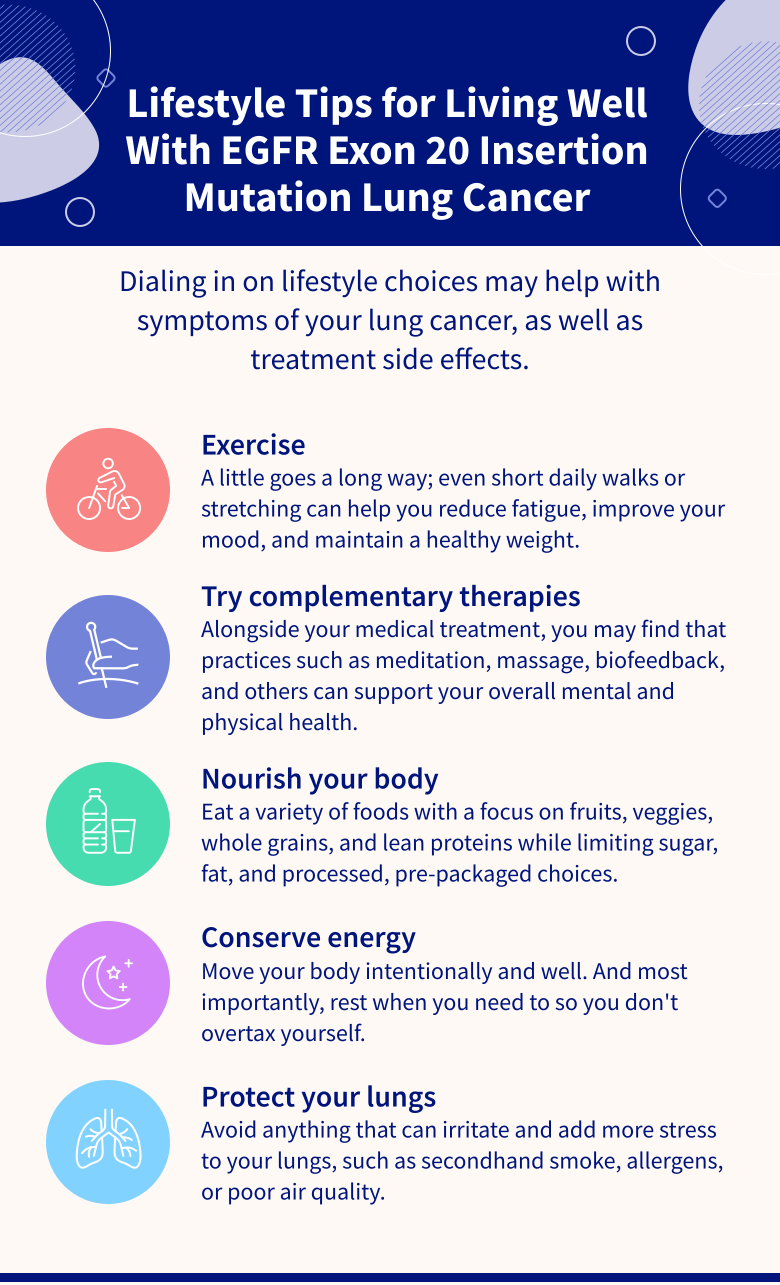
Unfortunately, there isn’t high-quality evidence that any particular dietary strategies or supplements or alternative medications have been shown to extend survival. We certainly don't recommend lifestyle changes or complementary medicines in lieu of the standard approved or anti-cancer treatments. However, I certainly encourage people to stay as active as they can, generally follow a heart-healthy diet, and continue the control of any other comorbid conditions that they may have, including diabetes or high blood pressure. Also know that when you're undergoing chemotherapy and radiation, those treatments have toxicities, and can cause fatigue and other side effects, which your oncology team should be helping you manage.
What are important questions to ask your doctor if you’re diagnosed with NSCLC with EGFR exon 20 insertion mutation?
Ask about your cancer in general, including the type of cancer itself, lung cancer versus other sites, and the stage of cancer and the sites of involvement in your body. Many of these cancers, unfortunately, will be diagnosed in stage IV, which basically just means that the cancer started in a lung and moved somewhere else, whether it's the bone, the brain, the other side of the chest, or the liver. All of those questions will help pinpoint things like diagnosis as well as treatment approach and what to expect. I also think it's important to ask your doctor how your individual characteristics impact their guidance for treatment.
You can imagine that someone who is otherwise healthy and 40 years old is going to be treated and thought about very differently than someone who's 80 with a lot of comorbidities. It's a good question to ask your providers to make sure that, instead of a one-size-fits-all treatment, they’re taking into account you as a person and the characteristics unique to you which may impact your prognosis and treatment decisions.
What’s on the horizon for treating NSCLC with EGFR exon 20 insertion mutation?
This is a very exciting time from a research and innovation standpoint. One of the most exciting general trends in drug development that we're seeing is several oral treatments that have promising signals of effectiveness, including in your brain, which is very important for this disease. The field is rapidly evolving, with new TKIs and bispecific antibodies in development to improve efficacy, address resistance, and target specific Ex20ins variants. Clinical trials are comparing new agents against chemotherapy for initial treatment, aiming for better outcomes. There are also several pill medications that are in clinical trials.