

When you’re doing everything you can to keep your ulcerative colitis (UC) in check, it’s natural to wonder if supplements might help. Maybe your UC treatment doesn’t prevent flare-ups as well as it used to, or it causes side effects. Or maybe you’re concerned that changes in your diet, hunger level, or your body’s ability to absorb certain nutrients are leading to gaps in your nutrition.
If you feel like any of the above applies to you, start a conversation with your regular doctor or gastroenterologist. It’s totally fair game to ask them if taking certain supplements along with your UC treatment is safe for you and worth your time.
“Most of my patients [with UC] take or look into taking supplements because they are looking to feel better. They want a natural approach and a desire for agency that is beyond taking a prescription from their doctor. It gives them a sense of control,” says Michael Dolinger, MD, a gastroenterologist at NYU Langone Health’s Inflammatory Bowel Disease Center in New York City.
If you’ve been doing research online, you might’ve come across rave customer reviews or bold health claims about certain herbal supplements. These include turmeric, aloe vera, boswellia, and wheatgrass. Before you buy into Internet buzz about them, find out what the science and experts say. And always talk to your main doctor, gastroenterologist, or a registered dietitian before you try any new supplement.
Turmeric
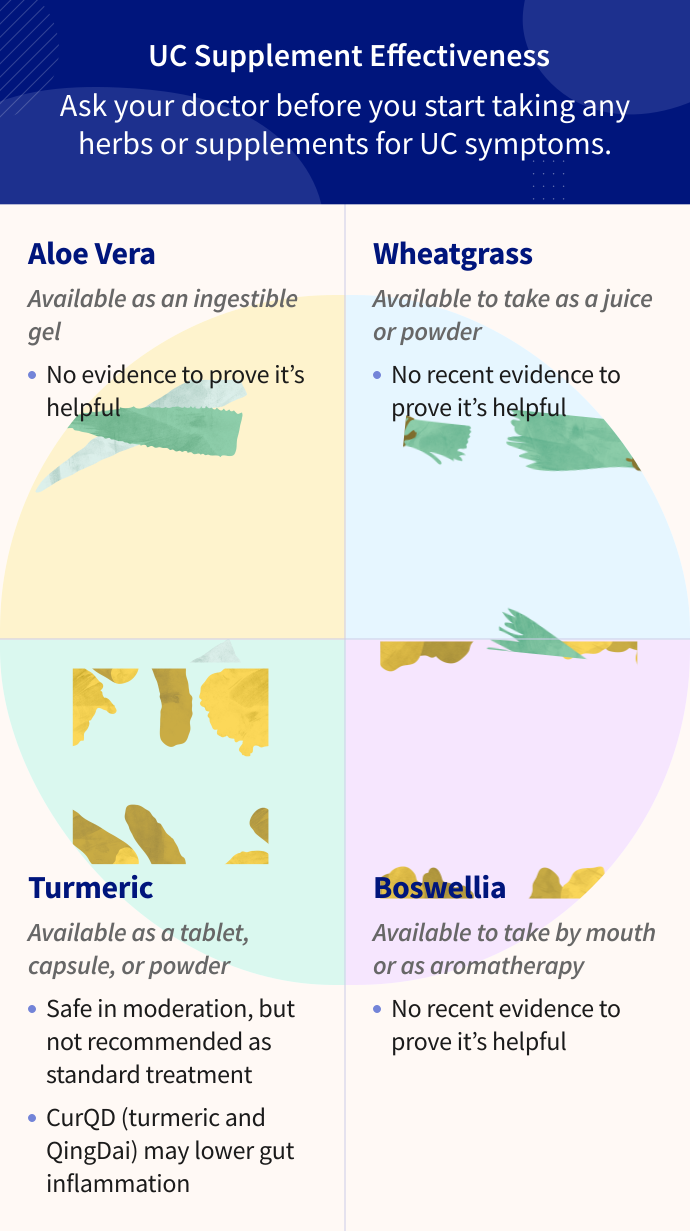
Turmeric is a golden-yellow spice that comes from a plant related to ginger. People use it in foods such as curry. A chemical in the turmeric root called curcumin made the spice a common remedy in certain traditional medicine systems for conditions like indigestion, colds, and stomach pain. UC causes ongoing inflammation in your body, and the curcumin in turmeric may help lower inflammation.
How do you take turmeric or curcumin?
The turmeric that you add to food isn’t going to help against UC. Many studies on turmeric and UC focus on the use of its active ingredient, curcumin, which is taken by mouth as tablets, capsules, softgels, or powder.
In general, experts haven’t yet decided the amount of turmeric or curcumin that might be helpful to take while someone is healthy or ill, says Julie Stefanski, RDN, LDN. She is a spokesperson for the Academy of Nutrition and Dietetics and is based in York, Pennsylvania.
How effective is turmeric or curcumin for UC?
Small studies suggest that taking curcumin along with your UC treatment may safely improve outcomes for people with UC. But bigger and more rigorous studies are needed.
In general, “research suggests turmeric (curcumin) is safe and is an anti-inflammatory,” Dolinger says.
He recommends to some of his patients a supplement called CurQD, which combines curcumin with an herbal compound called QingDai. This, he says, “can be very effective in combination with immune therapies for achieving faster remission and healing in both adults and children with ulcerative colitis.” Small studies have found that people’s UC symptoms improved within a few months of starting CurQD. They also had lower levels of a protein in poop called calprotectin; high levels of this protein can be a sign of inflammation in your intestine.
What side effects can turmeric and curcumin cause?
Like any supplement, turmeric and curcumin can bring on side effects for some people. Taking turmeric supplements by mouth can cause side effects such as:
- Upset stomach and vomiting
- Acid reflux
- Diarrhea
- Constipation
Some curcumin supplements that are made to be absorbed more easily by the body (called high-bioavailability supplements) may be linked to liver damage. Some symptoms of liver damage are:
- Extreme tiredness
- Nausea
- Less appetite
- Dark pee
- Yellowing of your skin, called jaundice
Aloe Vera
Aloe vera is a cactus-like plant that’s grown in hot, dry, subtropical parts of the world. In supplement form, you might already be familiar with aloe gel that’s applied to your skin to soothe the pain of issues such as sunburns. Other types of aloe vera supplements are taken by mouth. Some supplement makers claim their products have anti-inflammatory properties that can help against inflammatory bowel diseases (IBDs) such as UC and Crohn’s disease.
How do you take aloe vera?
The kind of aloe vera that’s been studied for UC comes in gel form. It’s different from the aloe gel that goes on skin. Other commercial aloe products are sold as drinks, concentrates, capsules, and powders.
How effective is aloe vera for UC?
That’s not clear. Researchers haven’t done enough large, well-designed studies in people to find out. Emerging evidence and small studies aren’t significant enough for any major medical groups to recommend aloe vera supplements, Stefanski says. Dolinger agrees that the evidence for aloe vera use is limited.
What side effects can aloe vera cause?
It can cause electrolyte imbalances, Dolinger says. That means the levels of certain minerals in your blood become too high or too low. A major imbalance can lead to dangerous problems such as a coma, seizures, and sudden cardiac death.
Also, taking aloe leaf extracts by mouth for as few as three weeks has been linked to acute hepatitis.
Boswellia
This herbal extract is made from the bark or gum resin of a tree found in mountainous parts of certain countries outside the United States. Some supplement makers claim it eases inflammation.
How do you take boswellia?
This supplement comes in forms that you can take by mouth, place on your skin, or breathe in as aromatherapy. Researchers have given it to people and animals by mouth in small studies.
How effective is boswellia for UC?
That’s unclear. Research on boswellia mainly includes small, older studies, Dolinger says. He urges caution if you are thinking of trying it.
What side effects can boswellia cause?
When boswellia is used in multi-ingredient supplements, side effects have included nausea, diarrhea, and constipation.
Wheatgrass
Wheatgrass refers to the bright green leaves that come from a young wheat plant. It has properties that may help fight inflammation.
How do you take wheatgrass?
Most often, you take it in juice or powder form.
How effective is wheatgrass for UC?
The answer isn’t clear. Similar to boswellia, the evidence for wheatgrass is mainly based on small, older studies, Dolinger says. He recommends being cautious about trying this supplement.
What side effects can wheatgrass cause?
It might cause nausea, loss of appetite, and constipation.
Are There Any Other Supplements or Herbs to Consider?
Yes. You can ask your doctor if the following supplements might be right for you:
Coconut water. A randomized trial showed that coconut water can help “reduce symptoms and calprotectin compared to placebo,” he says.
Probiotics. These supplements contain live microorganisms (microbes) that may help restore the balance of “good” bacteria in your gut. With an inflammatory bowel disease like UC, you tend to have fewer inflammation-fighting gut microbes than someone who doesn’t have UC. Dolinger recommends the probiotic Visbiome or VSL#3 for some of his patients.
Omega-3 fatty acids or fish oil supplements. Some people with UC take these for their inflammatory-fighting properties.
You can also ask your doctor about some vitamin and mineral supplements, such as:
Iron. This is the mineral that people with UC are most likely to be low on, Stefanski says. An iron deficiency tends to be caused by inflammatory blood loss and not getting enough iron from food.
“Ulcerative colitis is a condition in which a daily multivitamin and mineral supplement containing iron is recommended,” she says. Most gummy vitamin products don’t have iron in them, so check the product label to find out what minerals it has, she adds.
Vitamin D. This vitamin plays a key role in the health of your body’s defenses, also called your immune system. When you have UC, it’s a good idea to get your blood levels of vitamin D checked, Stefanski says. The 25-hydroxy vitamin D test can tell your doctor whether you could use a vitamin D supplement, she says.
Calcium. Your calcium levels can drop if your UC treatment includes a steroid, Stefanski says. Over time, steroid use can make it harder for your body to absorb calcium, and it can speed up bone loss. If that’s the case for you, your doctor may recommend calcium, vitamin D, and vitamin K supplements for bone health. Health care providers should aim to prescribe the right balance of those supplements so you don’t take in too much calcium, she says.
Why Is It Key to Check With Your Doctor Before You Try a Supplement?
Supplements are known as complementary treatments because they’re meant to work along with your regular treatment. As Dolinger says, “no supplement replaces standard medical therapy.”
Before you try a supplement, your doctor needs to make sure that it won’t affect (or "interact with") any UC medications you take. Some supplements can interfere with how your body processes UC medications such as mesalamine or biologics, Dolinger says.
What’s more, the FDA doesn’t regulate supplements as closely as it does medications. So, “there are often unregulated amounts of ingredients or filler ingredients used in many substances,” he says.
If you’re thinking about trying an herbal supplement in particular, it’s important to talk to your doctor or a registered dietitian and get your overall health checked first, Stefanski says.
“Many dietary supplements that contain herbs must be eliminated from the body by the liver and the kidneys, the same organs that are breaking down and metabolizing medications,” she says. “These products can interact, especially if the body is dehydrated. Antibiotics and steroids, two very common medications used in GI [gastrointestinal] conditions, have the potential to interact with dietary supplements.”
Currently, she says, “no major medical group that creates guidelines for the treatment of ulcerative colitis [has] recommended supplementation with any herbal supplements, stating that the emerging evidence and small studies are not significant enough to endorse use of products such as wheatgrass, aloe vera capsules, or curcumin supplements.”
“Organizations have not endorsed any supplement regimen to prevent acute flares or to treat a flare once it is occurring,” she adds.
When Should You Not Take Supplements?
Dolinger says there are often a few critical times when he tells his patients to avoid taking supplements:
- Before surgery to lower the risk of blood thinning
- When someone is very sick and in the hospital
- When starting multiple new medicines at once
How Can You Carefully Choose a Supplement?
If your doctor gives you the OK to try a supplement along with your UC treatment, you can ask them to suggest a brand and the amount to take.
Dolinger recommends always checking a supplement bottle for a label or seal that confirms whether it’s gone through third-party testing by an independent group, such as the U.S. Pharmacopeia (USP) or the National Sanitation Foundation (NSF). This helps ensure “that what is on the label is actually what is in the pill,” he says.

 Related Links

