What Is Thymidine Kinase 2 Deficiency (TK2d)?
Thymidine kinase 2 deficiency (TK2d) mainly causes muscle weakness. It’s a very rare mitochondrial disease. Mitochondria are tiny organ-like structures inside your cells that make energy. And if the DNA gets damaged or lost, you can have symptoms.
TK2d is caused by genetic changes in your TK2 gene on chromosome 16q21, explains Angela Lek, PhD, chief research officer of the Muscular Dystrophy Association. The changes stop an enzyme called thymidine kinase from working, which means that it can’t repair the DNA inside your mitochondria.
Only about 600 to 2,700 people have TK2D in the United States, but its effects can be devastating. “Over time, TK2d leads to progressive muscle weakness, first in your arm and leg muscles, then difficulty with swallowing and breathing, and, eventually, early death,” says Lek.
There is some hope, however. In November 2025, a new drug was approved by the FDA to help treat this condition. While it’s not a cure, it can slow the disease’s progress, says Lek.
Types of TK2D
There are three main types of TK2D:
Early onset. This is the most severe form of TK2D. It starts in the first year of life. While early growth and development are usually normal, babies who have it don’t ever learn to walk or lose the ability to walk after they achieve this milestone. Most children with early-onset TK2D end up on a ventilator to help them breathe and only survive for a few years.
Childhood onset. This form appears between the ages of 1 and 12. Symptoms start with muscle weakness in the arms and legs, and then spread to the face. It can cause facial paralysis and droopy eyelids (ptosis). As breathing muscles weaken, some children need a ventilator.
Late onset. People with late onset TK2D develop symptoms in adolescence or adulthood. Symptoms of muscle weakness begin in the limbs and worsen slowly. Most people will require assistive devices such as canes, walkers, and wheelchairs but don’t lose the ability to walk entirely. Many will eventually need to be on a ventilator. On average, people with late-onset TK2D live 20-30 years after the start of their symptoms.
TK2d Causes
Thymidine kinase 2 (TK2) is a gene on chromosome 16. It's in a certain area on the long arm (q21) of the chromosome. It makes an enzyme (protein), TK2, to repair DNA inside your mitochondria.
With TK2d, the TK2 protein can’t repair DNA. When the DNA isn't repaired, it can get lost. And as more mitochondria in your cells lose DNA, it causes muscle weakness throughout your body.
TK2d usually happens when both parents pass down the DNA change. This is known as recessive inheritance. In this case, a baby has a 1 in 2 chance to carry one DNA change and a 1 in 4 chance for TK2d.
TK2d Symptoms
TK2D symptoms can depend on which type of TK2d you have or your child has:
Early-onset TK2d. You may notice that your baby has:
- Low muscle tone or weakness
- Trouble feeding
- A hard time breathing (may need a ventilator)
- Hearing loss
- Seizures
- An eye that droops on one side (ptosis)
- Problems reaching certain social, mental, or physical milestones (developmental delay)
- Mental confusion or agitation (encephalopathy)
- Problems standing up (may use their hands to “walk” up their legs, called Gower sign)
Most infants with TK2d do not learn to walk but can use a wheelchair to get around. Other clinical problems can include heart problems (cardiomyopathy), anemia, or skin problems.
Childhood-onset TK2d. These symptoms progress somewhat rapidly, but slower than infants. The main sign is muscle weakness in the arms, legs, and face. Your child can have Gower sign – using their hands to “walk” up their legs when standing up.
You may also notice eye problems like droopy eyelids (ptosis) or trouble moving their eyes. Most children need a wheelchair by age 10, and eventually, a ventilator.
A few children also get problems that aren’t muscle related. They can have things like hearing loss, memory loss, or bone breaks and fractures.
Late-onset TK2d. Signs for TK2d later in your teen years or even adulthood were often present in your childhood. The symptoms were likely mild or went undiagnosed.
Typically, your facial muscles can weaken and your scapula (shoulder blade) bones stick out. You may also notice that you have:
- Weak shoulder, arm, hip, and thigh muscles
- Drooping eyelids (ptosis)
- Trouble moving your eyes
- Difficulty swallowing and talking
Sometimes you may have changes in the sound of your voice (dysphonia) or slurred speech (dysarthria). You can also get problems with your heart, hearing loss, or nerve damage in your hands or feet (peripheral neuropathy).
TK2d Diagnosis
Your doctor or your child’s pediatrician may suspect TK2d if muscle weakness in the arms, legs, and face shows up. It often comes with respiratory issues and eye problems, too. “Generally, when a health care provider notices unexplained muscle weakness, they will refer the patient to a neurologist,” says Lek.
Since people with TK2d may have symptoms in many different body systems, they may often be misdiagnosed with other conditions like spinal muscular atrophy (SMA) or muscular dystrophy.
Tests for TK2d
The following tests can help diagnose TK2d:
- Blood tests check your liver enzyme levels and a muscle enzyme (creatine kinase). High levels may point to TK2d.
- A muscle biopsy (a small sample of muscle tissue) checks for abnormal muscle tissues (ragged red fibers), other enzymes, and measures mitochondrial DNA, too.
- An electromyography (EMG) test measures your muscle function.
- Genetic tests look for DNA changes to see if you have TK2d.
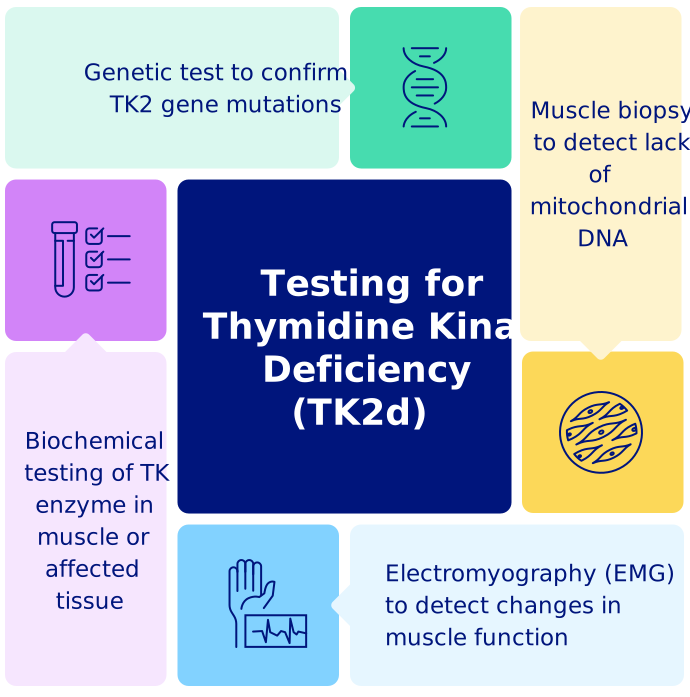
Since TK2d is so rare, not all gene tests check for it. Your doctor may order whole-exome or whole-genome sequencing tests so they can check large segments of your DNA. It’s the only way to know for sure.
Questions for Your Doctor
A diagnosis of TK2d can be overwhelming. Talk with your medical team so you can put together the best care plan. Here are some things you can ask during your doctor visit:
What is TK2d exactly?
They can explain the condition and its symptoms. Your doctor can discuss how TK2d impacts your body.
Does anyone else in my family need to get tested?
TK2d is passed down (inherited) from parents to children. So other family members like siblings may want to get tested, too.
Your doctor can discuss what a carrier is and what that means. Your family may also want to know if they’re carriers.
What are the treatment options?
A new drug, Kygevvi (doxecitine and doxribtimine), will be available in the first quarter of 2026. It’s the first medication specifically FDA-approved for the condition.
Other treatments that will help you manage symptoms include physical and occupational therapy, assistive devices like walkers, and cochlear implants for hearing loss.
Are there any clinical trials available for TK2d?
Your doctor can answer any questions about clinical trials. They can also direct you to clinical trials in your area and help you find resources, too.
Where can I find support to help manage TK2d?
Your doctor can refer you to other specialists. Specialists are doctors that treat a specific area of your body. Your doctor may also suggest seeing physical, occupational, and speech therapists. They can also refer you to organizations, support groups, or point you to local resources that can help.
Finding Expert Care
Since TK2d is such a rare condition, it can be hard to find expert care. Here are a few resources to help you locate specialists near you:
Since you may have many health care appointments, you’ll want to keep careful medical records. These two resources can help you manage your medical journey:
- MitoAction Mobile is an app that allows you to track your symptoms, medications, and doctor’s appointments.
- mitoSHARE is an online registry that also includes tools to track symptoms, medications, and doctor appointments.
TK2d Treatment
There is no cure for TK2d, but treatments can help. Different therapies help stabilize and manage your symptoms. Your medical provider may suggest the following:
First approved treatment for TK2d
Kygevvi is a medicine to treat TK2d that is specifically approved for adults, teens, and children whose symptoms appeared before age 12. It combines two medications, doxecitine and doxribtimine. These medicines are the normal building blocks for DNA, also called pyrimidine nucleosides.
These DNA building blocks help replace the missing energy in your mitochondria. This may help your muscles work better and get stronger.
Research shows that people who take Kygevvi have a greatly reduced risk of death. And they live almost twice as long, on average, as people who don’t take Kygevvi. “We really want to see as many patients access Kygevvi as possible because we know it can significantly slow down progression of the disease,” says Lek.
Side effects of Kygevvi include:
- Belly pain
- Vomiting
- Diarrhea
- Elevated liver enzymes, a sign of inflammation
Supportive care for TK2d
While there’s no cure, assistive devices can help make TK2d more manageable. You may get help from one or more of these options:
- Adaptive utensils to help make it easier to eat
- Back braces to help you sit, stand, and walk
- Breathing support devices like continuous positive airway pressure (CPAP) and bilevel positive airway pressure (BiPAP) machines
- Communication devices like hearing aids or iPads to allow text to speech
- Feeding tubes to help you swallow
- Orthotics to help you walk
- Walkers or wheelchairs to help you move easier
Experimental therapies for TK2d
Experimental therapies have not been approved yet. The medicines are still being studied for TK2d to see if they work.
Nucleoside therapy for TK2d. This therapy is still being studied for TK2d in clinical trials. The treatment supplies nucleosides for your body. Nucleosides are the building blocks of DNA. Studies report it may help mitochondrial DNA renew and stay strong.
Research suggests early nucleoside treatment can stop TK2d from getting worse in kids with early-onset disease. This therapy may also help adults, but the studies weren't clear. So researchers continue to test this medicine.
Another nucleoside therapy, called MT1621, is being studied in clinical trials. Researchers hope it will help mtDNA and cell function. Although not FDA approved, you may be able to get it in a clinical trial.
Gene therapy. This treatment isn't available and is being studied for TK2d. The goal is to replace your TK2 gene changes with new (functional) copies. Although studies suggest it's successful in mice, gene therapy hasn’t been done in humans.
TK2D Complications
The main problems for TK2d happen slowly, over time. Your muscle weakness may get worse as you get older. Or it can be mild. And your symptoms may make it harder or even impossible to walk, eat, or breathe.
In time, your lungs may not get enough oxygen. Or a group of life-threatening symptoms may develop. But it can depend on your type of TK2d, too.
Early-onset symptoms that can cause problems may include:
- Brain inflammation (encephalitis)
- Mental or developmental delay
- Hearing loss
- Seizures
Childhood onset TK2d symptoms can cause problems like:
- Facial paralysis
- Droopy eyelids
- Trouble moving the eyes
Late-onset TK2d can lead to problems such as:
- Scapular winging (shoulder blades weaken and your blades can stick out)
- Droopy eyelids
- Trouble moving your eyes
Taking Care of Yourself
While life with TK2d can be challenging, there are things you can do to make things easier. Here are a few things that may help:
What to Expect
TK2d causes muscle weakness that slowly worsens over time. Gene changes in your TK2d gene mean you can lose mitochondrial DNA — mtDNA — from damage. Your mitochondria may not work as well as they should. As the amount of mtDNA goes down over time, your muscles can lose energy.
TK2d usually starts as muscle weakness in your arms and legs. Later, you can have problems with your breathing and eye muscles. The muscles you use to chew, speak, and swallow may also get tired or weak.
These include physical, occupational, speech, and respiratory therapy. Therapists can help you keep your muscles strong. They’ll show you how to use your muscles the best way. And the exercises can maximize your quality of life.
A nutritionist may also help. They'll make sure you get the nutrients your body needs. Certain supplements may also be doctor-recommended. The goal is to manage symptoms and slow your disease and its impact.
How Your Condition Might Change Over Time
TK2d advances very rapidly in babies with early-onset TK2d. Most only live a few years. It happens more gradually with childhood-onset TK2d. Many children live until their teen years. If TK2d starts late, many adults live about 23 years after their symptoms first appear.
“The hope is that now that Kygevvi is available, patients will be able to start it as soon as they are diagnosed with TK2d and dramatically slow down the condition’s progression,” says Lek. “In the clinical trials, we saw that some patients who were on ventilators were able to go off of them, and others were able to discontinue the use of feeding tubes. While not everyone had such dramatic results, almost across the board it was very positive for patients.”
Getting Support
You can always find resources about TK2d and connect with families at websites like MitoAction, CureMito, or take on TK2d. The United Mitochondrial Disease Foundation is another great place to connect and find support, too.
Caring for Your Emotional Health
If you live with TK2d, or you are the parent of a child with the condition, it can impact every aspect of your life. You may need to create some time for yourself. Even a small daily action can go a long way to help you recharge. Here’s what you can do:
Focus on the basics. Make sure to get enough sleep. Eat healthy foods, exercise regularly, and stay hydrated. All these actions can help give you the physical and emotional strength you need to advocate for your child.
Follow a script. It can also help to have a few rehearsed “scripts” ready whenever you’re in a stressful moment. These can be simple, like reminding yourself that you’re a good parent.
Or tell yourself that you’re doing your best or that you need to slow down. Try to take five deep breaths before you respond to a situation.
Do a daily self-care moment. Take at least 5 to 10 minutes a day — do something good for yourself. Consider it a daily self-care snack. Some options include:
- Use a meditation app for a quick mindfulness or meditation exercise.
- Call a loved one for a quick hello.
- Listen to a favorite song.
- Read a few pages of a book you enjoy.
- Play a quick game on your smartphone.
Instead, use that extra time to check in via a phone call or text to people who care about you.
Information for Caregivers
Research shows that parents of children with a mitochondrial disease such as TK2d often feel guilt, worry, sorrow, anger, and stress. Here are some ways to both support your child and yourself:
Make a list of tasks to get done. Prioritize the ones you are most concerned about. It will help you figure out what needs to get done right away and what can wait. If possible, group them into categories like personal care, transportation, chores, and errands.
Write down worries. You may have financial concerns about your child’s medical expenses. Or you might find that you struggle with balancing the needs of all your children. You may be fearful that no one else will be able to care for your child if you get sick. The first step is to write these worries down so you can begin to come up with solutions.
Don’t be afraid to ask for help. It helps to be as specific as possible. For example, are there specific chores or tasks you could ask family members or close friends to do? Can you afford to hire outside help, so that you can be present for your other children? Is crowdfunding an option to help with medical bills?
Join a support group. It can really help to speak to other families who have shared experiences. Groups like Mito Action host local meetups so you can connect with other patients and their caretakers. The United Mitochondrial Disease Foundation also provides monthly support groups. They can also connect you with a support ambassador, which is someone who lives in your area who can connect you to various resources.
Takeaways
Thymidine kinase 2 deficiency is a very rare mitochondrial medical condition. Changes to the TDK gene on chromosome 16q21 can cause life-threatening muscle weakness that slowly worsens. A new medicine, Kygevvi, was approved in November 2025 for patients whose symptoms appeared before the age of 12 and has been shown to reduce risk of death. Physical, occupational, speech, and respiratory therapy can also help you walk, speak, eat, and breathe with assistance.
TK2D FAQs
What are the symptoms of mitochondrial damage?
Signs of mitochondrial damage include muscle weaknesses, poor growth, poor vision, and hearing loss. Developmental delay, seizures, migraine, and life-threatening breathing problems are common, too. They can start at birth or at any time.
Can you develop mitochondrial disease like TK2d later in life?
You can develop mitochondrial disease like TK2d at any point in your life. If you have TK2d, the earlier your diagnosis, oftentimes the more serious your symptoms are and the faster the disease may progress.
What are nutraceuticals or mito cocktails for TK2d?
Mito cocktail is a nickname for nutraceuticals. This refers to supplements that some doctors may recommend for your TK2d.
Some of the most common ones include coenzyme Q10, B vitamins, L-carnitine, creatine, and alpha lipoic acid. Always talk to your doctor before trying any supplement, including nutraceuticals.