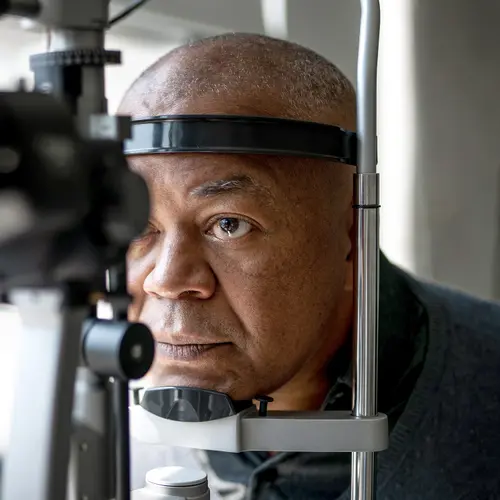
Age-related macular degeneration (AMD) is an eye condition that can affect central vision, which is the vision used for activities such as reading and recognizing faces. In people with wet AMD, abnormal blood vessels grow under the macula, the part of the retina responsible for central vision. These blood vessels can leak blood and fluid, which may lead to vision loss.
Lytenava (bevacizumab-vikg) is a medicine used to treat wet AMD. It is given as an injection into the eye about once a month. Lytenava is a type of medicine called a vascular endothelial growth factor (VEGF) inhibitor.
Below are common questions and answers about Lytenava, including how it works, how it is given, what benefits were seen in studies, and what risks it carries.
How Does Lytenava Work for Wet AMD?
Wet AMD is linked to the growth of abnormal blood vessels under the retina. These blood vessels can leak blood and fluid, which can damage the macula and affect central vision.
A protein called VEGF helps these abnormal blood vessels grow and leak. Lytenava binds to a form of this protein called VEGF-A and blocks it from activating certain receptors on blood vessel cells.
By blocking VEGF-A, Lytenava helps slow the growth of abnormal blood vessels and reduce leakage. This targets one of the processes that leads to vision loss in wet AMD.
Lytenava contains a medicine called bevacizumab, which is not a completely new medicine. Other bevacizumab products have been FDA-approved for years to treat certain cancers. Lytenava is a formulation of bevacizumab made specifically for use in the eye and approved to treat wet AMD.
How Is Lytenava Given?
Lytenava is given by a specially trained eye doctor (ophthalmologist or retina specialist) as an intravitreal injection, which means the medicine is injected into the fluid inside the eye.
Eye injections may sound scary, but knowing what happens during the procedure can make it easier to know what to expect.
Before the injection, your eye will be numbed to make the procedure more comfortable. Your eye doctor will also apply an antiseptic to your eye and eyelids to help lower the risk of infection. Using a small device to hold your eyelids open, they will ask you to look in a certain direction and then use a very thin needle to inject the medicine through the white part of your eye.
After the injection, your eye doctor will check your eye for any problems. Your eye pressure is also checked before and after treatment because it can rise for a short time after an intravitreal injection.
The injection itself is usually quick, although the full visit may take longer because of eye exams, dilation, or other testing. Plan to have someone come with you to help you get home because temporary vision changes can happen afterward. Do not drive or use machinery until your vision has recovered enough to do so safely.
The recommended treatment schedule for Lytenava is once a month (about every 28 days). If both eyes need treatment, your eye doctor may treat both during the same visit. Each eye needs a separate injection. Your eye doctor can give you more information about what to expect and how long your treatment may continue.
How Was Lytenava Studied for Wet AMD?
A clinical trial called NORSE TWO was done to test how well Lytenava worked for treating wet AMD.
To enter the study, people had to be 50 years or older and have active wet AMD that had not previously been treated in the eye that was being studied. The abnormal blood vessel growth had to affect the area under the center of the retina and show signs of active leakage or swelling on eye imaging. Vision in the studied eye also had to fall within a specific range on a standardized eye chart.
People were not allowed to join the study if they had already been treated with certain eye injections, laser procedures, surgery, or other treatments for AMD. They were also excluded if they had some other eye conditions or infections that could affect the results or require treatment during the trial.
The study included 228 adults with wet AMD from across the United States. People in the study were 54-98 years old, with an average age of 79 years. About 60% were women, and about 40% were men. Most were White (nearly 98%), about 1% were Asian, no participants were Black, and less than 1% had an unreported race.
Participants were randomly assigned to one of two treatment groups:
- 113 people received Lytenava once a month for up to 12 months.
- 115 people received ranibizumab once a month for the first three months, followed by two more doses about three months apart. Ranibizumab is another medicine used to treat wet AMD.
Neither the participants nor the researchers who examined their eyes knew which treatment each person was receiving.
The main goal of the study was to see how many people gained at least 15 letters on a standard vision test after 11 months. A gain of 15 letters is about three lines on an eye chart.
The study also looked at other measures of vision, including:
- Average change in vision from the start of the study
- How many people gained at least 5 or 10 letters
- How many people avoided losing 15 or more letters
- How many people had vision of 20/200 or worse at the end of the study
What Are the Benefits of Lytenava Based on Studies?
After 11 months, people using Lytenava saw greater improvements in several measures of vision than those using ranibizumab.
- More people gained at least three lines of vision. About 42% of people treated with Lytenava gained at least 15 letters on the eye chart, compared with about 23% of people treated with ranibizumab.
- Average vision improved. People using Lytenava gained an average of about 11 letters from the start of the study to month 11, compared with about six letters among those using ranibizumab.
- A few people had extreme gains or losses, which can skew an average. After adjusting for this, those treated with Lytenava still improved more — by about five to eight letters more than those treated with ranibizumab.
- More people gained smaller amounts of vision. About 69% of people using Lytenava gained at least five letters, compared with 51% of people using ranibizumab. About 57% of the Lytenava group gained at least 10 letters, compared with about 35% of the ranibizumab group.
- Most people avoided a large loss of vision. About 94% of people using Lytenava lost fewer than 15 letters by month 11, compared with about 83% of those using ranibizumab. At 12 months, about 86% of Lytenava-treated eyes had maintained or gained vision compared with the start of the study.
One important point when comparing the groups is that Lytenava and ranibizumab were given on different schedules in NORSE TWO. Lytenava was given every month, while ranibizumab was given monthly for the first three months and then less often.
In another clinical study called NORSE EIGHT, 400 adults with wet AMD received Lytenava or ranibizumab every four weeks for three doses. Vision improved in both groups after eight weeks, but the study did not meet its prespecified goal of showing that Lytenava was not meaningfully worse than ranibizumab.
Overall, many participants in the NORSE TWO trial experienced improved or maintained vision with treatment. Your results may be different from the study results. Your eye specialist can help you decide whether Lytenava may be an option for you.
Is Lytenava Safe?
Lytenava was generally well tolerated in clinical studies, but some side effects and serious risks are possible.
The most common side effect of Lytenava is bleeding of the thin, clear membrane covering the white part of the eye. This occurred in about 4% of people in clinical studies. Eye pain and floaters each occurred in about 2%. Less common side effects included a scratch on the cornea, dry eye, eye irritation, and increased eye pressure.
More serious risks can include infection inside the eye, retinal detachment, inflammation inside the eye, and increased eye pressure. VEGF-blocking medicines may also carry a risk of serious blood vessel problems, such as heart attack or stroke, although these events occurred at a low rate in Lytenava studies. Contact your health care provider or seek care right away if you have new vision changes or if your eye becomes red, painful, or sensitive to light.
Lytenava should not be used if you have an infection in or around the eye, active inflammation inside the eye, or a serious allergy to bevacizumab or any ingredient in Lytenava. It may also pose a risk during pregnancy. If you can become pregnant, use effective birth control during treatment and for at least three months after your last dose.
Your health care provider can review your medical history, eye health, and other risk factors to help decide whether Lytenava is a safe option for you.