
When you have advanced dry age-related macular degeneration (AMD), also known as geographic atrophy (GA), it may affect your central vision. While most people with AMD never get GA, most of the time, GA will affect both your eyes if you do get it, but often one eye is worse than the other. You may have blind spots. You may notice your vision isn't as sharp as it was before.
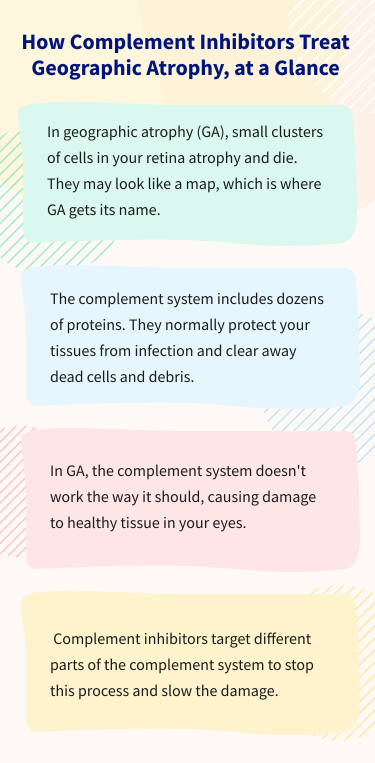
It's not clear exactly why some people with AMD get GA and others don't. It likely involves a complex combination of genetics and your environment. No matter what the risk factors or triggers are, GA happens when part of your innate immune system works excessively. If the part of your innate immune system called the complement system is too active, it encourages inflammation. You may get more deposits in your eyes called drusen in dry AMD. Instead of fighting infections and clearing away dead cells or other debris, part of the complement system called the membrane attack complex may start damaging healthy cells in your retina, leading to progressive vision loss.
Before 2023, doctors didn't have any treatments specifically for GA. Options included visual aids to help with vision loss and changes. Doctors also used supplements to help with GA.
The important role of the complement system in driving GA and worsening vision loss makes it a good target for medicines to stop the process. Because the complement system includes many proteins, there are lots of potential targets. In recent years, the FDA has approved two complement inhibitors for GA.
It's important to remember that GA varies from one person to the next. If you or a loved one has GA, they may progress at different rates. Talk to your doctor about the best way to treat your GA and whether they recommend you try a complement inhibitor to slow the process.
Complement inhibitors can't cure your GA. They also come with side effects and safety concerns. When making any treatment decision, it's important to ask questions so you can weigh the pros and cons of treatment to make a decision that's right for you.
How Do They Work?
Which Complement Inhibitors Are Used to Treat Advanced Dry AMD (Geographic Atrophy)?
Researchers and doctors continue to study ways to treat GA. Today, you have two complement inhibitor options. They both target the complement system in different ways. Your complement inhibitor treatment options include:
Other therapies that may help with GA include:
- Visual aids and rehabilitation
- Antioxidant-containing supplements (AREDS2)
- Implantable devices
What Is Pegcetacoplan (Syfovre)?
Pegcetacoplan (Syfovre) was the first complement inhibitor approved for advanced dry AMD or GA in February 2023. The same drug was originally approved to treat a blood disorder called paroxysmal nocturnal hemoglobinuria (PNH), which also involves the complement system.
Pegcetacoplan targets part of the complement system known as C3. C3 is a central player in the network. That means targeting C3 affects three different pathways within this system.
When these pathways are activated, it causes the complement system to clear away more infectious, foreign, or damaged materials and cells. But it also causes inflammation. When this happens more than it should in GA, it can damage healthy cells in your retina you need for your vision.
Pegcetacoplan blocks C3 to reduce complement activation, which may slow damage and progression of GA.
What Is Avacincaptad Pegol (Izervay)?
The FDA approved avacincaptad pegol (Izervay) later the same year, in August 2023. It targets the complement system in a different way. Instead of targeting C3, this medicine targets complement factor 5. The C5 factor had been shown to play an important role in the inflammation in AMD.
People with AMD have higher levels of C5 in their bloodstream, too. By blocking the formation of C5, it may reduce inflammation to slow the progression of GA.
How Do You Take Complement Inhibitors?
If you decide to start treatment with a complement inhibitor, you'll see your retina specialist regularly for shots into your eye. Your doctor might call these intravitreal injections.
Here's what to expect at your appointment:
- Your doctor will use another medicine to numb the surface of your eye.
- They'll use an antiseptic to clean the surface of any germs that could cause an infection.
- Your ophthalmologist will either hold your eye open or use a device to keep it open.
- They'll use a thin needle to deliver the medicine to your eye.
- They'll clean the surface of your eye again.
In most cases, the whole process takes 10 or 15 minutes though an entire visit may take up to 90 minutes.. Before your first injection, ask your eye specialist what you can expect.
Some Things You Should Consider
How Effective Are Complement Inhibitors?
The FDA approved pegcetacoplan (Syfovre) and avacincaptad pegol (Izervay) based on evidence from clinical trials showing that they were both safe and effective. Two phase III clinical trials testing pegcetacoplan included more than 1,200 patients ages 60 and up with GA secondary to AMD. Some people in the trial got the complement inhibitor while others got a placebo instead.
Researchers looked to see how treatment versus the placebo worked by measuring changes in the growth of GA lesions over 12 months. The results of the trials were mixed. One trial failed to show a significant effect on progression. The other showed pegcetacoplan slowed progression by 21% when given once a month and 16% when given every other month. But the trials failed to show that the treatment helped to slow vision loss after two years. More study is needed to understand long-term outcomes.
Clinical trials of avacincaptad pegol included people as young as 50 who received either the medicine or a placebo monthly. They looked at the progression of changes in GA lesions, at six months and a year.
The trial showed 27% less progression at one year for those receiving the complement inhibitor, compared to the placebo. Another trial testing only a lower dose showed a 14% difference in the progression of GA lesions at a year between the two groups.
The study didn't show a delay in vision loss. Since these medicines are relatively new options for treating advanced dry AMD, more study is needed to understand the benefits and risks of complement inhibitor treatment for GA over longer periods of time and which patients are most likely to benefit.
Are Complement Inhibitors Safe?
The FDA approved pegcetacoplan (Syfovre) and avacincaptad pegol (Izervay) based on evidence that they are both safe and effective enough for treating GA. But all medicines come with benefits and risks.
The treatment will be most helpful if your GA is otherwise progressing rapidly. If you're thinking about complement inhibitors for your GA, ask your doctor about any safety concerns you should consider and how likely the treatment is to improve your outcome.
What Are Common Side Effects?
The most common side effects of pegcetacoplan (Syfovre) include:
- Discomfort
- Wet AMD
- Floaters in your eyes
- Inflammation of blood vessels in your eyes
The most common side effects of avacincaptad pegol (Izervay) include:
- Inflammation of blood vessels in your eyes
- Increased pressure in your eyes
- Blurred vision
- Wet AMD
Complement Inhibitor Complications
Pegcetacoplan (Syfovre) and avacincaptad pegol (Izervay) also come with risks and warnings for:
- Severe inflammation and infection in your eyeball (endophthalmitis)
- Retinal detachments
- Increased intraocular pressure
Infections related to treatment involving eye injections can lead to permanent vision loss. Talk to your doctor about the benefits and risks to decide the best treatment plan for you. Ask them about any complications to look out for and what you should do if you notice any worrying symptoms or changes in your eyes or vision.
If you think you're having an adverse reaction to either complement inhibitor treatment, let your doctor know right away. You can also report it to the FDA at 800-FDA-1088 (800-332-1088) or www.fda.gov/medwatch.
Who Should Not Take Complement Inhibitors?
Pegcetacoplan (Syfovre) isn't recommended if you have an infection or active inflammation in your eyes. You shouldn't use it if you are allergic or hypersensitive to the medicine.
Avacincaptad pegol (Izervay) also should be avoided when you have an infection or swelling in or around your eye. Let your doctor know if you have any eye pain or redness.
Before receiving a complement inhibitor for GA, you should also let your doctor know if you:
- Are seeing flashes of light or floaters
- Have sudden changes in your vision
- Have high pressure in your eye or glaucoma
- Are pregnant or breastfeeding
- Are taking other medicines or supplements
How Much Do Complement Inhibitors Cost?
The cost for either pegcetacoplan (Syfovre) or avacincaptad pegol (Izervay) is over $2,000 per monthly or bimonthly dose, which you'll need to continue indefinitely.
But your out-of-pocket costs will depend on your health insurance and how much prescription drug coverage you have. It's possible you'll need prior authorization to get a complement inhibitor for your GA covered. It's always a good idea to check with your insurance company before starting a new medicine so you know what they'll cover.
If your insurance won't cover the cost or you can't afford your out-of-pocket costs, ask about financial assistance programs. Many organizations and drug companies offer assistance to help with treatment costs.
Clinical Trials of Complement Inhibitors
Because the complement system includes dozens of proteins, there are many possible treatment targets. Researchers are working to develop next-generation complement inhibitors that may work even better or more safely for many health conditions involving the complement system, including GA.
Researchers and doctors are also developing other treatment options for GA that work in different ways. Ask your doctor if you'd be a good candidate for a clinical trial. You can look for clinical trials testing new complement inhibitors or other GA treatments by searching at ClinicalTrials.gov.
Questions for Your Doctor
If you're thinking about starting treatment with a complement inhibitor for your GA, here are some good questions to ask your doctor:
- Should I start treatment with a complement inhibitor? Why or why not?
- Which complement inhibitor do you recommend for me and why?
- How will I know if a complement inhibitor is working?
- Will complement inhibitor treatment for GA stop me from losing my vision?
- What side effects and risks come with these treatments?
- Can treatment for my advanced dry AMD lead to wet AMD? How big of a concern is this?
- Should I consider other treatment options or a clinical trial?
What to Know if You're a Caregiver
Caring for someone with advanced age-related macular degeneration and geographic atrophy is challenging. Your loved one may need help with low vision. They may need help understanding the condition and how best to treat it. They may need assistance with everyday tasks and more. Caregivers need support, too. Organizations, such as Bright Focus and Macular Degeneration Research, offer information and resources for caregivers.