Everyone’s experience with pancreatic cancer is different. This pancreatic cancer progression timeline shows how symptoms, treatment, and care may change over time. Your treatment plan depends on where the tumor is in your pancreas, whether it has spread, if surgery is possible, and other factors. Because of this, your treatment may change as pancreatic cancer progresses.
Your symptoms can also change as treatment begins to work or the cancer gets worse. Knowing how pancreatic cancer treatment by stage may change can help you better understand the care you might receive over time.
What to Expect at Diagnosis
If your doctor thinks you might have pancreatic cancer, they'll perform several tests to confirm the diagnosis. And once they confirm it, they'll also test for genetic mutations that can help guide treatment decisions.
Imaging tests
Depending on your symptoms, your doctor may order a computed tomography (CT) scan or an ultrasound of your abdomen (belly area) to look at your pancreas and nearby organs. Doctors may also use magnetic resonance imaging (an MRI) or an endoscopic ultrasound (EUS) to get detailed images of the digestive tract.
Biopsy
To confirm a cancer diagnosis, doctors usually take a small tissue sample. They do this using a thin needle that goes through an endoscope during an EUS procedure.
Blood tests
Doctors look for certain substances released by cancer cells. One example is CA 19-9 (carbohydrate antigen 19-9), a protein that can be measured with a blood test. CA 19-9 levels may help doctors look for signs of pancreatic cancer and monitor how it responds to treatment.
Molecular and genetic testing
Doctors will test the biopsy tissue for specific gene changes. This helps the team identify the best treatments, such as targeted therapies or immunotherapy, that target the tumor's unique features.
How Tumor Location Affects Symptoms and Treatment
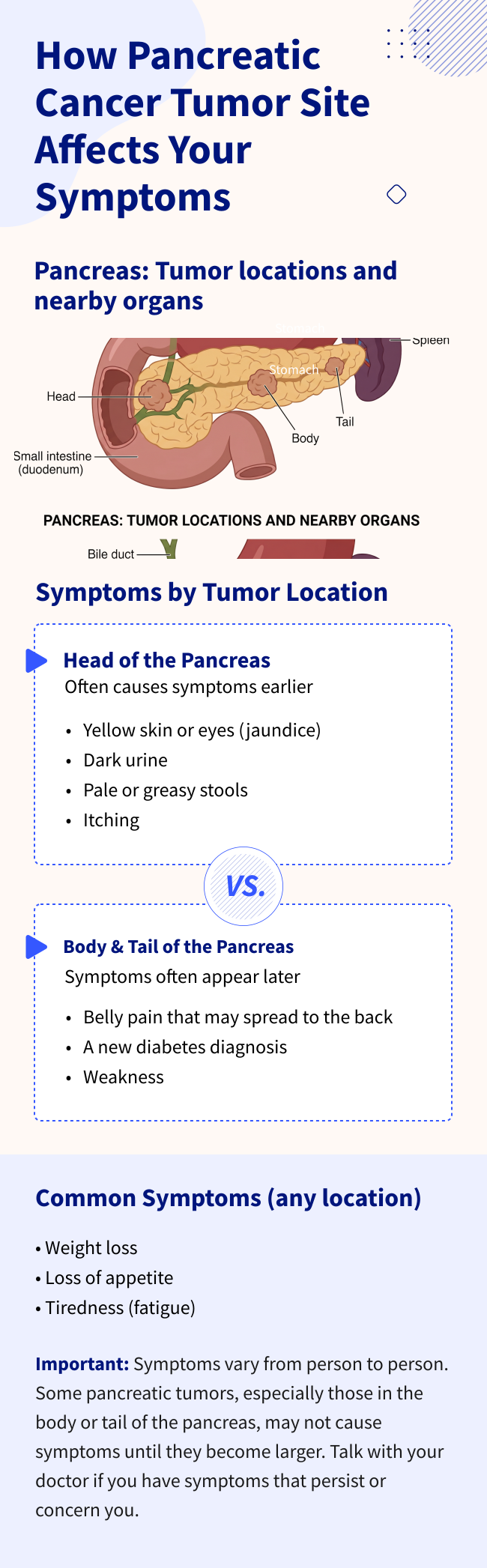
Cancerous tumors can form in different parts of your pancreas, which affects your symptoms and treatment plan.
Tumors in the head of the pancreas
Most pancreatic cancers, around 70%, happen in the head of the pancreas. Since the head is near your bile duct, tumors in this area often block bile flow and can compress your stomach or small intestine. This can lead to:
- Jaundice (yellowing of the skin and eyes)
- Dark-colored pee
- Pale or greasy poop
- Itchy skin
- Feeling sick to your stomach and throwing up
- Weight loss
If surgery is a treatment option, your doctor may remove the head of the pancreas, part of the small intestine, the gallbladder, and part of the bile duct. Sometimes, the stomach needs to be removed. This operation is called the Whipple procedure.
Tumors in the body and tail of the pancreas
Tumors can also form in the body or tail of the pancreas, which is in the middle section and the long, thin end that stretches toward the spleen. Since these sections don't block the bile duct as early, tumors in this area are often "silent" when small and can grow to be large. Symptoms usually appear only when a tumor presses on nearby nerves or organs.
Symptoms of a tumor in these areas of the pancreas include:
- Unexpected weight loss
- Dull, aching pain in your upper abdomen that spreads to your mid-back
- Diabetes that develops suddenly
- Loss of appetite
- Weakness
- Tiredness
Surgery for this type of tumor involves removing the body and tail of the pancreas, and often your spleen (called a distal pancreatectomy).
How Diagnosis Impacts Treatment Options
A diagnosis of pancreatic cancer plays an important role in helping your doctor to figure out treatment options, including whether they can remove it with surgery or whether you'll need a different treatment such as chemotherapy or targeted therapy.
Pancreatic cancer stages
Imaging tests like a CT scan or MRI help classify tumors into four main groups, or stages:
- Resectable. The tumor is only in your pancreas and has not spread to major blood vessels.
- Borderline resectable. The tumor is close to or slightly affects nearby blood vessels.
- Locally advanced. The tumor has grown into important blood vessels or nearby structures.
- Metastatic. The cancer has spread to distant organs, such as your liver or lungs.
Pancreatic Cancer Treatment by Stage
Understanding where your cancer falls within the pancreatic cancer progression timeline helps doctors choose the right treatment approach.
Once your doctor knows the stage of your cancer, the next step is to figure out treatment. Here's what your treatment could look like at each stage of pancreatic cancer:
Stages 1 and 2: Resectable and borderline resectable
At these early stages, the tumor is still in your pancreas and hasn't spread to big blood vessels or other parts of your body. Your doctor's main goal is to remove the cancer completely.
- Pre-surgery treatment. Also called neoadjuvant therapy, this is treatment you receive before surgery. It usually includes chemotherapy, with or without radiation therapy. The goal is to shrink the tumor and make it easier to remove during surgery.
- Surgery. Depending on the location of the tumor, you have two main options for surgery: the Whipple procedure, which removes the head of the pancreas and nearby organs, or a distal pancreatectomy, which removes the body and tail of the pancreas.
- Post-surgery treatment. Called adjuvant therapy, this is the treatment you receive after surgery. It may include chemotherapy or chemoradiation to destroy any remaining cancer cells and lower the risk of the cancer coming back.
Stage 3: Locally advanced
Stage three pancreatic cancer means the tumor has grown into nearby major blood vessels or nerves, which makes it impossible to remove with surgery.
- Chemoradiation. This treatment uses a combination of chemotherapy and radiation therapy to help shrink the tumor and control its spread.
- Targeted therapy or immunotherapy. For tumors with specific genetic changes, doctors use targeted therapies to focus on certain molecules and slow down or stop tumor growth.
Stage 4: Metastatic
When cancer spreads to distant organs like your liver, lungs, or belly, treatment changes. Instead of aiming to cure the cancer, the focus shifts to therapies for your entire body (systemic therapy) and symptom relief (palliative care). The goal is to improve your quality of life.
- Systemic chemotherapy. Chemotherapy travels through your bloodstream to attack cancer cells throughout your entire body.
- Palliative care. Procedures such as placing a stent help open blocked bile ducts or redirect bile flow, which are common symptoms of pancreatic cancer.
- Emerging therapies. Your doctor may suggest further molecular and genetic tests to explore different treatment options. Controlling pain and other symptoms is a very important goal of this type of treatment.
How Doctors Know When Treatment Is Working
Your medical team will know if treatment for pancreatic cancer is working in a few different ways:
- Imaging scans. CT and MRI scans are the main tools used to measure tumor size. After treatment, your doctor will usually order a scan to see if the tumor is shrinking, staying the same, or growing.
- Tumor marker blood tests. Doctors may use CA 19-9 blood tests to track your progress during treatment. Lower levels often mean the treatment is helping control the cancer.
Symptom relief. If symptoms like pain, itching, and nausea improve, it's a good sign that your treatment is working well.
When Treatment Stops Working
You've finished cancer treatment, and it worked well, but your cancer has returned. Or your doctors have found that the treatment isn't working and your cancer has grown or spread. You and your doctor will need to decide what's next.
Exploring new therapies
If you're healthy enough, your doctor may suggest trying a different line of chemotherapy or radiation therapy that can help ease your symptoms and control pancreatic cancer instead of curing it.
Another option is to enroll in a clinical trial to test a new treatment for pancreatic cancer.
"The good news is, pancreatic cancer treatment is evolving, and we're in a very exciting time," says Tracy Proverbs-Singh, MD, a gastrointestinal medical oncologist at Hackensack Meridian John Theurer Cancer Center in New Jersey. In the past, when a chemotherapy treatment stopped working, many times the only option was to try a different type of chemotherapy. But today, "we'll often look to see if a patient is eligible for a clinical trial."
Proverbs-Singh says there's now a new class of drugs that target the KRAS gene mutation, which is present in 90% of tumors linked with the most common type of pancreatic cancer, known as pancreatic ductal adenocarcinoma.
Keep in mind that, like any treatment, clinical trials have pros and cons. Talk to your doctor about whether you're qualified, how likely the treatment is to work, costs, possible side effects, how often you'll need treatment, and other important factors.
Serious illness care
Beyond your decision whether or not to continue treatment, there are ways to help you feel better and improve your quality of life with pancreatic cancer.
- Palliative or supportive care. The goal of palliative care is to help you manage the symptoms of cancer and treatment side effects. You can start it as soon as you're diagnosed. Proverbs-Singh calls pancreatic cancer "life encompassing, and a big adjustment" but says most centers have "a robust system of supportive care to help families manage." Along with doctors and nurses, this care often includes nutritionists, social workers, psychiatrists, financial counselors, and other professionals.
- Hospice care. When there's no longer a cure for your illness, you may have hospice care near the end of your life. It's also meant to control your symptoms and the side effects of treatment.
Questions to Ask Your Doctor
Open communication and trust with your cancer care team are crucial as you move forward in your journey. Here are some questions to help start the conversation:
- What is my cancer status now?
- What are my current treatment options, and how are they different from the treatments I've already had?
- Which treatment do you suggest, based on your experience treating my type of cancer?
- What are the pros and cons of treatment?
- What will happen if I stop treatment?
- Do you suggest joining a clinical trial?