Sarclisa (isatuximab-irfc) is a prescription medicine for people with a type of blood cancer called multiple myeloma.
Sarclisa is given as an infusion into a vein (IV) by a health care provider. Sarclisa Escena is a newer option that is given as an injection under the skin by a health care provider.
Sarclisa or Sarclisa Escena may be used with other medicines to treat multiple myeloma. The specific combination of medicines depends on which treatments you have already tried, if the cancer has come back after treatment (relapsed) or stopped responding to treatment (refractory), and whether the cancer is newly diagnosed.
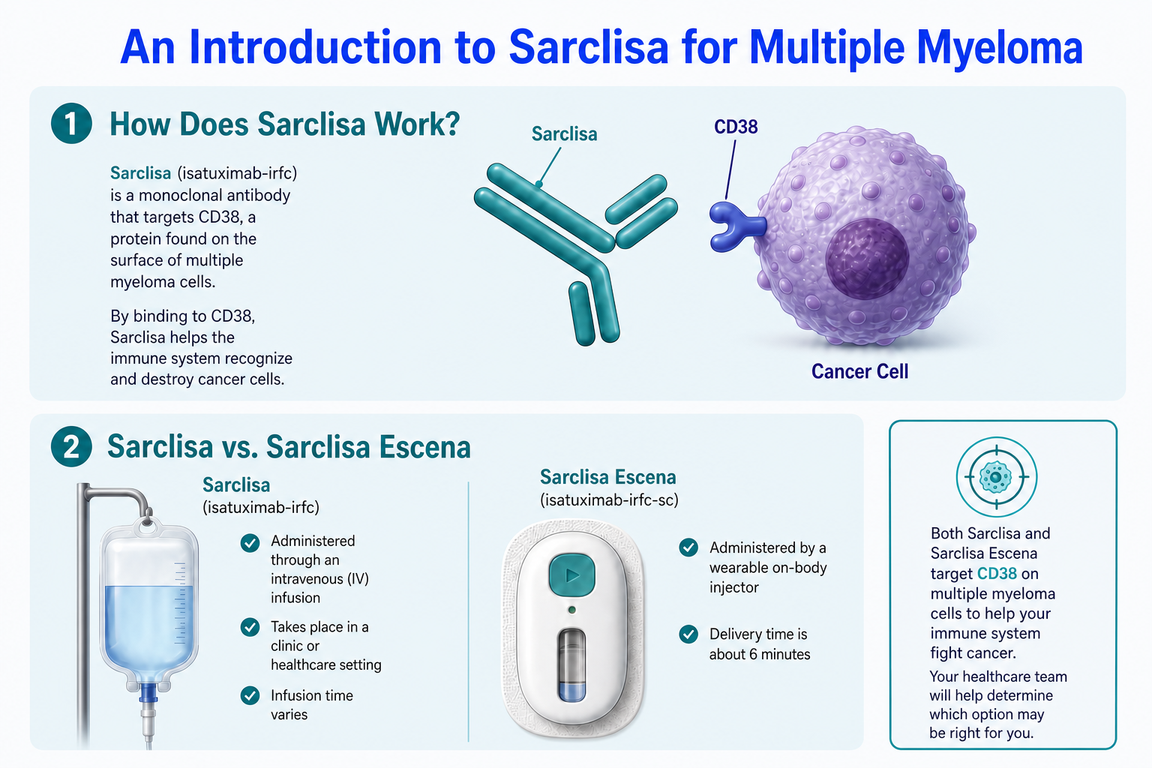
What Is the Difference Between Sarclisa and Sarclisa Escena?
Both Sarclisa and Sarclisa Escena contain the same active medicine (isatuximab-irfc) and work the same way to treat multiple myeloma. They both must be administered by a health care provider, usually in a hospital or clinic. The main difference is how they are given and how long each dose takes.
Sarclisa is given as an infusion into a vein (intravenous, or IV). Each infusion lasts a couple of hours. In contrast, Sarclisa Escena is given as an under-the-skin (subcutaneous) injection.
Sarclisa Escena is typically given under the skin of the stomach area (abdomen) using the CirCLIQ On-Body Injector, a wearable device that is designed to deliver the dose in about 20 minutes. Sarclisa Escena can also be injected under the skin using a syringe connected to a small tube (infusion set) in about 6 minutes. Both options require a health care provider to give the medicine; you cannot self-inject it.
Treatment with Sarclisa or Sarclisa Escena is usually given once every 1, 2, or 4 weeks, depending on your treatment plan and other medicines being used to treat your multiple myeloma. Your health care provider can tell you when you should receive each dose.
People receiving intravenous (IV) Sarclisa may be able to switch to Sarclisa Escena after completing their first treatment cycle. Ask your health care provider if you are interested in this option.
Your health care provider will also help decide how long treatment should continue based on how well it is working and how you tolerate it. If you have certain side effects, your health care provider may pause your treatment. In some cases, they may need to have you stop using Sarclisa or Sarclisa Escena completely.
How Does Sarclisa Work in Multiple Myeloma?
Sarclisa is a type of medicine called a monoclonal antibody that is also known as a targeted therapy or an immunotherapy. It works by targeting a specific protein called CD38 that can be on the surface of blood and bone marrow cells, including multiple myeloma cells. CD38 is expressed much more on multiple myeloma cells than healthy cells. Sarclisa attaches itself to the CD38 protein and helps the immune system find and attack the myeloma cells. This causes the cells to die.
Sarclisa Escena contains the same active medicine as Sarclisa and works the same way to help your immune system find and attack myeloma cells.
How Was Sarclisa Studied?
Sarclisa was studied across multiple clinical trials to make sure it was effective for treating multiple myeloma.
Relapsed and/or refractory multiple myeloma.A clinical study called ICARIA-MM was done to look at the benefits and risks of Sarclisa along with other medicines (pomalidomide and dexamethasone) in people with relapsed and/or refractory multiple myeloma. The people in the study had to have tried at least two prior therapies, including lenalidomide and a proteasome inhibitor.
The main goal of the study was to look at progression-free survival – the amount of time people live with cancer before it progresses or gets worse after starting a certain medicine.
A total of 307 people were in the study: 154 were given Sarclisa, pomalidomide, and dexamethasone, and 153 people were given pomalidomide and dexamethasone only. The ages of people in the study ranged from 36 to 86 years. The median age (meaning half of the people were younger and half were older) was 67 years, and 20% were 75 or older. Overall, 52% of the people in the study were male. Most were White (79%), 12% were Asian, 1% were Black or African American, 1% were Native Hawaiian or other Pacific Islander, and about 7% were “unknown” or did not report their ethnicity. People continued getting the treatment until their cancer got worse, they had serious side effects, they chose to stop, they passed away, or the study ended.
The median time people in the study were given Sarclisa, pomalidomide, and dexamethasone was 41 weeks, compared to 24 weeks in those who were given pomalidomide and dexamethasone alone.
A clinical study called IKEMA was also done to look at the benefits and risks of Sarclisa along with other medicines (carfilzomib and dexamethasone) in people with relapsed and/or refractory multiple myeloma. The people in the study had to have tried one to three prior therapies.
The main goal of the study was to look at progression-free survival.
A total of 302 people were in this study: 179 were given Sarclisa, carfilzomib, and dexamethasone, and 123 people were given carfilzomib and dexamethasone only. The ages of people in the study ranged from 33 to 90 years. The median age was 64 years, and 9% were 75 or older. About 56% of the people in the study were male. Most were White (71%), 17% were Asian, 3% were Black or African American, and 9% were “other” or did not report their ethnicity. People continued getting the treatment until their cancer got worse, they had serious side effects, they chose to stop, they passed away, or the study ended.
The median time people in the study were given Sarclisa, carfilzomib, and dexamethasone was 80 weeks, compared to 61 weeks in those who were given carfilzomib and dexamethasone alone.
Newly diagnosed multiple myeloma. A clinical study called IMROZ was done to look at Sarclisa along with other medicines (bortezomib, lenalidomide, and dexamethasone) in people with newly diagnosed multiple myeloma who had not received any prior treatments and were not eligible for a stem cell transplant.
The main goal of the study was to look at progression-free survival.
A total of 446 people were in the clinical trial, with 265 using Sarclisa, bortezomib, lenalidomide, and dexamethasone and 181 people using bortezomib, lenalidomide, and dexamethasone only. People continued getting the treatment until their cancer got worse, they had serious side effects, they chose to stop, they passed away, or the study ended.
The ages of people in the study ranged from 55 to 80 years. The median age was 72 years, and 28% were 75 or older. Overall, about 53% of the people studied were male. Most were White (72%), 11% were Asian, about 1% were American Indian or Alaska Native, 0.9% were Black or African American, 0.5% Native Hawaiian or other Pacific Islander, and about 14.6% did not report their ethnicity.
The median time people in the study were given Sarclisa, bortezomib, lenalidomide, and dexamethasone was 53.2 months, compared to 31.3 months for those who were given bortezomib, lenalidomide, and dexamethasone alone.
What Benefits of Sarclisa Were Seen:
Relapsed and/or refractory multiple myeloma. In the ICARIA-MM study, the median progression-free survival (the time it took for half of the people in the study to have disease progression or die after starting the medicine) was about 11.5 months in those receiving Sarclisa, pomalidomide, and dexamethasone, compared to about 6.5 months for those getting pomalidomide and dexamethasone alone. This suggests that people taking Sarclisa added to pomalidomide and dexamethasone lived longer without progression, compared to those taking pomalidomide and dexamethasone alone.
In the IKEMA study, the median progression-free survival was not reached in those receiving Sarclisa, carfilzomib, and dexamethasone, compared to about 19.2 months for those getting carfilzomib and dexamethasone alone. The true median progression-free survival in the study was not reached for the people in the Sarclisa group because they were still being followed and their cancer did not worsen. This suggests that people taking Sarclisa added to carfilzomib and dexamethasone had a lower risk of disease progression or death, compared to those taking carfilzomib and dexamethasone alone.
Newly diagnosed multiple myeloma. After following the people in the IMROZ study for a median (midpoint) of about five years (60 months), the estimated progression-free survival for the people who were given Sarclisa along with bortezomib, lenalidomide, and dexamethasone was about 63.2%, compared to 45.2% for the people who were given bortezomib, lenalidomide, and dexamethasone alone. This suggests that adding Sarclisa to bortezomib, lenalidomide, and dexamethasone was more effective than bortezomib, lenalidomide, and dexamethasone alone for people who were not able to have a stem cell transplant.
Your results may differ from what was seen in clinical studies.
How Was Sarclisa Escena Studied?
Sarclisa Escena was studied in a clinical trial called IRAKLIA. The study included 531 adults with relapsed and/or refractory multiple myeloma who had received at least one previous treatment including lenalidomide and a proteasome inhibitor. Participants received either Sarclisa Escena (given under the skin) or Sarclisa given intravenously (IV). Both groups also received two other cancer medicines (pomalidomide and dexamethasone).
The percentage of participants who responded to treatment was similar in both groups (objective response rate: 71.1% with Sarclisa Escena versus 70.5% with Sarclisa IV). These results suggest that the subcutaneous formulation worked just as well as the IV formulation.
Your results may differ from what was seen in the study.
How Will My Progress Be Monitored?
Sarclisa or Sarclisa Escena will start working as soon as you receive your first dose. Your health care provider will do regular bloodwork to monitor how the medicine is working in your body and treating your cancer. These tests will monitor your blood counts, such as white blood cells, neutrophils, and platelets, so that your health care provider knows you can continue to use Sarclisa or Sarclisa Escena safely. If you have certain side effects, such as frequent infections, your health care provider may do more tests to make sure it is safe for you to continue treatment.
How Can I Prevent and Manage Side Effects?
Side effects are common with medicines that treat cancer, including Sarclisa and Sarclisa Escena. It is important to tell your health care provider about any side effects you have during your treatment or after it is done. It can help them know if your side effects are serious or if they can give you more information to help you manage the side effects.
Your health care provider will usually tell you to take certain medicines before your dose to help prevent common side effects, such as administration-related reactions like itching, a rash, and nausea. It is important to follow your health care provider's instructions. You can ask your health care provider what else you can do to prevent or treat common side effects. For example, you can help prevent and treat nausea, vomiting, and diarrhea by eating bland foods and having multiple small meals throughout the day instead of three large meals. Your health care provider may also recommend that you keep certain over-the-counter medicines on hand to treat common side effects like diarrhea. They will also tell you how to watch for severe side effects, and what to do if you have these side effects.
Your health care provider will have you do bloodwork regularly while you are using Sarclisa or Sarclisa Escena. It is important to go to all of your appointments for bloodwork so that your health care provider can make sure the medicine is safe for you. These tests will look at your blood cell counts to make sure it is safe for you to continue treatment. This is because Sarclisa or Sarclisa Escena can cause low blood cell counts, such as low platelets (thrombocytopenia) and low white blood cells (neutropenia). If not treated, low blood cell counts can cause serious infections or affect your body’s ability to clot blood. This can be dangerous and even life-threatening.
If you have certain side effects during treatment, your health care provider may need to pause your doses or even stop your medicine altogether. This will depend on the side effect you have, how severe it is, and what treatment it needs. If your treatment needs to be paused, it is possible that your health care provider will restart Sarclisa or Sarclisa Escena once your side effect is treated and you get better.
These are not all the possible side effects of Sarclisa or Sarclisa Escena. Contact your health care provider for medical advice about side effects if you are having symptoms that bother you. You can also report side effects to the FDA at 800-FDA-1088 (800-332-1088).
What Are Other Unique Considerations to Be Aware Of?
Sarclisa IV can cause infusion-related reactions. These are considered common reactions, and for some people, they can be serious and even life-threatening. Your health care provider will monitor you closely for infusion-related reactions while you get your IV infusions. Most of the reactions happened within a few hours of starting the Sarclisa IV. It is important to tell your health care provider right away if you have any of the following symptoms of an infusion-related reaction.
- Shortness of breath or trouble breathing
- Dizziness, lightheadedness, or a feeling like you are going to pass out
- Coughing
- Wheezing
- A feeling that your throat is tight or irritated
- Runny or stuffy nose
- Headache
- Itching
- Nausea or vomiting
- Chills or a fever
- Chest pain or discomfort
- Blurred vision
- Heart beating faster than usual or a feeling of skipped heartbeats
Sarclisa Escena can cause other reactions that can be serious or even life-threatening, including injection site reactions or body-wide (systemic) administration-related reactions. Injection site reactions may include pain, redness, swelling, or irritation where the injection was given. Systemic administration-related reactions may be similar to those listed above for infusion reactions, such as shortness of breath or fever. Contact your health care provider right away if you notice any symptoms that start while you are receiving your dose or afterward.
It is possible that Sarclisa or Sarclisa Escena can affect the way blood tests work for your blood type. These changes can last for about 6 months after your last dose. Make sure to tell any health care provider who is treating you that you are using Sarclisa or Sarclisa Escena. This is important for them to know in case you need a blood transfusion.
Sarclisa or Sarclisa Escena can harm a fetus. You must not be pregnant before starting Sarclisa or Sarclisa Escena. Talk with your health care provider about using effective birth control during treatment and how long you should continue using birth control after your last dose.
Is There Any Cost Assistance Available?
There is a patient support program offered by the drugmaker called CareASSIST that may help you afford Sarclisa or Sarclisa Escena. Your health care provider can help you get started. You can find out more at Sarclisa (isatuximab-irfc) | CareASSIST Patient Support or by calling 833-930-2273.