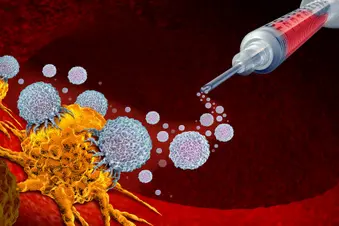
Immunotherapy is a type of cancer treatment that harnesses your body’s immune system to find and destroy cancer cells.
For decades, cancer treatment focused on surgery, radiation, and chemotherapy to remove or kill cancer cells. Then scientists began looking for ways to help the immune system do what it already does, but more effectively
“Immunotherapy is one of the most exciting and impactful breakthroughs in oncology in recent years,” says Marina Baretti, MD, a cancer researcher who holds the The Jiasheng Professorship in Hepato-Biliary Cancer Research at Johns Hopkins University. “It has really changed the trajectory of several cancers, especially those that are more immune-responsive.”
In a recent WebMD Reddit AMA on clinical trials for cancer, Baretti helped explain how clinical trials are the cornerstone of medical advancements like immunotherapy. Here’s a closer look at immunotherapy origins and how it’s revolutionized modern oncology treatment.
How Immunotherapy Started
The idea of immunotherapy isn’t new. As far back as the 1800s, doctors noticed that some people’s tumors shrank after they got certain infections. This led them to believe that the immune system might be able to fight cancer. Later, a doctor named William Bradley Coley tried to trigger this response to treat bone cancer. Although he had some success, medicine didn’t pay much attention to this approach for half a century.
Over the years, scientists learned more about how cancer works and how the immune system works. Researchers discovered T cells (a type of white blood cell that helps your body fight disease) in 1967. But they also learned that using the immune system to attack cancer isn’t a straightforward process because over time, cancer cells develop ways to hide from the immune system or actively suppress it. That’s why tumors can grow even in a body with a fully functioning immune defense.
“The challenge has been how can we arm our immune system to be more effective in both recognizing and also killing cancer cells?” Baretti says.
In 1986, the FDA approved the first immunotherapy agent, interferon-alpha 2, to treat hairy-cell leukemia, ushering in a new era of cancer treatment. In the decades afterward, clinical trials have led to major breakthroughs in immunotherapy. Researchers have used trials to develop drugs that help the immune system do its job better.
How Immunotherapy Works
One of the biggest discoveries in immunotherapy research is that not all cancers respond the same way. Some are highly “immune-responsive,” while others barely react at all. Typically this depends on how “visible” the cancer is to your immune system.
For example, Baretti says, tumors that are classified as microsatellite instability (MSI) high means they’ve lost their ability to repair DNA mistakes. Because of that, it builds up many mutations, which makes it easier for the immune system—and certain immunotherapies—to recognize and attack it.
“These tumor types have many more mutations, which means they produce many, many more aberrant proteins that make them more visible to the immune system,” she says.
These types of cancers tend to respond especially well to immunotherapy. In contrast, tumors with fewer mutations or those that actively suppress immune activity can be much harder to treat with immunotherapy alone.
There are different kinds of immunotherapy. One of the most widely used forms of immunotherapy is called immune checkpoint inhibition. Immune checkpoint inhibitors work by turning off the “brakes” (molecular signals that prevent it from attacking healthy tissue) to your immune system.
“We now have drugs that basically release these brakes from T cells so that they can be activated,” Baretti says. Once this happens, the T cells can see cancer as a threat and begin attacking it. In many cases, this can shrink tumors significantly.
Baretti says in early clinical trial results in people with advanced cancer, some people had what doctors call a complete response, meaning they had no detectable cancer on imaging scans.
“You would see the tumor completely melting away,” she says. “We still have patients that we follow and they are cancer-free many, many years later.”
The Essential Role of Clinical Trials
Clinical trials have played a central role in every stage of immunotherapy’s development, from early discovery to widespread clinical use.
“Clinical trials have been extremely central for the development and the optimization of immunotherapy,” Baretti says. “The impact of immunotherapy is now visible across oncology. In some cancers, it has replaced or supplemented chemotherapy as a first-line treatment. It has completely transformed the way that we think about cancer care.”
These studies are not just about testing drugs but also about understanding the biology behind them. In immunotherapy trials, researchers closely monitor patients and collect detailed data, including blood samples and tumor biopsies. These studies allow scientists to identify biomarkers that help predict who will benefit from treatment and why.
“These trials have given us important insights on the biology and the molecular makeup of some tumors that makes those tumors less or more sensitive to immunotherapy,” Baretti says. This kind of information is essential for moving beyond a one-size-fits-all approach to cancer care.
Clinical trials also provide the structure needed to prove that a treatment is both safe and effective.
“You really need to do that in systematic ways where you can prove that the efficacy is consistently driven by the treatment,” Baretti says. “Success in a single patient is not enough to change medical practice.”
Another major shift is how treatments are approved. Traditionally, cancer therapies were developed for specific organs like lung, breast, and colon. But immunotherapy helped doctors treat cancer based on its biology rather than its location. For example, clinical trial data helped doctors learn they can treat MSI-high tumors with immunotherapy no matter where they start in the body.
What’s Next for Immunotherapy
Baretti says even though immunotherapy has transformed oncology, it’s limited to a certain subset of people with cancer. Some cancers create environments that block immune cells from entering. Others lack the mutations that make them visible. And some develop resistance over time. That’s why clinical trials are so crucial for understanding and advancing this therapy.
“We want to try to understand why some tumor types respond and others don’t, and this is something that you can really do in the context of clinical trials where you can monitor patients carefully,” Baretti says. “The hope is that we can recapitulate those features in other tumor types so that immunotherapy can work for a broader patient population as well,” she says.
Research is focusing on combination therapies that pair immunotherapy with targeted drugs or other treatments, new types of immune drugs, including bispecific antibodies, cancer vaccines designed to train the immune system more precisely, earlier use of immunotherapy, and better biomarkers to match people with treatments most likely to help them.
“My hope is that clinical trials will be more precise and more biology-driven,” Baretti says. “I really see clinical trials not just as a pathway to new drugs, but also as a way to deliver more personalized, more effective, more meaningful care for our patients.”
Show Sources
Photo Credit: iStock/Getty Images
SOURCES:
Marina Baretti, MD, assistant professor of oncology and The Jiasheng Professorship in Hepato-Biliary Cancer Research, Johns Hopkins University School of Medicine.
Cancer Research Institute: “Immunotherapy Basics.”
Frontiers in Immunology: “The Intriguing History of Cancer Immunotherapy.”
Journal of the Advanced Practitioner in Oncology: “Immunotherapy Through the Years.”
Journal for Immunotherapy of Cancer: “High and low mutational burden tumors versus immunologically hot and cold tumors and response to immune checkpoint inhibitors.”
National Cancer Institute: “Immune Checkpoint Inhibitors.”
Cancer Immunology, Immunotherapy: “Microsatellite instability-high status as a pan-cancer biomarker for immunotherapy efficacy.”


