By Cheryl Anderson, as told to Rachel Reiff Ellis
When I was pregnant with my daughter in 2020, I found a lump on the back of my neck. At the time I wasn't worried. I told my doctors, and they kept an eye on it as my pregnancy progressed. But after my daughter was born and I had the lump removed, we discovered it wasn’t a cyst, like I’d assumed. It was a tumor.
I was diagnosed with sebaceous carcinoma, a rare type of skin cancer. Treatment was limited to surgery. The lymph nodes they removed showed no evidence the cancer had spread.
Sebaceous carcinoma is uncommon, especially on your neck, so my doctors wanted to know why it happened. Genetic testing showed I have Lynch syndrome — a condition caused by a gene mutation that significantly increases your risk of developing several types of cancer — and also Muir-Torre syndrome, a subtype of Lynch syndrome that causes oil gland tumors in your skin.
Suddenly, I found myself learning about different cancers associated with these conditions and facing a lifetime of increased surveillance.
Looking back, I was under an enormous amount of stress. I was having colonoscopies, skin checks, and regular screenings, all while working as a nursing manager in critical care during the height of the COVID pandemic. I decided to focus on things I could control. I started exercising more consistently, paying closer attention to nutrition, and trying to improve my overall health. I knew I couldn't change my genetics, but I wanted to do everything possible to support my body.
Signs of a More Serious Issue
Then I started having stomach problems. They were easy to explain away — I’d been diagnosed with GERD several years earlier, and my job was high stress (I joked with my coworkers that they were giving me an ulcer). I tried cutting dairy and gluten and experimenting with different approaches to see if I could figure out what was triggering my pain. Nothing really helped.
Just before Thanksgiving 2023, things escalated. The pain became so severe that I couldn't eat. Thanksgiving is my favorite holiday because I love food, so not being able to eat was unusual for me. At one point, I vomited what looked like coffee grounds. As a nurse, I knew that could mean old blood and that it wasn’t normal.
I called my gastroenterologist right away, and he scheduled an endoscopy for the Monday after Thanksgiving. They found what appeared to be an ulcer and took biopsies. While waiting for the results, cancer wasn't on my radar. Even with my history and Lynch syndrome diagnosis, I thought it’d be something less serious.
When the call finally came telling me I had gastric adenocarcinoma, I was completely shocked. I remember sitting at work and breaking down in tears. One of the doctors I worked with came into my office. I asked him to help me understand what the diagnosis meant. After reviewing the pathology, he told me I was probably going to need a total gastrectomy — a surgery to remove my stomach. I didn't believe him. My husband and I both thought there had to be another option. We assumed they could remove part of the tumor, or save at least some of my stomach. At that point, we didn't understand how advanced the cancer was.
Staging, Surgery, and Next Steps
Additional testing showed that my gastric adenocarcinoma was stage III. Once I fully understood what that meant, I was terrified. My children were still little. All I could think about was whether I’d be around to watch them grow up.
I underwent four rounds of chemotherapy before surgery. My surgeon knew I was going to lose a lot of weight after surgery, so he told me to eat. I took that assignment seriously. I called it my "food tour." I went out with friends, ate all my favorite foods, and enjoyed meals I knew might be difficult or impossible afterward. I gained 12 pounds before surgery, which was exactly what my surgeon wanted me to do.
In April 2024, surgeons removed my entire stomach and connected my esophagus directly to my small intestine. I often joke that I'm just a tube now because that's what it feels like. The surgery itself was intimidating, but I recovered surprisingly well. I remember being amazed that I could drink water the day after surgery. Even so, I knew my life was going to be very different moving forward.
After surgery, I completed another four rounds of chemotherapy. Then I learned that my pathology report showed positive margins, meaning there were still cancer cells present where my stomach had been removed. That was one of the hardest moments emotionally because we’d hoped surgery would be the end of the cancer. Instead, I needed six weeks of radiation along with more chemotherapy.
That period was the sickest I’ve ever been. Inflammation from radiation was so severe, I could barely eat or drink. Every week, I lost more weight. Eventually, I was so weak that I couldn't get dressed. I remember telling my husband I needed to be admitted to the hospital because I couldn't keep going like that. I’d resisted getting a feeding tube because I wanted to believe I could push through. But I ended up in the hospital and went home with a feeding tube for six weeks.
Looking back, that feeding tube probably saved my life. I needed nutrition and hydration so badly that once I started getting them consistently, my body was able to heal. My next scan came back clean, which was an incredible relief, although I had a long way to go before I felt strong again.
Life Without a Stomach
People don't often think about how much your stomach does until it's gone. Because the hormone that stimulates hunger is produced there, I don't feel hungry anymore. I can go for hours without eating, and then suddenly realize I'm dizzy because I haven't had enough food.
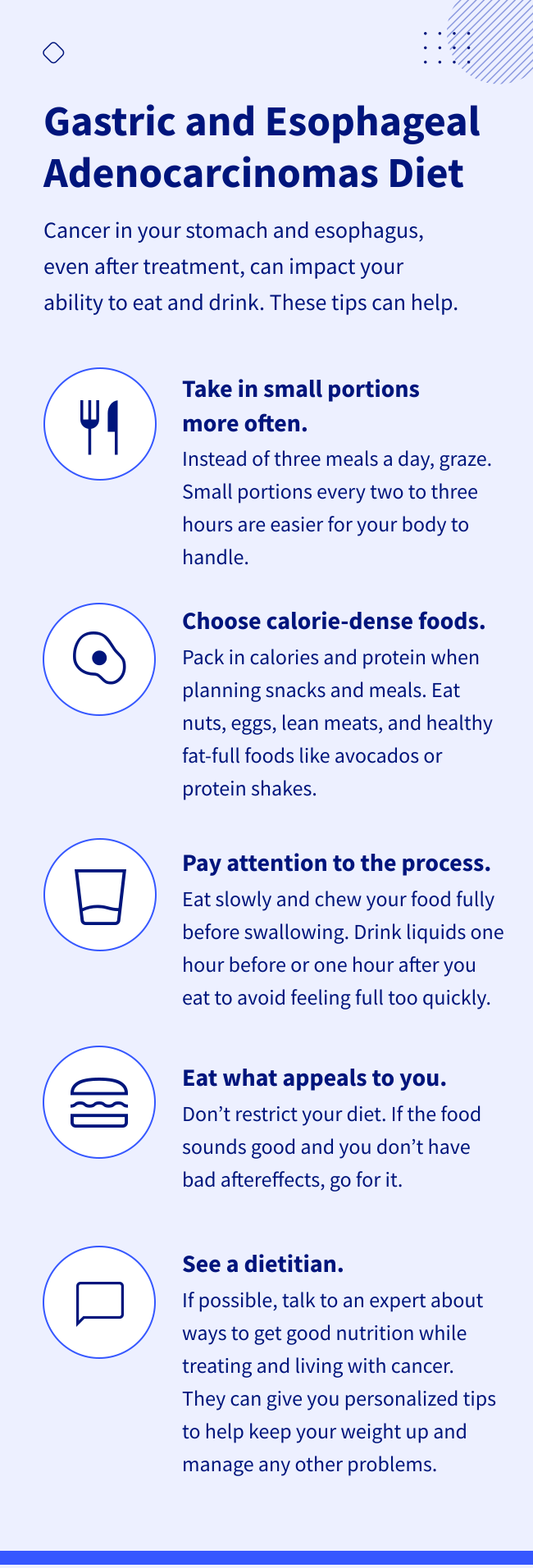
Eating has become something I have to plan rather than something that happens naturally. I can't sit down and eat a large meal because I don't have the capacity for it. Instead, I eat small amounts throughout the day. Most mornings, I set up my workstation with yogurt, berries, nuts, protein shakes, and other foods that I can snack on over several hours. It's almost like a job. If I'm not intentional about it, it's easy to fall behind nutritionally.
I also have to supplement aggressively because I don't absorb nutrients the way I used to. I receive regular B12 injections and take vitamins, iron, and other supplements. Maintaining my weight and muscle mass is one of my biggest priorities. I learned during treatment how quickly those reserves can disappear.
Uncertainty Is the Norm
After recovering from radiation, my husband and I decided to take a vacation. We hadn't traveled alone as a couple in years, and it felt like a celebration after everything we’d been through. Around the same time, I was working hard to rebuild my strength through exercise and nutrition.
Not long after we returned home, another scan found an abnormality on my ovary. At first, I thought it was probably a cyst. I didn't assume it was cancer. But additional testing showed a 7-centimeter tumor. Ultimately, I decided to have a hysterectomy.
When pathology results came back, they showed the tumor was metastatic gastric adenocarcinoma. A year after my original diagnosis, the cancer had returned.
Thankfully, around that time a newly approved immunotherapy became available for my specific type of cancer. I was one of the first patients at my treatment center to receive it. Today, I continue on maintenance treatment with immunotherapy and oral chemotherapy. My scans have remained clear since the hysterectomy. I’m grateful for every clean scan, even though the uncertainty never goes away.
Facing the Future on My Own Terms
Cancer changed the way I think about almost everything. Before my diagnosis, I was focused on work. I’d spent 18 years at the same hospital system, recently completed my master's degree, and believed that advancing my career was what I was supposed to be doing. I was constantly chasing the next goal and carrying tremendous stress.
The diagnosis forced me to reevaluate my priorities. I left my management position and accepted a remote job with a much better work/life balance. I’d missed time with my children. Cancer made me realize those years aren't something you get back.
My husband and I have changed a lot, too. Throughout treatment, he was my biggest support. There were times I couldn't get out of bed, and he took care of our children and managed everything at home. Going through cancer together changed our perspective on what matters. We don't want to postpone experiences anymore. We take vacations. We spend time together. We prioritize making memories because neither of us wants to assume there’ll be time later.
One of the best pieces of advice I got during my treatment came from my oncologist. She told me I needed to keep living my life. She encouraged me to see friends, attend events, and continue doing things that bring me joy. That advice stayed with me because I didn't want to become "the cancer patient." I didn't want cancer to define who I am.
I still deal with anxiety, especially around scans and new symptoms. Every cancer survivor understands that feeling. But I’ve learned I can't control what happens tomorrow. I can only control how I care for myself today. For me, that means focusing on nutrition, exercise, stress management, and gratitude, and spending time with the people I love.
My biggest motivation has always been my children. More than anything, I want to see them grow up and build lives of their own. That's what keeps me moving forward. Cancer has changed my body, my plans, and my perspective, but it’s taught me to appreciate what matters most. I don't take ordinary moments for granted anymore. I try to make the most of the time I have right now.