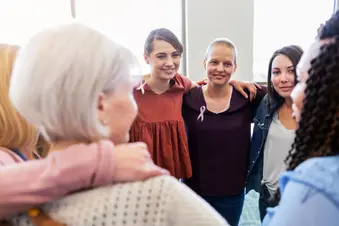
Jessica Harden, 30, and Gabi Williams, 31, both part of the Young Survival Coalition, a support and advocacy group for young adults affected by breast cancer, discuss the importance of finding community when you've been diagnosed with early breast cancer.
Jessica: I found a lump on my right side in May of this year. I have no family history of breast cancer. I’ve never had serious health issues. The lump was still there after a couple of months, so I went to see my OB/GYN.
My doctor sent me for a mammogram and then an ultrasound. The radiologist came back in and said, “I just want you to know, I can’t be 100% sure, but I’ve done this for a long time, and I think you have cancer.”
I was alone in the room, and I started crying. I was like, “Can you get my husband?” They called him back and told him. Then they did a biopsy, sent that off, and then called me with the results the next morning.
So I have breast cancer. I’m stage IIA with lymph node activity. We were leaving for a family trip for the Fourth of July when I found out.
Once I came back, we had our first meeting with my oncologist team and all 20 people who you meet that day. Then I made a post on the internet and said: I have cancer. I’m thinking of starting a GoFundMe. I run my own business, so I’m not going to be able to work. I’m already starting to panic about that. I don’t know what to do.
And my community came through times 100. Through them, we’ve raised about $8,000. And people sent hundreds and hundreds of gift boxes to my house with coloring books and journals and resources.
And one of my neighbors raised money for us by selling T-shirts. I’ve had a lot of people show up for me.
Gabi: Jessica, I just want to say, you’re about to go through something really hard, but you’ll get through it, and you can do it. I know how challenging it is, and your whole life gets flipped upside down.
I was diagnosed in June 2024, kind of similar where I felt the lump myself. At the time, I was 29. Everyone along the way was telling me, “You’re so young, it’s probably benign. You’ll be fine.”
The radiologist was the first one who was like, “This isn’t a cyst. There’s blood flow here. I’m afraid this is cancer.” I’ll never forget those words. I didn’t bring anyone with me to the appointment, so I understand and sympathize with what it feels like to hear that news alone.
I was diagnosed with triple-positive invasive ductal carcinoma stage IB. I did six rounds of TCHP. That’s a drug combination used to treat early-stage HER2-positive breast cancer.
Jessica: That’s the treatment I started with on Aug. 11 of this year.
Gabi: My first round of chemo was on Aug. 15, 2024.
Jessica: I’m the youngest person in the waiting room at every appointment I go to, everyone else seems to be at least 60.
Gabi: I’m still usually one of the younger ones in the lobby waiting around. But once I started getting treatment at MD Anderson Cancer Center in Houston, they didn’t make a big deal about how young I was. They just cared about me as a patient, which was good. I didn’t need to be reminded that I was a 29-year-old with cancer.
Jessica: That’s one thing I hate the most, when people see me and they make that sad, “you poor thing” face.
Gabi: I call them sympathy eyes. Just wait till you lose your hair. I say that jokingly. I’m sorry. I have dark humor.
Jessica: No, I have dark humor too.
Gabi: OK, good.
Finding People Who Get It
Gabi: When I got diagnosed, I made one of the best decisions ever when I joined a Facebook group for people with triple-positive breast cancer. I shared an image of me getting my first chemo, and there were several girls on there that were like, “Oh, I just got my first chemo this week, too.” Then one of the girls was like, “Hey, let’s make a group chat.”
It was nice to have a space where we could be like, “Oh my gosh, this is happening to me. Is this happening to you guys, too?” Or “How’s everyone’s hair looking?” One week I remember there were like four of us in the hospital at once, sending selfies from treatment.
Having that support system and people who could relate to me was so important. I was the youngest at 29, but we were all kind of similar age ranges. And we talked every single day throughout the process.
Jessica: That’s one thing I don’t have that I’m looking for. My community showed up for me in every other way, but I haven’t found anyone else to talk to who’s similar in age and diagnosis: I’m zero progesterone, 25% estrogen, and HER2-positive.
Gabi: I would recommend, if you can find some breast cancer Facebook groups, just post like, “Hey, I just started my chemo journey. I’m looking for other people with a similar diagnosis,” and you’d be amazed at how many other women are out there looking to connect.
I went to the Young Survival Coalition’s in-person event in 2025, and that was amazing. It was like a cancer convention. Just to be surrounded by hundreds of girls — they just all understood.
I remember leaving that weekend on a high, even though I was still feeling pretty weak, recovering from chemo. There were girls there that had just finished the hard chemo the week or two before, and they were there just having the best time.
Jessica: My older sister has a friend who beat breast cancer several years ago, and I’ve been talking to her a lot. We didn’t know each other very well before my diagnosis, but she’s been amazing through this. Now I see her totally differently. She’s been sending me hope kits, and she’s the one who suggested I join the Young Survival Coalition.
Support During and After Treatment
Gabi: I think community is everything during treatment, and especially in survivorship. During treatment, you get support from people outside of the cancer space. In survivorship, a lot of that support stops. Because you look better, your hair is coming back, and you’re not doing chemo anymore.
For me and my husband, having to go through IVF as our option for having children and having the ability to conceive naturally taken away from us — people don’t understand that. That’s why I feel like it’s so important to find a community of people in the cancer space, because they know that chemo, surgery, and radiation are just the beginning.
No one else will get that you have to plan the rest of your life through the cancer lens, or what we call the recurrence filter. Like, “Oh, I want to go on this trip in two years,” and then it’s like, “What if I have a recurrence?” People who’ve never had cancer may not understand that those kinds of thoughts always go through your mind.
Gabi: It’s tough. I think the biggest thing that people outside the cancer space maybe don’t realize is just how devastating it is. I didn’t realize the level of grief I would have. Whether it was my fertility, being diagnosed as a newlywed and grieving that, or grieving my dream life that I worked so hard for.
Jessica: My husband and I have only been married for two years.
Gabi: Yeah, so we’re in a similar boat. We’d only been married for a year when I was diagnosed.
Jessica: Some people do this single or with no support. My friend did it during COVID, with no visitors.
Gabi: I can’t even imagine. I say all the time, I don’t know what I would have done without my Facebook group and my husband.
Being Seen as More Than Cancer
Jessica: One thing that’s hard about talking to people who aren’t going through something similar is that you have to monitor their emotions. When you tell someone, “I have cancer,” and they don’t have cancer, they get upset. And then you have to help them feel better about you being sick.
Gabi: As someone who’s gone through it and been bald and worn all the hair things and all of that, I can tell you that it’s exhausting, dealing with how bad your cancer makes other people feel.
Between my last TCHP and surgery, we took a road trip to Georgia. I wasn’t wearing any head coverings or anything. Low key, I loved being bald. It was fun. I’m not gonna lie. I kind of liked it.
But I would walk into gas stations, and everyone was like, “Ma’am, I’ll get the door for you,” and they’re staring at me, and they’re looking at me with their sympathy eyes saying, “Hope you have a great day.”
Jessica: Yeah, it kind of feels like they’re saying, “Good job, little fighter!”
Gabi: I know. And I’m like, “I just want to be seen for me.” I’m somebody with cancer. Cancer doesn’t define me.
Jessica: I’m planning on cutting my hair off soon. My family offered to shave their heads in support, and I was like, “Please do not. Please allow me to have a conversation with you without it being about cancer. Can we talk about something bad the neighbors did, or someone who lied at work, without me seeing your bald head, too?”
Gabi: And you’ll find, too, people outside the cancer community will maybe not share things they’re going through in their life because they’re like, “Oh, I didn’t want to upset you.” And I’m like, “Well, let me have that decision to say, ‘Hey, you know what? I’m not mentally prepared to have this conversation right now.’”
You do get treated really differently. People come from a good place, and I try to remember it. But going through it, it’s exhausting.
Before we go, I have another plug for a survivorship group. It’s called Genuine Climbing. They offer women’s climbing retreats to survivors of any sort of cancer. I did one in May 2025, and it was one of the most life-changing experiences I’ve had.
The retreat was just a small, intimate group of women. We were in upstate New York doing rock climbing. I can’t even explain the connection that you build with these ladies over a long weekend. You’re also challenging your body to do something hard, which feels good.
And they just get it. They just understand. You don’t have to explain anything, and that’s the best part. That’s the best part about community in the cancer spaces. People just get it.
Show Sources
Photo Credit: E+/Getty Images
SOURCES:
Jessica Harden, breast cancer advocate, Roachdale, Indiana.
Gabi Pincomb, breast cancer advocate, Houston, Texas.


