By Div Dubey, MBBS, as told to Hallie Levine
Div Dubey, MBBS, is a neuromuscular specialist and professor of neurology at the Mayo Clinic in Rochester, Minnesota.
Lambert-Eaton syndrome, also known as Lambert-Eaton myasthenic syndrome (LEMS), is a very rare autoimmune condition where the immune system attacks the points where muscles and nerves connect. This leads to muscle weakness in the upper legs, hips, arms, and shoulders that can spread to the eyes, face, and throat.
People with Lambert-Eaton syndrome often have difficulty walking and doing other daily activities. They sometimes can also find it to talk, chew, and swallow. But there are new treatments to help with the condition.
Since Lambert-Eaton syndrome is so rare — it affects less than 3 people in 1 million — there are not many doctors that know how to treat it. Here, Div Dubey, MBBS, a neuromuscular specialist and professor of neurology at the Mayo Clinic in Rochester, Minnesota, provides insights and the latest research on this disorder.
What is Lambert-Eaton syndrome?
It’s an autoimmune disorder. Your antibodies attack the P/Q calcium channels that are at the end of your nerve cells. This means a neurotransmitter called acetylcholine isn’t released. Your muscles need acetylcholine to activate. If levels fall below a certain level, your muscles can’t function properly and you develop muscle weakness.
Here at the Mayo Clinic, we have studied Lambert-Eaton syndrome for almost 70 years. It was actually first identified here in 1957 by two Mayo Clinic physicians, Edward Lambert and Lee Eaton.
How often do you see patients with Lambert-Eaton syndrome?
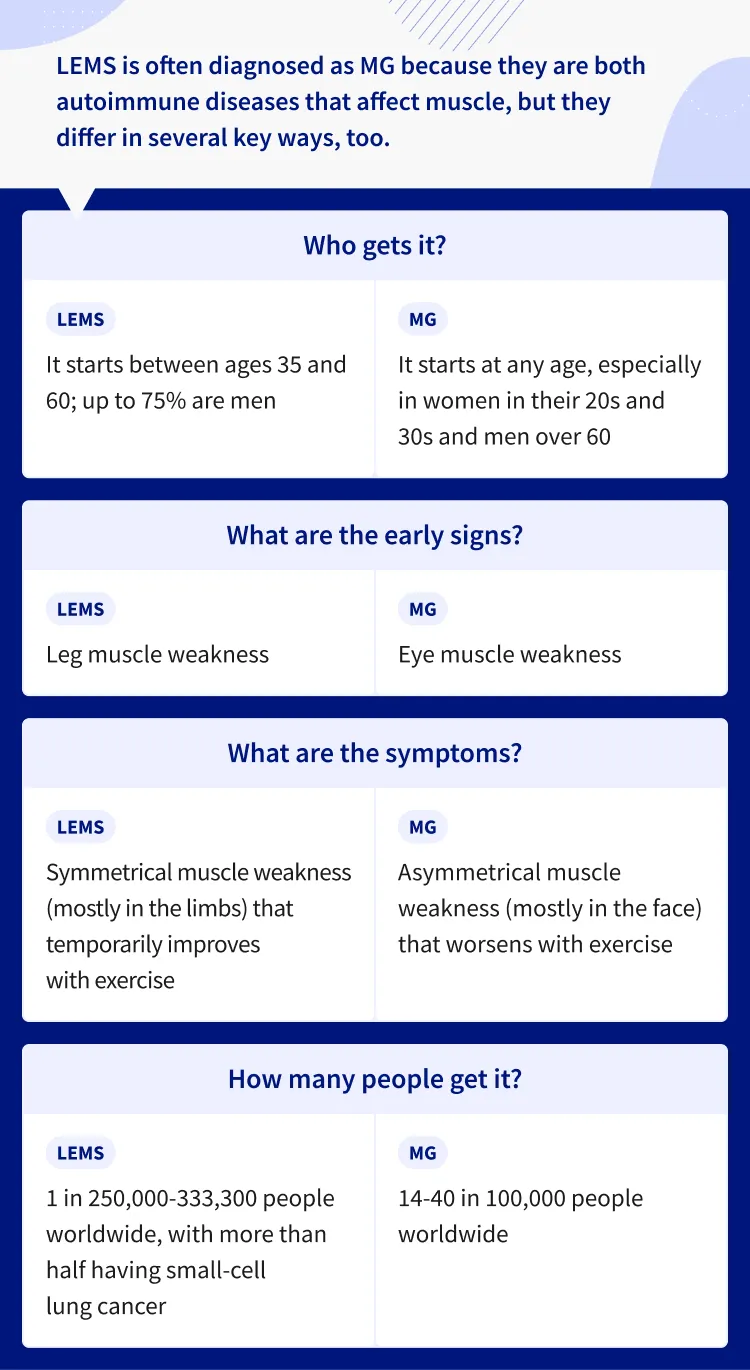
I have to be honest: not often. Most general neurologists will never see it in their clinical practice. Here at the Mayo clinic, our experience is different because we see many patients that are referred to us with complicated neurological disorders. Sometimes, people come to us after years of going undiagnosed or even misdiagnosed. Oftentimes, previous doctors have told them they have myasthenia gravis (MG), another more common neuromuscular disorder. But the diseases have slightly different causes, and present differently. Lambert-Eaton syndrome usually begins in the lower limbs, while MG starts in the eye muscles.
What should I do if I think I might have Lambert-Eaton syndrome?
You want to see a neuromuscular neurologist. This is a type of neurologist who specializes in conditions that affect the nerves and muscles, like Lambert-Eaton syndrome. Oftentimes, our patients come to us with symptoms like leg weakness and dry mouth. We will run a test called electromyography, which shows how well your muscles and nerves work together. If that comes back abnormal, we will then run a blood test to check for anti-calcium channel antibodies. Both tests together support a diagnosis of Lambert-Eaton syndrome.
The blood test is also used to diagnose MG, so if your doctor orders it first, it’s also very important that you ask for electromyography, too. LEMS produces very specific results that are different from MG.
What is the link between Lambert-Eaton syndrome and lung cancer?
There are two forms of LEMS. The first type, which makes up 50% to 60% of all cases, is associated with small-cell lung cancer. These patients are often former smokers and tend to be older (in their 60s). In these cases, your body’s immune system accidentally attacks your nerves as it tries to wipe out the cancer.
The other form of LEMS doesn’t seem to be linked to lung cancer. Patients tend to be younger when they are diagnosed. But we still do a CT scan to check for lung cancer every six months for up to two years after their diagnosis, to be safe.
How is Lambert-Eaton syndrome treated?
There’s no cure for Lambert-Eaton syndrome, but we have new ways to better manage it. Amifampridine (Firdapse) was FDA approved in 2018 to treat the condition. It increases the release of the neurotransmitter acetylcholine to improve muscle signaling.
We also need to suppress the immune system so that it doesn’t continue to attack nerve endings. One way to do that is to use intravenous immunoglobulin (IVIG), which is a treatment that infuses donated human antibodies into a patient’s body. Another option is plasmapheresis, which removes the harmful antibodies from your blood. After that, we may use an immunosuppressant such as prednisone to help ramp down the immune system long-term, either alone or along with drugs like azathioprine or cyclosporine.
If your Lambert-Eaton syndrome is caused by small-cell lung cancer, then your medical team will treat the underlying cancer at the same time they treat the condition. You may need surgery, chemo, and/or radiation, depending on your cancer.
Who’s on your medical team if you have Lambert-Eaton syndrome?
Your neurologist is definitely your quarterback. They will coordinate your care, but they definitely need a lot of help from other team members. This includes neurodiagnostic technologists, radiologists, and possibly physiatrists to help with muscle weakness. Most patients also need occupational and physical therapy to retrain muscles and help them walk and sometimes even talk, chew, and swallow. If patients have lung cancer, then they will need to be seen by a whole cancer team as well.
What is the prognosis of someone with Lambert-Eaton syndrome?
It’s generally quite good if it’s not linked to cancer. Even if you do have cancer, if it’s found early and treated, your symptoms will improve. Research suggests that patients with Lambert-Eaton and small-cell lung cancer have better survival rates compared to other small-cell lung cancer patients.
Most people with Lambert-Eaton syndrome who don’t have cancer have a normal life expectancy. The key is to get a diagnosis as soon as possible. When that’s delayed, disability grows over time. The earlier treatment starts, the more we can prevent the muscle weakness that occurs with the disease. Otherwise, while they regain strength with treatment, they’ll have to spend a lot of time in therapy retraining muscles.
I’m also excited about research into new diagnostic blood tests. We want to identify new biomarkers that may help us better predict the disease course and also distinguish between the two main types of Lambert-Eaton syndrome.
While Lambert-Eaton syndrome may be an incredibly rare disease, the treatment future looks very bright.