
Treatments for chronic inflammatory demyelinating polyneuropathy (CIDP) help stop your body’s attack on the myelin covering that protects your nerves. They can make you feel better and stronger.
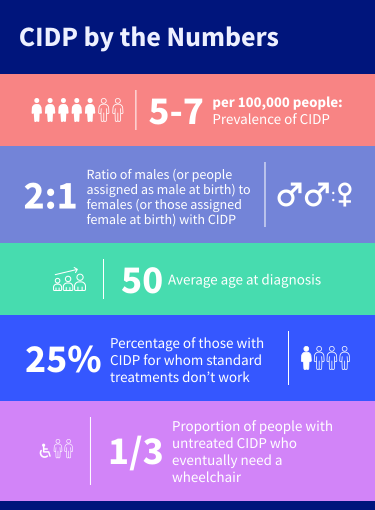
Roughly 90% of people with CIDP improve with treatment. Almost 40% of them are cured or go into remission, which means they have few or no symptoms for a while. You may be able to stop treatment altogether if you respond well. But about half of those who get treatment will relapse, which means they start to feel worse again after feeling better for a time.
You can recover from CIDP, but you may have lasting symptoms like weakness or numbness.
Several types of treatment are available. All of them work by changing your immune system so that it stops attacking your own nerves. Once that happens, the damage to your nerve tissues may start to heal. Your treatment will depend on your type of CIDP and other factors.
Your doctor will probably start with the standard treatments: corticosteroids, immunoglobulin therapy, and plasma exchange. If those aren’t effective, they may suggest other options, like monoclonal antibodies and other types of immunosuppressant drugs. You may also need treatment to relieve your nerve pain.
What Are Corticosteroid Treatments for CIDP?
Corticosteroids are often used first to treat CIDP. They’re relatively cheap, and you can take many of them at home by mouth. These meds lower inflammation in your body by slowing down your immune system. This can help ease your symptoms and prevent further damage. Corticosteroids can lead to remission or a cure in some people.
But you can get serious side effects if you take corticosteroids for a long time. Some of these problems are:
- Diabetes
- A puffy "moon" face
- High blood pressure
- Fluid buildup
- Weight gain
- Sleep problems
- Infections
- Bone fractures
- Hair and skin changes
- Mood issues
- Muscle weakness
What Are Immunoglobulin Treatments for CIDP?
Immunoglobulin treatments use antibodies from the blood of healthy people to treat CIDP. Antibodies are proteins that help fight off foreign substances. When immunoglobulin treatments are infused or injected into your body, these donated antibodies help keep your immune system from attacking the myelin cover of your nerves.
Along with steroids, immunoglobulin therapies are usually the first options doctors suggest to treat CIDP. There are two basic types.
What is intravenous Immunoglobulin (IVIg)?
With IVIg, antibodies from healthy volunteers are infused via IV into one of your veins over several hours. You usually get IVIg at an infusion center. You may need it several times a week or once every few months, depending on how you respond.
What is subcutaneous immunoglobulin (SCIg)?
If you do well with IVIg treatment, your doctor may recommend a type of immunoglobulin that you can give yourself at home. This is called subcutaneous immunoglobulin (SCIg). It’s injected just under the skin.
What Are Plasma Exchange (Plasmapheresis) Treatments for CIDP?
A procedure called plasmapheresis is sometimes used to help people with CIDP get their symptoms under control quickly. It removes the antibodies in your blood that cause your immune system to attack the myelin covering your nerves. But it’s not a cure.
With plasmapheresis, a nurse or doctor puts a needle in your arm. Then, your blood moves from your body into a machine. The machine filters antibodies from your blood, then returns the blood back to you. The process takes several hours.
Plasmapheresis is usually only effective for a few weeks. You may need four to seven treatments over eight to 10 days. But this depends on how badly you need it. Doctors sometimes use plasma exchange to ease symptoms while you’re waiting for a longer-term treatment to take effect.
What Are Monoclonal Antibodies for CIDP?
Monoclonal antibodies are lab-made proteins that act like the antibodies your body makes. They’re designed to target specific parts of your immune system. You probably won’t start on a monoclonal antibody as your first treatment for CIDP. But these medicines may be useful when combined with other therapies or if other treatments fail. You get them through an IV or as a shot.
Side effects. It’s rare, but the side effects of monoclonal antibodies can sometimes be serious. They include an infusion reaction, which is when your body overreacts to a treatment you get by IV. Infusion reactions can range from minor to life-threatening.
What is efgartigimod alfa and hyaluronidase-qvfc combination?
The FDA approved a combination of efgartigimod alfa and hyaluronidase-qvfc (Vyvgart Hytrulo) in 2024 to treat adults with CIDP.
A doctor or nurse injects this medicine under your skin weekly.
In clinical trials of efgartigimod alfa and hyaluronidase-qvfc, 7 out of 10 people reported improved symptoms. The chances that CIDP would get worse were 61% lower in people in the study who used this medicine than in those who got a placebo (fake treatment).
What is rituximab?
Rituximab targets specific immune cells that cause damage to nerves. It’s often used in people with CIDP who don’t respond well to IVIg treatment.
You get it as an infusion, usually once or twice every six months. Your doctor might recommend rituximab along with other treatments, like corticosteroids or plasmapheresis.
What Are Other Immunotherapies for CIDP?
Your doctor can choose to prescribe other drugs that suppress your immune system if the standard therapies don’t work well. You might take these along with corticosteroids.
Research on the effectiveness of these medicines for CIDP is limited. Most of the information comes from small studies or case reports.
What is azathioprine?
Azathioprine is usually used to prevent organ rejection in people who’ve had kidney transplants, or for those with serious rheumatoid arthritis (another type of immune disease).
It can also help treat CIDP when other treatments don’t work. It comes as a tablet you take by mouth.
What is cyclophosphamide?
Cyclophosphamide is usually used to treat different types of cancer. But it can also be an option for people with CIDP. You can take cyclophosphamide or get it through an IV.
Some research has suggested cyclophosphamide can help with symptoms of CIDP when you take it by mouth for several months. You can take it on its own or along with prednisone.
What is cyclosporine?
Cyclosporine can treat organ transplant rejection and autoimmune disorders such as rheumatoid psoriasis. It may also help to calm your immune system if you have CIDP.
This medicine usually comes as a pill or liquid you take by mouth.
What is methotrexate?
Methotrexate is commonly used to treat some types of cancer as well as immune system disorders like psoriasis and rheumatoid arthritis. For CIDP, you can take it by mouth or as an injection.
Studies so far have had mixed results on whether methotrexate can help with CIDP.
What is mycophenolate?
Mycophenolate is a medicine that’s often given to prevent rejection after you’ve had an organ transplant.
Some studies have found mycophenolate can improve strength in people with CIDP. It may also help some lower their dose of corticosteroids.
You take mycophenolate by mouth.
What Are Nerve Pain Treatments for CIDP?
You may also need treatments to help you deal with nerve pain that results from CIDP. It can be hard to effectively treat nerve pain, and you may need to try more than one drug. Medications used for CIDP nerve pain include:
- Antidepressants
- Antiepileptics
- Opioids
What are antidepressants?
Antidepressants are best known for treating depression, but they can also help with nerve pain. That’s because they affect the chemical “messengers” that help brain cells communicate, called neurotransmitters. This is thought to disrupt the pain signals your nerves send to your brain. It may take several weeks to get the full pain-relieving effect of antidepressant drugs.
Here are some oral antidepressants your doctor may recommend to ease CIDP nerve pain:
- Amitriptyline (Amitid, Elavil, Endep). Though it’s an antidepressant, amitriptyline isn’t commonly used for depression. That’s because it has a lot of side effects. It’s a tricyclic antidepressant, which means it increases the neurotransmitters serotonin and norepinephrine in your brain. Limited data suggests it may help ease nerve pain in some people.
- Duloxetine (Cymbalta, Drizalma Sprinkle). Duloxetine is a selective serotonin reuptake inhibitor (SSRI). This type of antidepressant makes more serotonin available to your brain. It’s the only antidepressant that’s FDA-approved for treating nerve pain.
- Venlafaxine (Effexor). This is another SSRI. You may use it along with gabapentin or pregabalin to treat CIDP nerve pain.
What are antiepileptics?
Antiepileptics are usually used to treat or prevent seizures. They stop abnormal electrical activity in your brain. These medicines also ease nerve pain in some people because they keep your nerves from sending pain signals to your brain.
Side effects: They don’t cause bad side effects for most people. But they may include drowsiness, fatigue, weight gain or loss, and difficulty concentrating. Less common but serious side effects include bone loss, blood disorders, and severe allergic and skin reactions.
When your doctor may prescribe them. These may be the first drugs your doctor tries for your nerve pain.
These are some of the oral antiepileptic medicines often prescribed for nerve pain with CIDP:
- Gabapentin (Gralise, Neurontin). Gabapentin changes the way your body senses pain. Many people notice improvement after one to two weeks.
- Pregabalin (Lyrica). Pregabalin lessens the number of pain signals that damaged nerves send out. One study found that pregabalin worked better than gabapentin at relieving pain in people with CIDP.
What are opioids?
If antidepressants and anti-epilepsy drugs don’t relieve your pain, your doctor may consider an opioid drug.
Side effects. These painkillers can be addictive. They may also have major side effects like nausea, constipation, drowsiness, and dizziness.
You’ll need regular follow-up visits with your doctor to monitor the effects of these drugs.
When your doctor may prescribe them. Doctors usually prescribe them only for a limited time.
- Oxycodone (Oxaydo, Roxicodone, Roxybond). This is a very strong type of painkiller. Your doctor might prescribe the immediate-release form of oxycodone for short-term pain relief. But there’s not much scientific evidence that it works well for nerve pain.
- Tramadol (ConZip, Qdolo, Ultram). This synthetic opioid is not as strong or addictive as oxycodone. But like other types of opioid drugs, it should only be used for short periods.
How Much Do CIDP Treatments Cost?
The cost of CIDP treatment varies widely depending on the treatment you use. Steroids usually cost less than intravenous immunoglobulin (IVIG), for example. IVIG can cost thousands of dollars a year. Here are price estimates for some CIDP treatments.
Lower cost treatments
- Corticosteroids.These are often the least expensive initial treatment for CIDP. A 2019 study found the two-year cost for receiving only steroids was just over $3,000.
- Plasma exchange (plasmapheresis). This may be used in severe cases and it’s less commonly used than steroids or IVIG. The cost falls between steroids and immunoglobulin therapies
Higher cost treatments
- Intravenous immunoglobulin (IVIG) and subcutaneous immunoglobulin (SCIG). These therapies are often the most expensive. In a 2024 study, chronic users of immunoglobulin (IG) therapy had an average annual medical cost of $206,418.
- Monoclonal anitibodies. Newer drugs for CIDP, such as Vyvgart (efgartigimod alfa), can be very expensive. In 2024, the annual cost of Vyvgart was estimated to be over $830,000, compared to Hizentra (a subcutaneous IG therapy) costing between $164,000 and $252,000.
- Hematopoietic stem cell transplant (HSCT). This is a potentially curative, one-time treatment for severe CIDP. While the initial cost is high (around $108,000 in one study), it can be more cost-effective over the long term for those who are dependent on IVIG.
- Hospitalizations. A 2018 study found the average cost of a CIDP-related hospitalization was over $68,000.
Check with your health insurance provider about your coverage and possible out-of-pocket costs.
Treatment cost assistance
If you meet certain criteria, manufacturer co-pay programs may help. Also try these foundations, which may help you with out-of-pocket expenses:
Ask your doctor if they know about other cost-assistance programs.
Clinical Trials for CIDP Treatments
With a clinical trial, you may be able to try a new medication before it’s approved for the public. Taking part may also save you money on treatment.
To participate, you need to meet certain criteria such as:
- Have a confirmed diagnosis of CIDP
- Be receiving standard treatments for CIDP
- Be willing to undergo regular medical assessments and follow the study protocol
Clinical trials for CIDP treatments may compare certain drugs to other classes of drugs to see which work better and why.
To find studies across the country, visit ClinicalTrials.gov to see:
- Information about the trial and its research goal
- Whether the study is still enrolling
- Where it's located
- What conditions you must meet to qualify