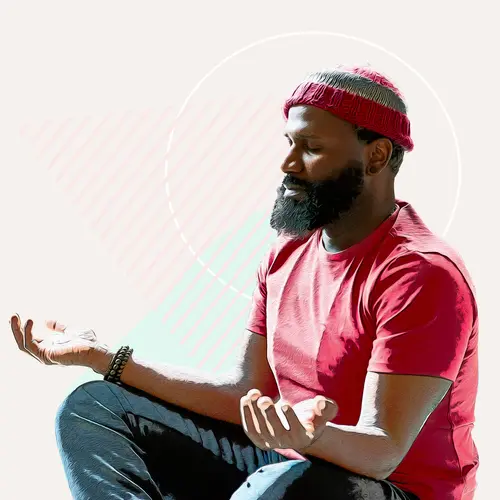
In Western countries like the U.S., the types of yoga practiced often focus on physical movements that help you build strength. Somatic yoga, on the other hand, is more in line with the Southeast Asian roots of yoga, which place equal emphasis on exercising the mind and the body as a spiritual practice.
"Somatic yoga follows the basic precepts of hatha yoga, which really focuses on the dynamics of body awareness, a sense of mindfulness, and, in its truest aspect, a sense of spirituality as well," says Mary Lou Galantino, PT, PhD, MSCE, FAPTA, a professor of physical therapy at Stockton University in Galloway, New Jersey.
How Does Somatic Yoga Work?
During a session of somatic yoga, you will focus on your breath and become aware of your body.
"The way I describe it is it's allowing you to feel what is happening in your body in real time as you move through various poses," says Katie Coleman, PT, DPT, a physical therapist who specializes in pelvic health at Orlando Health in Orlando, Florida.
Let's take shoulder shrugs – also called standing shrugs – as an example. This is a common exercise in which you simply raise your shoulders up toward your ears, often while holding weights in each hand. In somatic yoga, you'd approach this differently.
"There's this intentionality to feel your shoulder muscles turn on as you lift them that's more about what your shoulders want to do and how you can connect to them in a pain-free way and less about just lifting your shoulders all the way to your ears," says Angie Corogin, MEd, ERYT500, a yoga instructor at the Cleveland Clinic in Cleveland, Ohio. "You start by first noticing your shoulders as you move them just a little bit and roll them gently as you breathe in and out."
Focusing on your breath as you do this or any other somatic yoga exercise is critical.
"The very first and most important feature is to notice the breath," Galantino says. "Our goal is to, number one, foster the breath and notice where you are in the moment. From there, our goal is to focus on gentle movements."
In somatic yoga, Galantino says, you practice diaphragmatic breathing, or belly breathing, in which you engage your abdominal (belly) muscles to breathe more deeply and efficiently.
Somatic yoga also involves body awareness without judgment, Corogin says. For example, if you feel tension in your neck, it's important to notice that and pay attention to it as you do somatic yoga. Avoid getting into thoughts of why it may feel tense, such as sitting at your desk all day, Corogin adds.
"When we get into that type of narrative, we really lose track of what we are feeling," she says. "Somatic practice is all about just paying attention to how it feels in my body: What are my limits? How can I move in a gentle way?"
What Are the Benefits of Somatic Yoga?
Somatic yoga has many potential benefits, but it's important to know that, so far, little research exists to back them. But that's starting to change. For example, Galantino and her colleagues published a small study that suggests that somatic yoga may help improve balance and prevent falls in people with cancer whose chemotherapy has caused peripheral neuropathy, a type of nerve damage that causes weakness, numbness, and tingling in your hands and feet.
"Our goal is to prevent falls from the toxicity of chemotherapy," Galantino says.
Other potential benefits of somatic yoga include:
Greater strength and flexibility. Even though somatic yoga involves gentler, less strenuous exercise than some other types of yoga, it can make you stronger and more flexible.
Greater proprioception. This is your body’s ability to sense its position in space as well as its movements. It can improve balance and coordination, reducing the risk of falls.
Improved mood and mental health. Somatic yoga can help relieve stress and release hormones like serotonin, dopamine, and oxytocin, which promote feelings of well-being.
Better sleep. Somatic yoga helps you relax, reduces pain, and – because it works your body – can make you feel tired, all of which can help you sleep more deeply.
Chronic pain reduction. It helps you relax and lowers tension in your body, which can help with some types of pain.
What Are Some of the Most Common Poses in Somatic Yoga?
Some poses engage all or most of your body, while others focus on a particular part of your body, such as your hands. The following are common poses particularly suited to beginners.
Finger waves or hand awakening
Start with the fingers of one hand spread wide so that you feel the palm of your hand stretch. Focusing on your breath, gently and slowly curl your fingers into a loose fist as you breathe out. Then, as you breathe in, slowly open your fist, returning your fingers to the starting position.
"At first, it might feel a little clunky as you do this," says Corogin, who recommends it for people who type a lot or who need to practice fine motor coordination. "It is great for easing stiffness in your hands."
Corpse pose
Lie on your back with your arms extended at your sides, palms facing upward. Your legs should be fully extended, your feet several inches apart and pointing out to the side.
"Start by slowly inhaling through your nose, then exhale through your open mouth, allowing your jaw to relax, allowing your shoulders to relax," Coleman says.
As you lie in this pose, do a body scan. This involves focusing your attention on your body, starting with your head and moving down to your feet.
"We work our way through the sensations in the different parts of our body," Coleman says. "It's a way to help reset and make sure that we get that full, calming sensation."
Cat-cow
Start on your hands and knees. Your hands should be about shoulder-width apart, with your back flat as if forming a table. As you breathe out, slowly arch your back like an angry cat as you lower your head toward the floor, says Coleman. Then, breathing out, slowly lower your back while raising your head so you're looking toward the ceiling to form the cow.
"As you practice and develop muscle memory, it will become easier to coordinate the movements with your breathing," says Coleman.
Bridge pose
Lie on your back with your knees up and about shoulder-width apart. Make sure your whole back, including your lower back, is connected to the floor, Corogin says. With your core muscles engaged, slowly raise your hips toward the ceiling. Push your arms and shoulders into the floor as you do this. Hold the position for four to five seconds, then slowly lower your hips to the floor. This pose can be challenging, Corogin says, as not everyone has the strength to raise their hips.
How to Get Started With Somatic Yoga
Check with your doctor before starting a new exercise program, especially if you have health issues that may make things challenging or risky, including:
- Joint issues, such as arthritis
- Heart disease
- Neurological diseases
- Recent surgery
- Recent injury
"These are all good reasons to first get medical clearance," Corogin says.
The poses are gentle and low risk, so Coleman says you don't need an instructor to guide you. Instead, you can follow along with, say, a YouTube video of beginner somatic yoga if you prefer to start on your own rather than taking a class.
She recommends starting with five to eight poses per session. Work up to about 30-60 minutes two to four times a week. But if that's too much to maintain on a consistent basis, try shorter daily sessions.
"I wouldn't underplay the power of getting in a five- to 15-minute practice per day," Corogin says. "There's a real benefit to that regular practice."
What do I need to bring to a somatic yoga class?
All you need is a yoga mat. Be sure to dress in comfortable clothes, such as yoga pants or baggy sweatpants.
Can I do somatic yoga at home?
Absolutely. Just make sure to create a relaxing setting.
"It would be ideal if you had a quiet space with dim lights," Coleman says. "Maybe light a candle and play gentle music to evoke a calm environment."
Takeaways
Though more research needs to be done, somatic yoga offers several possible benefits, such as stress and pain reduction, better balance to prevent falls, and increased strength and flexibility. The poses are easy to perform and gentle on the body, focusing on the mind-body connection rather than physically strenuous movements. That makes them safer to learn and practice on your own.
Somatic Yoga FAQs
Does somatic yoga work?
Somatic yoga has not been heavily researched, though small studies have suggested some benefits, such as improved balance for people with nerve problems caused by chemotherapy.
What's the difference between somatic yoga and regular yoga?
In Western countries like the U.S., yoga is often practiced solely for its physical benefits like strength-building. Somatic yoga emphasizes traditional yoga's mind-body connection.
Does somatic yoga lower cortisol?
Possibly. Some research suggests that meditative forms of yoga may help lower cortisol and other markers of stress.
How do you become a somatic yoga instructor?
Several organizations offer certification courses for somatic yoga instructors. Corogin says that James Knight's Gentle Somatic Yoga course is among the most respected and best accredited.