
By Abbal Koirala, MD, as told to Keri Wiginton
If you have IgA nephropathy, or IgAN, you may wonder what the diagnosis means for your kidneys 10, 20, or 30 years from now. That can be hard to predict because IgAN can take a very different course from one person to another.
Some people have a little blood or protein in their urine but maintain good kidney function for many years. Others lose kidney function much faster. Many fall somewhere in between.
For years, treatment focused mainly on protecting the kidneys by controlling blood pressure, lowering protein in the urine, and reducing stress on the kidney filters. Some people at higher risk of progression also took systemic steroids, which act throughout the body and can cause significant side effects.
Today, we have more focused ways to treat IgAN. That includes a gut-targeted steroid designed to act closer to where some of the abnormal IgA is produced, along with newer drugs that target other parts of the immune process. At the same time, we still use treatments that help protect kidney function.
Over the next several years, I expect much of the research to focus on how best to use the growing number of treatments, including which ones to use, when to use them, and whether certain combinations work better for certain people.
Here’s where IgAN treatment is now, where I think it’s headed, and what those changes could mean for you.
We Can Treat IgAN From Two Directions
For people at higher risk of progression, I think of IgAN treatment as having two goals that often happen at the same time.
The first is nephron preservation. Nephrons are the tiny filtering units inside your kidneys. Your body can’t replace them, so we want to protect the healthy ones you have for as long as possible.
That means controlling blood pressure, limiting sodium, and using medicines that reduce pressure in the kidney filters and lower protein in the urine. Depending on your situation, treatment may include an ACE inhibitor or ARB, an SGLT2 inhibitor, or a dual angiotensin and endothelin receptor agonist (a type of drug that blocks two hormone signals that can put extra pressure on the kidneys).
The second goal is to treat the immune process that drives IgAN.
In the past, we generally started with kidney-protective care and considered immune-suppressing treatment later if protein in the urine stayed high. Today, for someone at a higher risk of progression, we’re more likely to think about both sides of the disease from the start.
That means we want to protect healthy kidney tissue while also turning down the immune activity that keeps damaging it. That shift has become possible because we understand much more about how IgAN works in the body.
IgAN Has Several Steps
Before talking about the newer treatments, it helps to understand the basic steps involved in IgA nephropathy. I think of IgAN as both an autoimmune disease and an immune complex-mediated disease. Each term describes a different step in the same disease process.
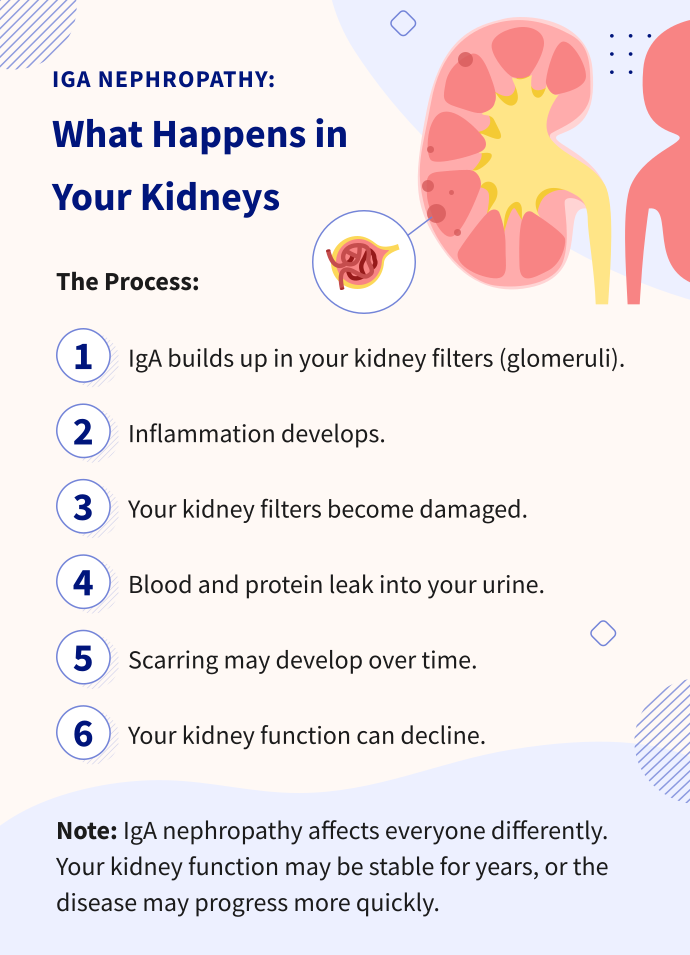
The autoimmune part (when the immune system attacks itself) happens early. Your body makes an abnormal form of its own antibody called galactose-deficient IgA1. The immune system can then make antibodies that recognize this abnormal IgA.
When those antibodies attach to the abnormal IgA, they form clumps called immune complexes. The complexes can get in the blood and build up in the kidney filters, where they trigger inflammation and damage.
So the autoimmune part helps explain how the harmful immune response starts. The immune complexes help explain how kidney damage happens.
And because IgAN happens through more than one step, researchers have several places where they can try to interrupt the disease process and slow kidney damage.
We Can Target the Disease Closer to Where It Starts
One early target involves immune tissue along mucosal surfaces, including the intestine. This tissue normally helps your body make IgA antibodies that protect you from germs.
That link between the gut immune system and IgA production led researchers to develop targeted-release budesonide (Tarpeyo), a steroid designed to act in a specific area of the small intestine involved in IgA production.
We already knew glucocorticoids could help some people with IgAN. But standard systemic steroids travel through the entire body and can cause side effects such as susceptibility to infections, mood changes, digestive problems, osteoporosis, cataracts, and worsening diabetes.
Targeted-release budesonide takes a more focused approach. It’s still a steroid, but it’s designed to act mostly in the gut. Some of the medicine still gets into the bloodstream, so steroid-related side effects can still happen. But the treatment showed that we could aim therapy closer to an earlier step in the disease process.
Research has since moved even further upstream.
Targeting Cells and Signals Behind Harmful Antibodies
Two immune proteins you’re likely to hear more about are called APRIL and BAFF. They send signals that help B cells grow and survive. B cells are immune cells involved in making antibodies, including IgA. That makes APRIL and BAFF important targets in IgAN.
Drugs that block APRIL alone, or APRIL and BAFF together, turn down signals that support the cells involved in making the harmful antibodies. I sometimes think of that as cutting off the fuel supply.
In my view, APRIL- and BAFF-targeting drugs are one of the most exciting areas in IgAN research. Studies have shown meaningful drops in protein in the urine, and some of these treatments also seem to reduce microscopic blood in the urine, or hematuria, the kind too tiny to see with the naked eye.
Researchers are also studying CD38 inhibitors. Anti-CD38 drugs target plasma cells. Those are mature immune cells that make large amounts of antibodies. If APRIL and BAFF blockers cut off the fuel supply, targeting plasma cells is more like shutting down the factory itself.
Removing plasma cells might lead to a deeper or longer-lasting response and might even have effects after treatment stops, but this is still just a theory. We need studies to show whether those benefits hold up over time and how this approach compares with other treatments. These drugs could also suppress the immune system more strongly, so long-term safety will be important.
Targeting Inflammation in the Kidney
Researchers are also studying treatments that act further down the disease pathway, including complement inhibitors.
When IgA-containing immune complexes settle in the kidney filters, they can turn on the complement system. Complement is part of the body’s normal immune defense. But in IgAN, too much activity can drive inflammation and kidney damage.
What interests me is that complement may also play a role in longer-term damage. When protein leaks through damaged kidney filters, it may activate complement deeper in the kidney and contribute to fibrosis, or scarring.
Clinical trials are looking at drugs that block complement at different points. Researchers want to know how well these treatments lower protein in the urine and whether they can slow the loss of kidney function over time.
Treatment aimed at APRIL, BAFF, or plasma cells acts earlier in the immune response, closer to where harmful antibodies are made. Complement inhibitors act later, closer to the inflammation and injury taking place inside the kidney.
That brings us to one of the most important questions in the field: How should we use treatments that work at different points along the same disease pathway?
Treatment May Become More Tailored
IgA care is already shifting toward finding the right combination of treatments for each person.
Most people will still need a foundation of kidney-protective treatment. That may include an ACE inhibitor or ARB (or a dual-acting drug such as sparsentan in place of one) along with an SGLT2 inhibitor when appropriate. A disease-specific treatment could then be added based on a person’s risk and other features of their IgAN.
The best choice depends on how well your kidneys work, the amount of protein and blood in the urine, how quickly eGFR is falling, and what your kidney biopsy shows.
We also have to think about practical issues. Some medicines are pills, while others are weekly or monthly injections. You may be fine with shots, but many people prefer to avoid them. Insurance coverage and out-of-pocket costs can also affect which treatments you can get.
But the question we’re asking more often is: Which mix of treatments makes the most sense for this person? We still need studies to tell us which combinations work best and who benefits most from them.
Another possibility is using different treatments at different stages of the disease. In some immune diseases, doctors use one medicine to get active disease under control and another to keep it there. We call those induction and maintenance treatments.
Could we eventually do something similar in IgAN? Could a complement inhibitor help calm active kidney inflammation, followed by an APRIL-targeting treatment to keep the disease quiet? Or would another sequence work better?
Those are questions future trials need to answer.
How Long Treatment Should Last
Many clinical trials follow people for around a year. But IgAN can affect someone for decades. So even when a newer drug works early on, we still have to figure out what happens next.
If a person takes a monthly injection and reaches remission, how long should they stay on treatment? Could they eventually space doses out to every two or three months? Could they take a break from treatment and restart if the disease flares again?
There are also long-term safety questions. Some immune-targeting medicines can lower immunoglobulin levels. Since immunoglobulins help guard against infections, we need to know what happens when these pathways are suppressed over many years.
With some biologic drugs, the body can also develop antibodies to the drug, which may affect how well it works over time.
The goal is to keep IgAN under control while giving each person the amount of treatment they need. Finding that balance will be an important part of research going forward.
More Ways to Gauge Remission
Protein leakage is strongly linked with kidney disease getting worse. For people at risk of progression, we want to get proteinuria below 0.5 grams per day and ideally below 0.3 grams.
Clinical trials often use proteinuria, or too much protein in the urine, as an early sign that treatment is working.
We’re also paying more attention to microscopic hematuria, or tiny amounts of blood in the urine you can’t see. Persistent hematuria has been linked with kidney disease progression, so seeing it decrease or disappear may become another sign that IgAN is under better control.
While proteinuria and hematuria give us useful information, they’re indirect measures of what’s happening inside the kidney. Researchers are starting to explore whether looking at kidney tissue before and after treatment could tell us more.
A repeat biopsy might show whether inflammation and immune deposits have decreased or gone away. Over time, that might help us make a more meaningful, tissue-based definition of remission that we can use along with urine and blood tests.
That approach still needs to be studied. Repeat biopsies aren’t currently a standard way to monitor IgAN treatment.
We also don’t yet have a blood or urine biomarker that can reliably tell us how active one person’s IgAN is or which disease pathway should be targeted. Researchers are studying markers such as galactose-deficient IgA1, but those remain largely in the research setting.
Some People Still Need Better Answers
One group I’m particularly interested in is people with rapidly progressive IgAN, where kidney function worsens quickly and a biopsy may show severe inflammation and damage in many of the kidney filters.
These people have long been treated with strong immune-suppressing medicines such as cyclophosphamide and whole-body steroids such as prednisone.
Many people with rapidly progressive disease were excluded from trials of newer IgAN treatments. That leaves us with important questions about whether testing drugs targeting APRIL, BAFF, plasma cells, or complement could help people with these more aggressive forms of the disease. Future studies need to address that group.
Looking Ahead
With so many treatments arriving in a short period, some of the most important research now involves figuring out how to use them well.
We need to learn how long treatment should last, which therapies work best together or at different stages of disease, and how to keep people safely in remission over many years.
I’m very careful with the word cure. For me, the more reasonable goal is long-term remission and preserving kidney function for as long as possible.
What gives me hope is that we’re getting closer to a point where IgAN may stay quiet and kidney function declines at a rate much closer to what happens with normal aging.
If your kidney function is declining, protein in your urine stays high, or you have questions about newer treatments, consider talking with a nephrologist who specializes in glomerular diseases. The field is changing quickly, and a specialist can help you understand which choices may make sense for your disease.
If you’re interested in clinical trials, ask your nephrologist about studies at academic kidney centers near you. The IgA Nephropathy Foundation and National Kidney Foundation can also help you learn about research opportunities.