

Immune complex-mediated membranoproliferative glomerulonephritis (IC-MPGN) is a rare and serious kidney disease that damages the kidney's filtering units (the glomeruli).
Abdallah Geara, MD, a nephrologist and clinical director of the glomerular disease program at the University of Pennsylvania, shares his knowledge about this condition, including the challenges of diagnosis, treatment nuances, and what to ask when seeking expert care.
What is IC-MPGN?
You can understand immune complex-mediated membranoproliferative glomerulonephritis best by breaking the name into its two main parts. First is immune complex, which is a molecule formed when our immune systems are trying to fight a foreign body. So anytime you have an infection, your body forms an immune complex in order to clear the infection. In the case of IC-MPGN, immune complexes form in parts of the kidney even though infection isn’t present, causing inflammation in the filters of the kidney (glomeruli).
The second part, membranoproliferative glomerulonephritis, refers to the histologic aspect of disease, meaning, how does it look under the microscope? And when we look at IC-MPGN under the microscope, we see inflammation in the glomeruli. If you think about the kidney as a collecting system, the filters are glomeruli. Glomerulonephritis means inflammation of the glomeruli. Membranoproliferative is a term that means the filtering membrane on the glomeruli is thickened. You have a lot of cells that are invading these filters. So you have an inflammation of the filter with thickening of the filtering membrane. That's what we see on the kidney biopsy under the microscope.
What are the typical symptoms of IC-MPGN?
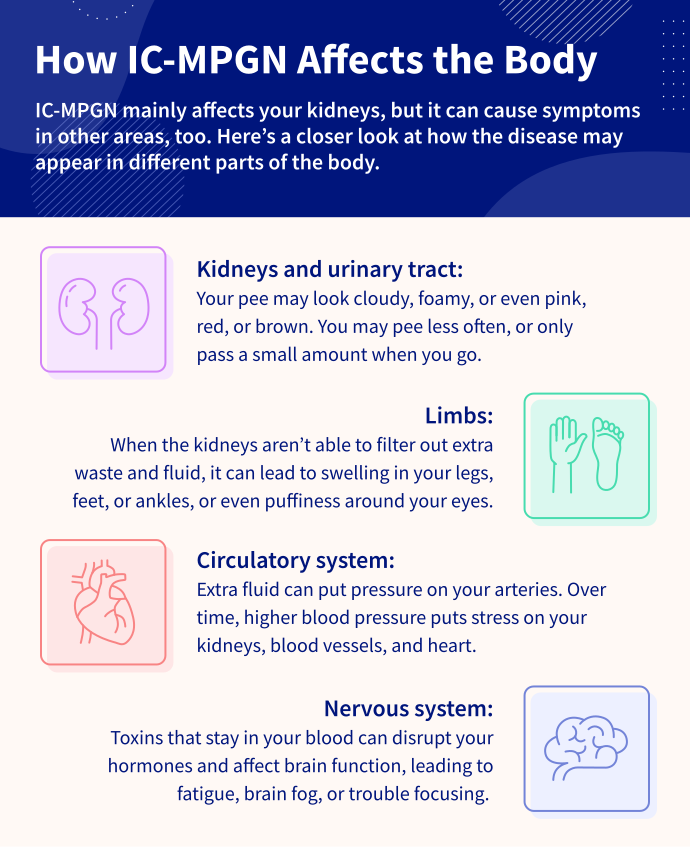
Many people with IC-MPGN are asymptomatic from a kidney perspective. You might have fatigue, high blood pressure, or some swelling. But we aren’t talking about a disease that will cause pain at the level of the kidney, visible blood in the urine, or anything more directly kidney related. The signs are more indirect.
How do doctors diagnose IC-MPGN?
Because symptoms aren’t often a clear sign of an issue, most of the time it’s abnormal blood work that triggers us to do a kidney biopsy. When we see elevated creatinine, especially if you’re having protein or blood in your urine, it prompts us to look more closely at what’s going on with the kidneys.
We know at this point you likely have nephrotic syndrome, which means you’re dealing with one of several kidney disorders characterized by protein in the urine, low blood protein, high cholesterol, and swelling. To be truthful, most of the time when we do a biopsy, IC-MPGN isn’t usually highest on our differential diagnosis list. More often we're thinking about conditions such as IgA nephropathy (Berger’s disease), or lupus in the kidney, which are more frequent causes of kidney issues. IC-MPGN is much rarer. But a biopsy will help us correctly diagnose IC-MPGN.
What causes IC-MPGN?
One of the pathways with which our body fights infection is called the complement pathway. In normal, non-pathologic situations, your complement pathway exists to fight infection. So when infection strikes, the complement pathway activates, clears the infection, and then stops and “goes to sleep” and waits for the next infection or pathogen.
In some people, we think that this complement pathway gets dysregulated and becomes hyperactive, leading to inflammation in the kidney. In the situation of IC-MPGN, your complement pathway is dysregulated and hyperactive either all the time or intermittently without a specific outside trigger. Or in some cases, it overreacts to an outside trigger. Sometimes a viral illness may trigger the condition — you get a minor viral illness, but your complement system overreacts to it and leads to this kidney inflammation.
What are the treatment options for IC-MPGN?
Our approach has changed quite a bit because there are few medications that have been approved recently. It used to be that we would give people a genetic medication to suppress their immune system without targeting the complement pathway. We used to give them steroids or mycophenolate mofetil. For people whose immune system is intermittently active, this calms it down, and it will stay calm for a long time.
But we found out that the majority of people will have partial remission or will not respond to this treatment, and they will have progressive disease. One of the new medications recently approved, pegcetacoplan, is a targeted complement inhibitor, which means that it specifically suppresses the complement pathway. Researchers did a clinical trial that showed that treatment with this medication decreases protein in the urine, stabilizes kidney function, improves the histology of the kidney, meaning that the amount of deposits and complement pathway activation will decrease. So having a medication now that targets the exact cause of the disease is an ideal scenario.
Not everyone with IC-MPGN will have similar disease progression. On average, people with the condition lose 6 to 10 milliliters per minute per year of filtration capacity. But that's the average. We know that there is a subgroup of people that have very stable kidney function in the long run. We have a group that is slowly progressive, and we have a group that's rapidly progressing. So not everyone is a candidate for pegcetacoplan therapy. If you’re already stable, you may not require it, but the majority of people I see do have progressive disease and they need targeted therapy.
What are some ways to support IC-MGPN management with lifestyle changes?
Like every kidney disease, you’re in a process that’s leading to the loss of filtration capacity. And the minute that you have loss of the filtration capacity, the healthy part of the kidney will try to compensate and overwork itself. So it’s important to take steps to help decrease the amount of work your kidneys are doing.
We encourage a healthy weight and a low-sodium diet. Moving to a vegetable-based diet is optimal, as is getting your protein from plant sources over animal sources. Keep your salt intake low by avoiding processed foods. Your doctor may also recommend other diet changes such as low potassium or low phosphate foods, depending on your blood work.
What are some important questions to ask your doctor about your IC-MPGN diagnosis?
Along with questions about how you should adjust your diet and lifestyle, it’s important to have a good understanding of how your kidneys are functioning. You should know not only about your creatinine levels, but also the levels of protein and blood in your urine. Even if your kidney function looks stable, if you still have protein or blood in your urine, that's a sign that the kidney is under stress.
You should also be familiar with your complement level in your blood work. If the complement level is consumed (showing lower than normal levels), that might mean that the disease is still active. Know that you may need repeat kidney biopsies because sometimes we need the information to know how the disease is progressing. This tells us how aggressive the condition is and how proactive or reactive the treatment needs to be.
You should also ask questions to better understand any treatment you start. It’s important to understand the safety of your treatment, specifically around infection and vaccination, because these treatments require vaccination before you begin them.